
- Telecalling is how businesses use phone calls, made or received, for sales, support, payment reminders and follow-ups.
- Calls fall into three types: inbound, outbound and blended. Banks, insurers, real estate firms and colleges all depend on them.
- Fast response wins deals. Call new leads within minutes, and don't stop after the first attempt.
- Track connect rate, talk time, response time and conversions, and keep every campaign within TRAI and DPDP rules.
- A call tracking tool like Callyzer shows managers every call without changing the way the team works.
Telecalling is how businesses use phone calls to win leads, close sales and support customers. Even with email, chat and social media around, a phone call is still the quickest way to get a clear answer from a customer.
That is why businesses in most industries across India still run telecalling teams. The problem is that many of these teams work without a proper system. Leads get missed, follow-ups get delayed and managers have no idea what is happening on calls.
So, what is telecalling, how does it work, and how can you get better results from it? This guide explains everything in simple terms, from the basics to the rules and tools you need.
What Is Telecalling and What Does It Mean?
Telecalling is the process of calling customers, or receiving their calls, for a business goal. That goal can be a sale, a booking, a reminder, a support query or feedback.
The term is mostly used in India. Wiktionary describes it as Indian English for making phone calls, mainly for telemarketing. In other countries, the same work is usually called telesales or inside sales.
The telecalling meaning is easy to understand with a few everyday examples:
- A bank executive calls to offer you a credit card
- A loan company calls about the personal or home loan you enquired about
- A real estate agent calls after you check a flat on a property website
- An insurance advisor calls to explain a health or life insurance plan
All of these are telecalling. Simply put, tele calling means talking to customers over the phone to help them take the next step.
Who is a telecaller?
Now for the telecaller meaning. A telecaller is the person who makes or answers these business calls. Companies also use titles like tele-sales executive, customer care executive or inside sales executive.
This process includes hearing out customer’s requirements, making them understand about the product or service, clarifying their doubts until they come to a decision. Good Telecalling skills can truly be the factor between winning and losing the lead.
Telecalling vs telemarketing vs telesales
Many people searching for the tele calling meaning also come across words like telemarketing, telesales and cold calling. These terms are related, but each one means something slightly different.
| Term | What it means | Example |
|---|---|---|
| Telecalling | Any business call, made or received | Calling back a lead who filled a form on your website |
| Telemarketing | Promoting products or service by phone to build interest, qualify leads or run surveys, usually across a large list | A credit card offer called out to thousands of people |
| Telesales | Calls made only to sell | Selling a health insurance plan over the phone |
| Cold calling | Calling people who have never contacted you | A B2B salesperson calling a factory owner for the first time |
| Call centre | A setup of people, phone lines and software for handling large call volumes | A 200-seat customer care centre for a telecom company |
In short, telecalling is the bigger umbrella. Telemarketing opens the conversation and builds interest, often through cold calls. Telesales then closes the deal. A call centre is where telecalling happens at a large scale.
How Does Telecalling Work?
Telecalling is more than just dialing numbers. A successful team goes through a structured process that starts from the lead at the first telephone call to the final outcome, be it a sale, booking, payment, or solution of a complaint. Let’s look into how this process is done.
Step 1: Set a clear goal for each campaign
All telemarketing campaigns should have one clear goal to begin with so that the telecallers can understand what is expected from them. For instance:
- A credit card sales team aims to get completed card applications
- A loan team aims to collect the documents needed for loan approval
- An insurance team aims to sell new policies or renew existing ones
- A customer support team aims to solve the customer's problem on the first call
Setting the target is followed by including additional targets around it like number of calls per day, connect rate, and conversion rate. This provides direction to the telecallers.
Step 2: Build and organise the lead list
Leads can come from many places:
- Website forms and landing pages
- Social media and Google ads
- Online marketplaces and industry portals
- Referrals, events and walk-in enquiries
- Existing customer databases
Before calling, clean the list. Remove duplicate and invalid numbers, add useful details such as the product the lead asked about, and check DND status before making any promotional calls.
Step 3: Segment and assign leads
Every lead does not require the same handling approach. Classify leads according to their level of interest, product, geographical or linguistic preference and allocate them to the appropriate telecallers.
The leads that requested for a callback can be sent to veteran telecallers whereas old leads can be put in a different re-engagement campaign. It ensures that all leads are called quickly without overburdening any member of the team.
Step 4: Prepare the call flow
Before the first call, give telecallers a clear call flow. It usually includes:
- A short, friendly introduction
- Questions to understand the customer's needs
- The main points about the product or service
- Answers to the most common objections
- A clear call to action at the end
This keeps the message consistent across the team while still leaving room for natural conversation.
Step 5: Make the call and understand the need
During the call, the telecaller introduces themselves along with their company and then asks whether it is a suitable time to talk before pitching anything.
A client who wants to know about a personal loan may be curious about interest rates, eligibility criteria, and EMI options, among other things. If one listens before pitching, then one can pitch the suitable product accordingly.
Step 6: Record the call outcome
After every call, the telecaller records what happened. This usually includes:
- The call status, such as interested, not interested, callback requested or wrong number
- Notes about the customer's needs and concerns
- The next action and its date
Using CRM software makes this automatic. Call details are saved accurately, and any telecaller can pick up where the last one left off.
Step 7: Follow up at the right time
Most customers do not decide on the first call. Follow-ups keep the conversation going, whether it is a reminder about a pending application, a call after sending a quote or a check-in before an offer ends.
Set a reminder for every follow-up, and share supporting details such as brochures, quotes or payment links on WhatsApp.
Step 8: Track performance and improve
Call reports and call recordings must be looked into from time to time by managers. Metrics such as connection rate, talk time, follow-through completion, conversions provide information on what works well and what does not work.
In due course, the data will provide you with information on top performing leads, times when customers are receptive and who among telemarketers requires training.
Use these insights to plan your next campaign.
What Are the Different Types of Telecalling?
Telecalling is divided into three main types, based on who makes the call.
1. Inbound telecalling
In inbound telecalling, the customer calls the business. These calls usually come from ads, websites, Google listings or customer care numbers.
Inbound telecallers usually:
- Answer product and pricing questions
- Take orders and bookings
- Handle complaints and service requests
2. Outbound telecalling
In outbound telecalling, the business calls the customer. It is mostly used for sales, follow-ups, reminders and surveys.
Outbound telecallers usually:
- Call new leads and explain the offer
- Follow up with interested prospects
- Send payment or renewal reminders
- Collect feedback after a purchase
3. Blended telecalling
In blended telecalling, the same team handles both incoming and outgoing calls. This is very common in small and mid-sized businesses. For example, a car showroom team may handle service calls in the morning and call test drive leads in the evening.
Here is a detailed comparison of inbound and outbound telecalling:
| Basis | Inbound telecalling | Outbound telecalling |
|---|---|---|
| Who starts the call | The customer calls the business | The business calls the customer |
| Main purpose | Answering enquiries, taking orders, resolving complaints and service requests | Generating sales, qualifying leads, following up, sending reminders and running surveys |
| Where calls come from | Ads, website, Google listings, helpline numbers and printed material | Lead lists from forms, portals, ads, referrals and existing customer data |
| Customer intent | High, as the customer already needs something | Varies from low for cold leads to high for warm leads and existing customers |
| Call volume | Depends on customer demand, with peaks during campaigns or service issues | Planned by the team based on lead volume and targets |
| Skills needed | Patience, product knowledge and quick problem solving | Persuasion, persistence and handling rejection |
| Common challenges | Long wait times and missed calls during busy hours | Low pick-up rates and numbers marked as spam |
| Main metrics | First call resolution, average handling time, missed call rate | Connect rate, conversion rate, follow-up rate |
| Compliance | Fewer restrictions, since the customer starts the call | Must follow TRAI rules, DND preferences and permitted calling hours |
| Example | A customer calls a bank to ask about credit card charges | A bank calls a customer to offer a pre-approved credit card |
Types of telecalling based on purpose
Telecalling can also be grouped by the reason behind the call.
Here are the most common types, each with a sample line:
Sales calls: These calls aim to sell a product or service directly over the phone. They work best with leads who have already shown interest.
Example: "Hello Mr. Shah, this is Priya from Shield Insurance. You recently checked our term insurance plan, so I am calling to explain the premium options."
Lead qualification calls: These calls check whether a lead is a good fit before it goes to the sales team. The telecaller confirms the customer's need, budget and buying timeline.
Example: "Before I share the pricing, may I know when you are planning to make the purchase?"
Cold calls: These calls reach people who have had no earlier contact with the business. The goal is to introduce the company and find out if there is any interest.
Example: "Good morning, I am calling from Mehta Packaging. We supply packaging boxes to food brands across Gujarat. Do you have two minutes to talk?"
Follow-up calls: These calls reconnect with leads who showed interest but have not decided yet. Many deals close on the second or third conversation, not the first.
Example: "Hello Ms. Patel, I am following up on the personal loan offer we discussed last week. Have you had a chance to review it?"
Appointment setting calls: These calls book a meeting, demo, consultation or visit. Offering specific time slots makes it easier for the customer to say yes.
Example: "Would Saturday at 11 AM or Sunday at 4 PM be more convenient for your product demo?"
Customer support calls: These calls resolve issues with orders, bills, products or services. The focus is on solving the problem quickly, ideally on the first call.
Example: "I can see your refund has been processed. It will reach your account within 3 working days."
Payment reminder and collection calls: These calls remind customers about upcoming or overdue payments, such as EMIs, insurance premiums or subscription renewals.
Example: "Your EMI of ₹8,450 is due on the 5th. Shall I send you the payment link on WhatsApp?"
Feedback and survey calls: These calls collect customer opinions after a purchase or service. The answers help the business improve its products and customer experience.
Example: "Could you spare two minutes to share how your recent service experience was?"
Upsell and cross-sell calls: These calls offer existing customers an upgrade, an add-on or a related product.
Example: "Since you have been using our credit card for a year, you are now eligible for a higher credit limit at no extra cost."
Which Industries Use Telecalling?
Telecalling is used in almost every industry where customers need guidance before buying, or regular reminders after buying. Here is how some of the biggest sectors in India use it:
| Industry | How telecalling is used |
|---|---|
| Real estate | Calling portal leads, booking site visits, following up after visits |
| Banking and NBFCs | Selling loans and credit cards, collecting KYC documents, EMI reminders |
| Insurance | Explaining policies, renewal reminders, claim updates |
| Education | Counselling students and parents, admission follow-ups, fee reminders |
| Healthcare | Booking appointments, sharing test reports, selling health packages |
| Automobile | Test drive bookings, service reminders, new model launches |
| Travel | Selling holiday packages, confirming bookings, collecting feedback |
| Telecom | New connections, plan upgrades, stopping customers from switching |
| B2B and manufacturing | Qualifying enquiries, dealer and distributor follow-ups |
| Retail and e-commerce | Confirming COD orders, recovering abandoned carts |
Every sector uses calling a little differently. To see real examples for each one, read our post on the industries that benefit from telecalling.
What Are the Benefits of Telecalling?
Telecalling is still one of the most effective ways to reach customers. Here is why businesses keep investing in it.
1. Faster response to new leads
Speed matters a lot in sales. A study by Dr. James Oldroyd with MIT and InsideSales found that companies that called a lead within 5 minutes were about 100 times more likely to reach them than companies that waited 30 minutes. They were also 21 times more likely to qualify the lead (Digital Applied).
A Harvard Business Review study found something similar. Companies that responded within an hour were nearly 7 times more likely to qualify a lead than those that waited just one hour more. Still, the average company took 42 hours to respond.
2. Two-way conversation
On a call, customers can ask questions and get answers right away. This clears doubts much faster than emails or chat messages.
3. Builds trust
Hearing a real person, especially in their own language, makes customers feel more comfortable. This matters a lot in insurance, loans and property, where trust often decides the sale.
4. Instant feedback
Telecalling gives you direct feedback from customers on every call. When a customer says no, the telecaller can ask why and get an honest answer on the spot. For example:
- If many customers say "too expensive", your pricing or payment options may need a review
- If many say "not right now", your follow-up timing may need to change
- If many say "I never asked for this", your lead sources may need a closer look
Over time, these answers help you improve your offer, pricing and targeting based on what customers actually say.
5. Cost-effective and easy to scale
Telecalling helps you reach more customers at a lower cost. A telecaller can speak to dozens of customers in a single day without any travel time or expense, something a field sales team cannot match.
It is also easy to grow. You can start with one or two telecallers and add more as your lead volume increases, without large upfront investment.
6. Better customer retention
Telecalling is not only for winning new customers. It also helps you keep the ones you already have. Regular calls show customers that the business cares about them after the sale, not just before it.
Here is how telecalling supports customer retention:
- Welcome and onboarding calls help new customers get started and clear their early doubts
- Renewal reminders stop policies, subscriptions and plans from lapsing by mistake
- Service check-ins catch small problems before they turn into complaints
- Win-back calls reach customers who have stopped buying or are about to cancel, and find out what went wrong
- Loyalty and offer calls tell existing customers about upgrades, rewards or special deals
Keeping an existing customer usually costs less than finding a new one. Satisfied customers are also more likely to buy again and recommend you to others.
7. Easy to measure
With call tracking in place, you can see how many calls were made, how many connected and how many turned into sales.
Ready to Make Your Telecalling More Productive?
Manage calls, track team performance, and follow up with leads more effectively using Callyzer.
What Does a Telecaller Do?
If you are wondering what is telecalling work like on a normal day, here is a simple picture. A telecaller's day usually starts with a list of new leads and pending callbacks. Through the day, they:
- Call new leads and explain the product or service
- Follow up with customers who asked for more time
- Answer questions and solve basic issues
- Book appointments, demos or site visits
- Share brochures and payment links on WhatsApp
- Update every call outcome in the CRM
Most telecallers also have daily targets for the number of calls, talk time and conversions.
Skills every telecaller needs
The right skills decide how many conversations turn into results. Here are the most important skills every telecaller should build:
1. Clear communication
Customers cannot see you, so your words and tone carry the entire conversation. Good telecallers speak clearly and at a steady pace, and explain things in simple words that anyone can understand. A confident, friendly tone builds trust within the first few seconds of a call.
2. Active listening
Listening is just as important as speaking. When a telecaller pays close attention to what the customer says, it becomes easier to understand their real need. Repeating key points back, such as "So you are looking for a ₹5 lakh loan for three years", shows the customer they have been heard.
3. Product knowledge
Customers expect quick and accurate answers. A telecaller who knows the product well, including pricing, features, eligibility and policies, can answer questions confidently without putting the customer on hold.
4. Objection handling
Objections like "it is too expensive" or "call me later" are part of almost every call. Skilled telecallers stay calm, find out the reason behind the objection and respond with useful information instead of pushing harder.
5. Language skills
In a country like India, speaking the customer's preferred language makes a big difference. Telecallers who can switch between English, Hindi and a regional language such as Gujarati, Marathi or Tamil connect with customers much faster.
6. Empathy
Some customers call with complaints or concerns. Understanding their situation and responding politely can turn a difficult call into a positive experience.
7. Patience and resilience
Telecallers hear "no" many times a day. The ability to stay positive and bring the same energy to every call is what separates good telecallers from average ones.
8. Time management
A telecaller handles new leads, follow-ups and callbacks every day. Planning calls in blocks and sticking to follow-up schedules keeps the pipeline moving and makes sure no lead is forgotten.
9. CRM and basic tech skills
After every call, telecallers need to update the lead status, add notes and schedule the next follow-up in a CRM. Being comfortable with these tools keeps data accurate and saves time.

What Are the Common Challenges in Telecalling?
Telecalling works well, but it comes with a few common problems. Here is what teams usually face, and how to fix each one.
Low pick-up rates
Many customers ignore calls from unknown numbers, and numbers marked as spam get even fewer answers.
How to fix it: Call warm leads quickly, use a consistent business number and avoid calling the same person too many times in one day.
Missed follow-ups
Telecallers manage dozens of leads at the same time. One customer may ask for a callback on Tuesday, another may want details after payday, and a third may need time to discuss with family. Without a proper system, these callbacks are easy to miss, and an interested lead can quickly lose interest or go to a competitor.
How to fix it: Set automatic follow-up reminders for every lead that asks for a callback.
No visibility for managers
When calls are made from personal phones, managers cannot see how many calls were made, how long they lasted or what the result was.
How to fix it: Use a call tracking tool that records every call automatically.
High attrition
Telecallers often switch jobs, and customer numbers and chat history leave with them.
How to fix it: Keep all leads, notes and call history in a central CRM instead of on personal phones.
Rejection and burnout
Hearing "no" many times a day affects motivation and call quality.
How to fix it: Celebrate small wins, mix call types through the day and coach with real call examples.
Compliance risks
Calling DND numbers for promotions, or calling late at night, can lead to penalties and complaints.
How to fix it: Follow TRAI rules and check DND status before starting any promotional campaign.
Best Practices to Improve Telecalling Results
Good telecalling results come from good habits, not just experience. Here are 12 practices that can help your team connect with more customers and close more deals.
1. Call new leads as quickly as possible
A lead is most interested right after they fill in a form or make an enquiry. If you wait too long, they may forget about you or talk to a competitor. Set up instant lead alerts so your team can call every new lead within minutes.
2. Follow up more than once
Many leads do not answer the first call, and that does not mean they are not interested. They may be busy, travelling or in a meeting. Plan several attempts at different times of the day, and on different days, before marking a lead as unreachable.
3. Call at the right time
Every business has hours when customers are more likely to pick up. Working professionals may answer early in the morning or in the evening, while business owners may be easier to reach mid-morning. Study your own call reports to find the best time slots for your customers, and always stay within the permitted calling hours.
4. Check lead details before dialling
Take a few seconds to read the lead's history before you call. Know where the lead came from, what product they asked about and what was discussed earlier. Mentioning these details shows the customer that you value their time.
5. Use a script, but sound natural
A good telecalling script gives telecallers a clear structure: an opening line, questions to ask and answers to common objections. Reading it word for word, however, sounds robotic.
Train your team to use the script as a guide and speak in their own words. For opening lines that grab attention, read our guide on creating the perfect Telesales Pitch.
6. Listen more than you speak
The best telecallers ask good questions and let the customer do most of the talking. Open questions, such as "What are you looking for in a health insurance plan?", help you understand the real need before you suggest a solution.
7. Speak the customer's language
Customers feel more comfortable when they can talk in their preferred language. Wherever possible, assign leads to telecallers based on language, especially when calling customers in different states or regions.
8. End every call with a clear next step
Never end a call without agreeing on what happens next. Fix a specific date and time for the demo, meeting, visit or callback, and confirm it before you hang up. A vague "I will call you sometime" usually means the lead goes cold.
9. Update the CRM right after each call
Notes written at the end of the day are often incomplete or inaccurate. Recording the call outcome, key points and next action immediately keeps your data reliable, and makes follow-ups easier for anyone in the team.
10. Support calls with WhatsApp messages
After a call, send the customer a short message with the brochure, quotation, payment link or meeting details. This keeps the conversation going and gives the customer everything they need in one place.
11. Coach the team using call recordings
Call recordings are one of the best training tools you have. Review a few calls with the team every week, highlight what went well and discuss what could be improved. Real examples teach far more than theory.
12. Reward quality, not just call volume
If telecallers are rewarded only for the number of calls they make, they may rush through conversations. Set targets that also include talk time, completed follow-ups and conversions, so the focus stays on quality conversations.
Which Telecalling KPIs Should You Track?
To improve telecalling, you first need to measure it. These are the most useful metrics to track:
| KPI | What it shows | How to calculate |
|---|---|---|
| Calls per day | How active each telecaller is | Total outgoing and incoming calls in a day |
| Connect rate | How many calls get answered | Connected calls ÷ total dialled calls × 100 |
| Talk time | Time spent in real conversations | Total duration of all connected calls |
| Average call duration | How long conversations last | Total talk time ÷ connected calls |
| Lead response time | How fast a new lead gets its first call | Time of first call minus time the lead came in |
| Follow-up rate | Whether callbacks happen on time | Follow-ups done on time ÷ follow-ups planned × 100 |
| Conversion rate | How many leads become customers | Converted leads ÷ leads contacted × 100 |
| Missed calls not returned | Incoming opportunities lost | Missed calls with no callback in the set time |
| Cost per conversion | How much each sale costs you | Total telecalling cost ÷ number of conversions |
Need a benchmark? Callyzer's analysis of more than 5 crore call records found that telecalling teams in India connect on 46 to 48% of their calls on average. You can read the full findings in our Telecalling Daily Call Report Analysis.
Look at these numbers together. For example, if a telecaller makes 150 calls a day but each lasts only 15 seconds, they are probably dialling to hit a target rather than having real conversations.
Telecalling Rules You Must Follow in India
Business calls in India have clear rules. Most telecalling teams need to follow two sets of them: TRAI's telemarketing rules (TCCCPR) and the Digital Personal Data Protection (DPDP) Act.
TRAI rules for business calls
- Promotional calls must be made from the 140 number series. The 1600 series is for service and transactional calls from banks, insurers and other RBI, SEBI, IRDAI or PFRDA regulated companies, and for government calls (MediaNama, July 2026).
- Businesses must register with a telecom operator before making commercial calls from these numbers.
- Customers can block promotional calls through the DND registry, for example by calling or sending an SMS to 1909.
- Telemarketing calls are not allowed between 9 PM and 9 AM (TCCCPR overview).
- Making promotional calls from normal 10-digit mobile numbers can get the number disconnected and the sender blacklisted. TRAI made these penalties stricter in 2025.
DPDP Act and customer data
The DPDP Rules, 2025 were notified in November 2025 and are being rolled out in phases over 18 months. The main rules on consent, notice, data security and customer rights apply from 13 May 2027 (Vratex).
For telecalling teams, this means you should:
- Take clear consent when you collect a lead, and say why you will call
- Tell customers when a call is being recorded
- Keep lead data and recordings safe, and limit who can access them
- Stop calling when someone asks, and delete their data if they request it
- Keep data only as long as you need it
Note: This is general information, not legal advice. Rules can differ by industry and type of call, so check with your legal or compliance team before starting a campaign.
What Tools Do Telecalling Teams Need?
The right tools save telecallers from manual work, so they can spend more time talking to customers. Most telecalling services and tools fall into these groups:
| Tool | What it does | How it helps |
|---|---|---|
| Telecalling CRM | Stores leads, assigns them and tracks follow-ups | The whole team works from one list |
| Call tracking | Records every call with time, duration and result | Reports are ready without manual entry |
| Call recording | Saves calls for later review | Helps with training and quality checks |
| Auto dialer | Dials the next number automatically | More calls in less time |
| Lead integrations | Brings leads from websites, ads and portals into the CRM | Faster first calls |
| WhatsApp and SMS | Sends brochures, quotes and reminders | Keeps leads interested between calls |
| Mobile app | Lets field teams call and update from their phones | Managers can track work done outside the office |
| AI call analysis | Transcribes and scores calls | Coaching without listening to every call |
SIM-based calling vs cloud telephony
Indian businesses usually make calls in one of two ways. Here is how they compare:
| SIM-based calling | Cloud telephony | |
|---|---|---|
| How calls are made | Through a normal SIM card on the mobile network | Over the internet, through virtual numbers |
| What the customer sees | A regular 10-digit mobile number | A virtual number, often a landline-style or special series number |
| Internet needed | Only to sync call data | For every call |
| Setup | Install an app on each telecaller's phone | Buy virtual numbers and set up IVR and call routing |
| Best for | Mobile-first sales teams and small to mid-sized businesses | Large call centres with desk-based agents |
Many businesses use both. SIM-based tracking works well for teams that call warm leads and existing customers from their phones. Cloud telephony is better for high-volume inbound support.
How Callyzer helps telecalling teams
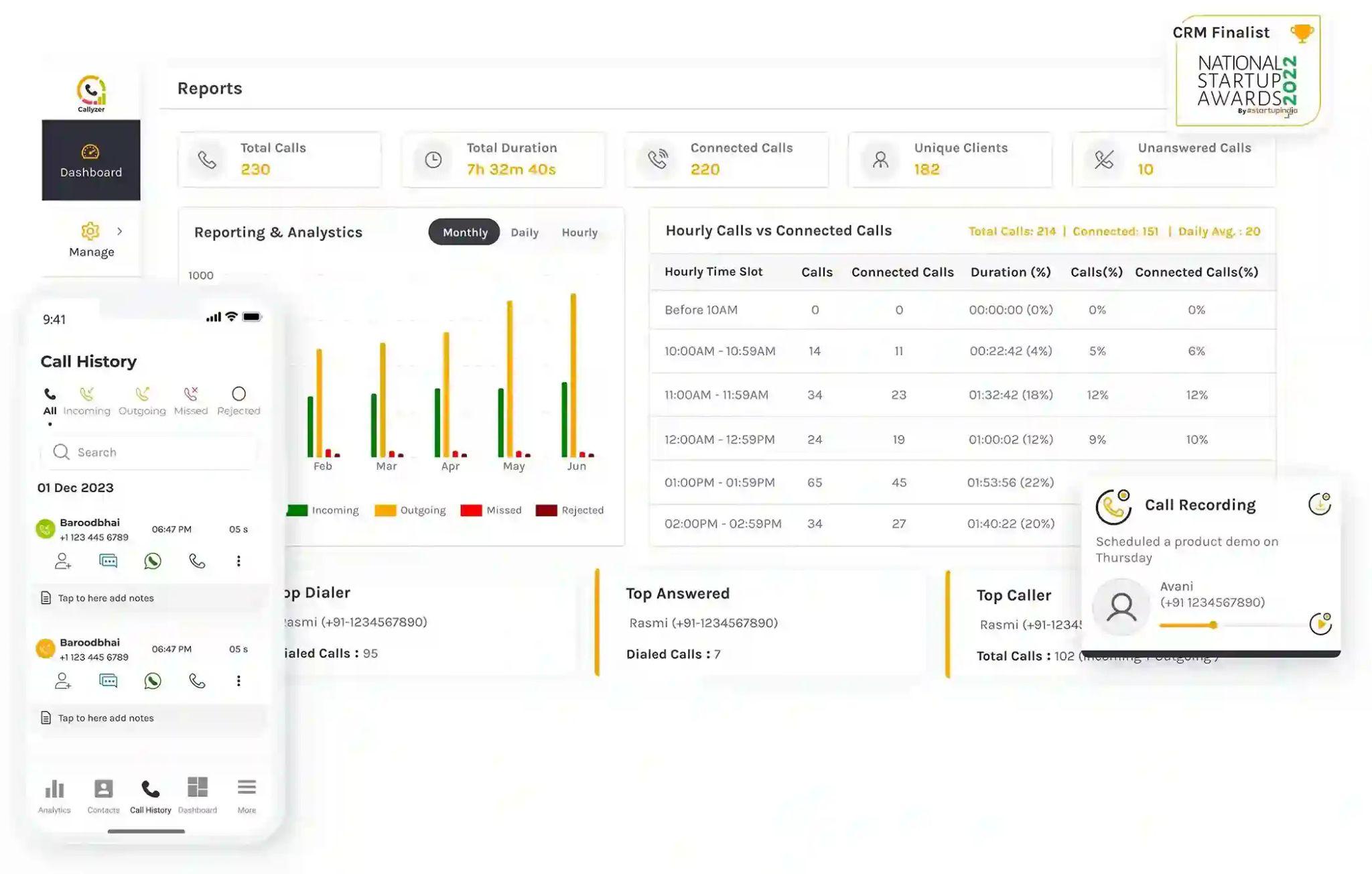
Callyzer is SIM-based telecalling software India businesses use to manage and grow their calling teams. Your telecallers keep using their regular mobile numbers, and every call is tracked automatically. Managers get full visibility without changing the way the team works.
With Callyzer, you can:
- Track every call automatically: incoming, outgoing and missed calls are logged with time and duration, with no manual entry
- Listen to call recordings: review real conversations to coach your team and maintain call quality
- Manage leads in one place: assign leads, update their status and keep the full customer history safe, even when a telecaller leaves
- Never miss a follow-up: set reminders so every callback happens on time
- Get clear reports: see call volume, talk time, connect rates and team performance on one dashboard
The result is a telecalling team that responds faster, follows up on time and converts more leads, with managers who know exactly what is happening on every call.
Final Thoughts
So, what is telecalling in one line? It is a business talking to people on the phone to help them buy, get support or stay as customers.
Getting good at it comes down to a few simple habits. Call leads quickly, follow up on time, keep conversations useful and record every call properly.
If you want to start improving today, focus on three things: reduce your lead response time, log every call and review a few recordings every week. Then keep an eye on how your connect and conversion rates change.
FAQs
What is telecalling and how does it work?
Telecalling is when a business calls customers, or takes their calls, to get something done. That could be a sale, a booking, a payment or a sorted-out complaint.
The routine is simple. A lead comes in, gets assigned to a telecaller and gets a call. The outcome is logged, a follow-up is set if needed, and every week someone checks the numbers to see what to change.
What KPIs should be tracked in telecalling?
Start with calls per day, connect rate, talk time and conversion rate. Then add lead response time and follow-up rate, because that's where most deals are won or lost. Cost per conversion tells you whether the whole effort is paying for itself.
Read them together, though. 150 calls a day means very little if each one lasts 15 seconds.
How can technology improve telecalling?
Mostly by taking the manual work away. Call tracking logs every call on its own, so nobody fills in sheets at the end of the day. Recordings give managers real calls to coach from.
Lead integrations push new enquiries straight to a telecaller, which cuts response time. Automatic reminders make sure callbacks happen when promised. And with WhatsApp built in, the quote or payment link can reach the customer while the call is still fresh in their mind.
What is the difference between telecalling and telesales?
Telesales is one part of telecalling. A telesales call has one job: to sell.
Telecalling covers that, but also support calls, payment reminders, feedback calls, appointment booking and follow-ups. So every telesales call is a telecalling call, but plenty of telecalling calls have nothing to do with selling.
How can businesses track telecalling performance?
Most start with manual call sheets, and those don't hold up for long. They're easy to fill in late and hard to check.
A call tracking tool does the job properly. It records every call from the team's phones with time, duration and outcome, and turns that into daily reports. Managers can see who is calling, who is connecting and who is converting, without having to ask anyone.