
Healthcare sales strategy in India is won by teams that understand how different buyers purchase, lead with business outcomes instead of product features, and maintain disciplined follow-ups through long approval cycles. In a market shaped by compliance requirements, multiple decision-makers, and months-long buying journeys, the deals that survive are usually the ones that stay active between meetings, not the ones with the best demo.
Healthcare sales strategies are the approaches companies use to sell products and services to hospitals, clinics, diagnostic laboratories, and other healthcare organizations. Unlike many industries, healthcare sales involve longer buying cycles, multiple decision-makers, and strict compliance requirements.
In India, every healthcare buyer works differently. A clinic, a hospital chain, and a diagnostic laboratory network evaluate purchases in very different ways, making a one-size-fits-all sales approach ineffective.
This guide explores how healthcare buying decisions work and the strategies that help sales teams move deals from first conversation to purchase order.
What Does Healthcare Sales Cover in India?
Healthcare sales in India broadly covers seven segments, and each one buys differently:
- Pharmaceuticals: Medicines sold through medical representatives who manage defined doctor territories and build long-term relationships with physicians and healthcare providers.
- Medical devices and equipment: Products ranging from blood pressure monitors and ultrasound machines to MRI and CT scanners. As deal sizes increase, buying cycles typically become longer and involve more stakeholders.
- Hospital consumables and surgical supplies: Items such as syringes, gloves, sutures, and implants. These are usually purchased under negotiated contracts and reordered regularly, making account retention just as important as acquisition.
- Healthcare IT and software: Hospital management systems, EHR platforms, appointment scheduling tools, and other digital solutions. Sales often begin with a phone conversation or product demonstration before moving into evaluations and approvals, making relationship-building and stakeholder management central to an effective medtech sales strategy.
- Diagnostic and laboratory services: Pathology partnerships, sample collection contracts, and imaging collaborations. Relationships and regional coverage often play a major role in winning business in this segment.
- Health insurance and patient services: Insurance products, patient financing solutions, and engagement platforms typically distributed through hospitals, healthcare providers, and TPAs(Third-Party Administrator).
- Wellness and preventive healthcare: Health check-up packages, screening programs, and corporate wellness initiatives sold by hospitals and diagnostic providers to businesses and institutions.
A sales representative selling a pathology partnership and one selling hospital software do very different jobs, but they often sell to the same types of buyers. That is where many healthcare sales strategies fall short. It treats healthcare as one market when it isn't.
In India, regardless of what you sell, healthcare buyers usually fall into three distinct categories. Understanding how each of them buys is the first step to building a strategy that works.
Who Actually Decides in Indian Healthcare? The 3 Buyer Playbooks
Before you pick a pitch, figure out which buyer you are sitting across. Most medical sales strategies fail for one simple reason: they treat three very different buyers as one.
1. The Owner-Doctor Clinic
Who decides: The doctor who owns the clinic. There is no committee.
Typical Sales cycle: One or two meetings, closed within two to four weeks.
What kills the deal: A long presentation. The doctor is evaluating you between patients. If your pitch takes 20 minutes to reach the price, you have lost them.
What to lead with: A local reference works best here. For instance, "Dr. Mehta's clinic two kilometres away has used this for eight months". This works better than any brochure.
Pro Tip: The owner-doctor wants three answers: what it costs, whether it works, and who nearby already uses it. Get to all three within the first few minutes.
2. The Hospital Chain
- Who decides: The decision usually involves two or three stakeholders. An administrator manages the process, procurement negotiates pricing, and a senior doctor or department head often becomes the internal advocate for the purchase. That person is your champion.
- Typical Sales cycle: Mid-sized purchases typically take anywhere from three to six months to move from first discussion to final approval.
- What kills the deal: Silence. Hospital deals rarely fall apart during meetings or demos. They are lost in the weeks that follow, when priorities shift, internal discussions stall, and follow-up conversations never happen.
- What to lead with: Evidence that reduces perceived risk. Case studies from similar hospitals, pilot programs, reference customers, and a clear implementation plan make it easier for your champion to build support internally.
Selling to hospitals in India means winning your champion first. The administrator listens to them, not to you. Your champion has to defend this purchase inside the hospital, so give them all the strong material to do it.
This is one of the most important strategies for high value healthcare sales, where decisions are rarely made by a single person and buying cycles can stretch for months.
3. The Diagnostic Lab Chain
- Who decides: The operations head or centre manager usually leads the decision, with the owner or founder stepping in for larger contracts and strategic purchases.
- Typical Sales cycle: Anywhere from two weeks to two months, depending on the size and complexity of the contract.
- What kills the deal: A clinical pitch delivered to a numbers-driven buyer. Lab chains operate on metrics like cost per report, turnaround time, utilization rates, and daily sample volumes.
- What to lead with: Their numbers. Start by understanding daily sample volumes, reporting capacity, and turnaround expectations, then position your solution in terms of cost per report, efficiency gains, and throughput improvements.
Turn Every Healthcare Sales Call Into a Growth Opportunity
Track calls, manage follow-ups, and help your healthcare sales team close more deals with Callyzer's SIM-Based Telecalling CRM.
What Regulations Should Healthcare Sales Teams in India Know?
Three regulations directly affect how you sell. Most reps know the names. Fewer know what changes in their daily work.
| Regulation | What it governs | What it means for your sales team |
|---|---|---|
| DPDP Act, 2023(Digital Personal Data Protection Act) | Patient and personal data | If your CRM, call recordings, or lead sheets contain patient names, numbers, or health details, you need clear consent to use them. Implied consent does not count. Hospitals stay liable even when a vendor or call centre handles the data. |
| UCPMP, 2024(Uniform Code for Pharmaceutical Marketing Practices) | Marketing of medicines and medical devices | The UCPMP 2024 has significantly tightened engagement rules for pharmaceutical sales teams. Gifts, sponsored travel, hospitality, and personal benefits for doctors and their families are prohibited. Brand reminders such as diaries and calendars cannot exceed ₹1,000 per item, while free samples are subject to strict limits and documentation requirements. Companies are also responsible for the actions of their representatives, making compliance a field-level responsibility rather than just a legal one. |
| CDSCO licensing (Central Drugs Standard Control Organisation) | Sale and import of medical devices | All Class C and D devices have needed a valid CDSCO licence since October 2023. Hospital purchase departments require upfront proof of this licensing before even considering a product for tender or use. |
The UCPMP also controls what a rep can say in a pitch, and these rules catch more salespeople than the gift ban does:
- Every claim about a product's usefulness must rest on current evidence, and the company must be able to produce that evidence when a doctor or pharmacist asks for it.
- The word "safe" cannot be used without qualification, and no one can claim a medicine has no side effects, toxic hazards, or risk of addiction.
- "New" cannot describe a drug or therapy that has been generally available in India for more than a year.
- Comparisons must be factual and fair. A competitor's brand name cannot appear in a comparison without that company's consent, and running down a competitor's product, or a doctor's clinical opinion, is barred even when done indirectly.
- No product can be promoted before it receives marketing approval.
For a sales team, this changes how scripts get written. Claim sheets need their sources attached, comparison slides need a compliance check before they go out, and lines like "completely safe" have to leave every pitch and every telecalling script.
Across all healthcare segments, Indian buyers have become more compliance-conscious. The sales representative who can answer regulatory questions with confidence earns trust faster than the one who needs to "check with the office and get back to you."
Which Healthcare Sales Strategies Actually Work in India?
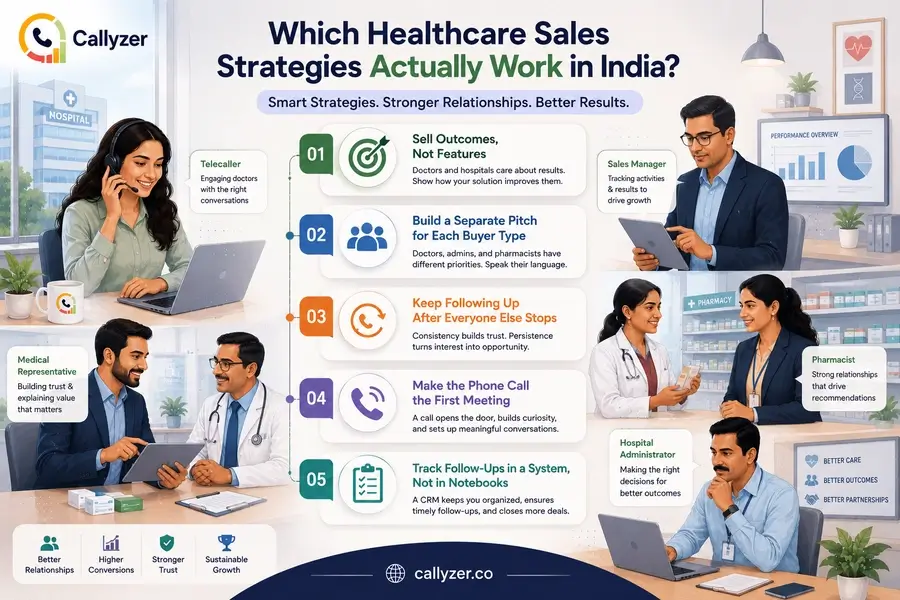
With the buyers and rules mapped, here are the five sales strategies for healthcare teams in India that hold up in the field.
1. Sell Outcomes, Not Features
Most healthcare pitches fail in the first minute because they open with specifications instead of outcomes. "Our analyzer runs 400 tests per hour" only matters if the buyer can connect that number to money saved, faster turnaround times, or higher patient volumes. Most buyers will not do that calculation themselves.
Good sales teams do it before the meeting, using the numbers collected during qualification. The metrics change depending on the buyer:
- A lab thinks in reports per day and cost per report.
- A clinic thinks in patients handled per hour and front-desk time saved.
- A hospital thinks in revenue per bed, utilization rates, and equipment downtime.
When your pitch uses the buyer's numbers instead of your product specifications, the conversation stops being a product demonstration and becomes a business discussion.
Consider the difference.
A specification-first pitch sounds like this:
"Our analyzer processes 400 tests per hour and includes automated calibration."
An outcome-first pitch sounds like this:
"You mentioned your centre handles around 600 samples a day and reports are usually delivered the next morning. With this machine, your team clears that workload by early afternoon, making same-day reporting possible and giving referring doctors a reason to choose your lab over competitors."
The product is identical. The facts are identical. What changes is the story being sold. One representative is selling a machine. The other is selling growth.
2. Build a Separate Pitch for Each Buyer Type
Many teams carry one pitch deck everywhere. The same presentation goes to a solo dermatologist, a 200-bed hospital, and a 40-centre lab chain, and it converts poorly with all three, because each buyer needs a different first meeting.
Build three versions of the same pitch instead:
- For owner-doctors: A one-page ROI snapshot with transparent pricing and key benefits, designed to be read in the five minutes between patient consultations.
- For hospital committees: A presentation backed by case studies from similar hospitals, expected outcomes, and an implementation timeline that your internal champion can easily circulate.
- For lab chains: A simple calculator that shows the impact on cost per report, turnaround time, and processing capacity before and after implementation.
3. Keep Following Up After Everyone Else Stops
An unanswered call is often treated as a rejection by sales teams. In healthcare sales, it usually means the buyer is busy, not uninterested.
The buyer is a doctor in OPD or a lab manager on the floor. Callyzer's analysis of 5 crore telecalling records found that 53% of first-attempt business calls in India go unanswered, so a missed call is the baseline, not a verdict on the lead.
The strategy is to fix a minimum follow-up count before any lead can be marked dead. Conversion in Indian telecalling typically takes 12 to 13 touches, while most reps stop after two or three.
Pro tip: To see where your team stands use a sales call monitoring software to check the average number of call attempts per lead before it gets marked closed-lost. If that number is under five, your team is not losing deals. It is abandoning them.
4. Make the Phone Call the First Meeting
The old way of selling in healthcare is travel-first. A rep visits clinic after clinic, waits at reception, and gets five minutes with the doctor if the day goes well.
The numbers tell the story. Every visit comes with fuel costs and travel time, a full day may cover only five or six clinics, and much of that effort goes into meeting doctors who are not yet serious buyers.
The phone flips this math. A rep can speak to 30 or 40 prospects a day by call. So use the first call to do the job the first visit used to do:
- Confirm who makes the decision at that clinic, hospital, or lab.
- Ask what they use today and what it costs them.
- Find out if they even have the problem your product solves.
If the answers are good, book a visit. If not, move on without spending a rupee on travel. The rep now visits only interested buyers, and each visit starts warm because the groundwork happened on the call.
Teams responsible for appointment confirmations and patient scheduling face a similar challenge. Our guide on healthcare appointment booking scripts covers the call structures that help improve booking rates and reduce no-shows.
One thing decides whether this works: when you call.
Doctors do not ignore calls because they are uninterested. More often, they are simply in the middle of consultations, rounds, or procedures.
Call timing matters. Analysis of 5 crore calling records by Callyzer found that connect rates peak at 5 PM, with calls made between 4 PM and 5 PM performing significantly better than those made earlier in the day. That window often coincides with the end of OPD hours, when doctors have more time for non-clinical conversations.
A simple way to test whether your team has this right is to look at connect rates by hour of the day. If most calls go out between 10 AM and 1 PM, when clinics are at their busiest, the problem may not be lead quality at all. It may be your dialing schedule.
The full hour-by-hour breakdown is in our guide on the best time to call customers in India.
5. Track Follow-Ups in a System, Not in Notebooks
When follow-ups live in diaries, spreadsheets, or a sales representative's memory, the process works at 20 leads and breaks at 200. In healthcare sales, where hospital and lab deals can take months to close, a single missed callback can be enough for a competitor to step in.
The solution is a system that tracks every interaction and preserves the full history of the account. Managers should be able to see how many conversations have happened, when the last touchpoint occurred, and which opportunities have gone silent.
Manual updates tend to fail at the end of a long day, which is exactly when follow-up tasks get forgotten. The longer the sales cycle, the more dangerous those gaps become.
Hospitals and clinics running their own calling teams face the same tracking problem with appointments, insurance renewals, and patient follow-ups. Our guide on healthcare telecalling in India covers that side of the workflow.
A quick test of your current system is to pull ten closed-lost deals from the last quarter and review the interaction history. If the records cannot tell the story of what happened, when follow-ups occurred, and where the deal stalled, the process was never truly under control.
How Does Callyzer Fit Into Healthcare Sales?
Every strategy in this guide depends on one thing: knowing what is actually happening on your team's calls. That is the gap Callyzer closes.
Callyzer is a SIM-based call management software that runs on your team's regular Android phones and SIM cards, with no VoIP setup or new hardware.
For a healthcare sales team, that translates into:
- Every call gets logged automatically at the SIM level, so follow-up records exist even on days when reps forget to update the CRM.
- Team leads can see touches per lead, the date of the last contact, and which hospital deals have gone quiet, which is how the 12-touch discipline from strategy 3 gets enforced in practice.
- Hour-wise connect rate reports show when your buyers actually pick up, so the calling schedule from strategy 4 is set from your own data, not guesswork.
- Lead sources are tracked through to closure, which keeps sales and marketing in healthcare organisations working from the same numbers instead of blaming each other for cold leads.
Healthcare providers such as Pristyn Care already use Callyzer to bring structure and visibility to their calling operations. According to Pristyn Care, Callyzer has helped the organization benchmark sales performance, evaluate employee productivity, monitor remote teams, and use call metrics such as call duration and call volume to improve coaching and training outcomes.
If your deals move on the phone, this is the layer that makes the rest of this playbook measurable..
FAQs
What is outcome-based selling in healthcare?
Outcome-based selling means pitching what the product changes for the buyer, not what it does. The rep skips the features sheet and talks in the buyer's own numbers. A lab hears reports processed per day. A hospital hears revenue per bed. When the pitch sounds like a business result instead of a feature list, decisions come faster.
Who are the key decision-makers in hospital sales?
Three people shape most hospital purchases in India. An administrator or purchase head runs the process, procurement negotiates the price, and a senior doctor champions the product internally. That champion matters most, because the administrator trusts their judgement over any vendor's pitch. Standalone clinics and nursing homes are simpler: the owner-doctor decides alone.
How do I build trust with healthcare professionals?
Respect their time and back every claim with evidence you can produce on request. Know your compliance answers cold. Doctors deal with reps all day, so the ones who stand out show up with a local reference and a short pitch, then follow up without applying pressure. One impressive meeting builds nothing in this market. Trust comes from repeated, reliable contact.
What regulations must healthcare sales reps follow in India?
Three main ones. The DPDP Act, 2023 requires clear consent before storing or using patient data, including data inside CRMs and call recordings. UCPMP 2024 bans gifts and hospitality for doctors and caps free samples at 12 packs per drug per doctor per year; it also holds companies answerable for their reps' conduct. And CDSCO licensing makes a valid licence mandatory for selling medical devices.
How does telecalling help in healthcare lead generation?
One rep on the phone reaches 30 to 40 prospects a day at a fraction of what field visits cost, so the top of the funnel stays full. Calls qualify each lead before anyone travels. What does the prospect use today? Does the problem exist, and who actually decides? Telecalling also carries the follow-up load through long deal cycles, and that is where most healthcare leads are won or lost.
How can call monitoring improve healthcare sales team performance?
Call monitoring shows managers what really happens between meetings. How many attempts did each lead get? Which hours produce the best connect rates? Which deals have gone quiet? With that data, coaching stops being opinion. Abandoned leads get caught before a competitor picks them up, and follow-up discipline holds even when reps are stretched thin.