
This blog covers the best and worst times to call customers in India, backed by Callyzer's analysis of over 5 crore telecalls. It breaks down the top-performing time windows by hour, day of the week, and industry — including real estate, EdTech, insurance, and B2B. You will also find a practical guide on what your team should do during low-response hours, and how to use your own call data to find the timing that works for your specific lead base.
The best time to call customers in India is between 3 PM and 5 PM on weekdays, with 5 PM recording the highest connect rate at 61.79%, based on Callyzer's analysis of over 5 crore telecalls across 12,000+ tracked numbers.
The 11 AM to 12 PM window is the worst — it is the busiest calling slot in India, and your prospect has likely already ignored three calls before yours arrives.
If your team is dialling through the whole day without a strategy, you are spending half your effort on hours that simply do not convert.
Why Does Call Timing Affect Your Connect Rate?
The average Indian mobile user receives 4 to 6 unsolicited calls every day. In metros, that number is higher. By the time your call arrives, your prospect has already made a snap decision about whether to answer — and that decision has very little to do with your script.
What it has everything to do with is context.
A prospect in the middle of a meeting will not pick up. One who just sat down after lunch is half-present at best. But the same person, reached at 4:30 PM when their afternoon tasks are wrapping up, is far more likely to give you 90 seconds.
This is why two agents with identical scripts and identical lead lists can have connection rates that differ by 20 percentage points — one is dialling into the right window, the other is not.
Timing also has a compounding problem in India. Most telecalling teams have read the same general advice about "morning slots." So they all dial at 11 AM. The result is a bottleneck — your prospect's phone rings four times in an hour, they screen everything, and your call becomes collateral damage in someone else's bad timing.
Calling when fewer competitors are dialling, and when your prospect actually has bandwidth, is one of the few levers that costs nothing to pull.
What Is the Best Time to Call Customers in India?
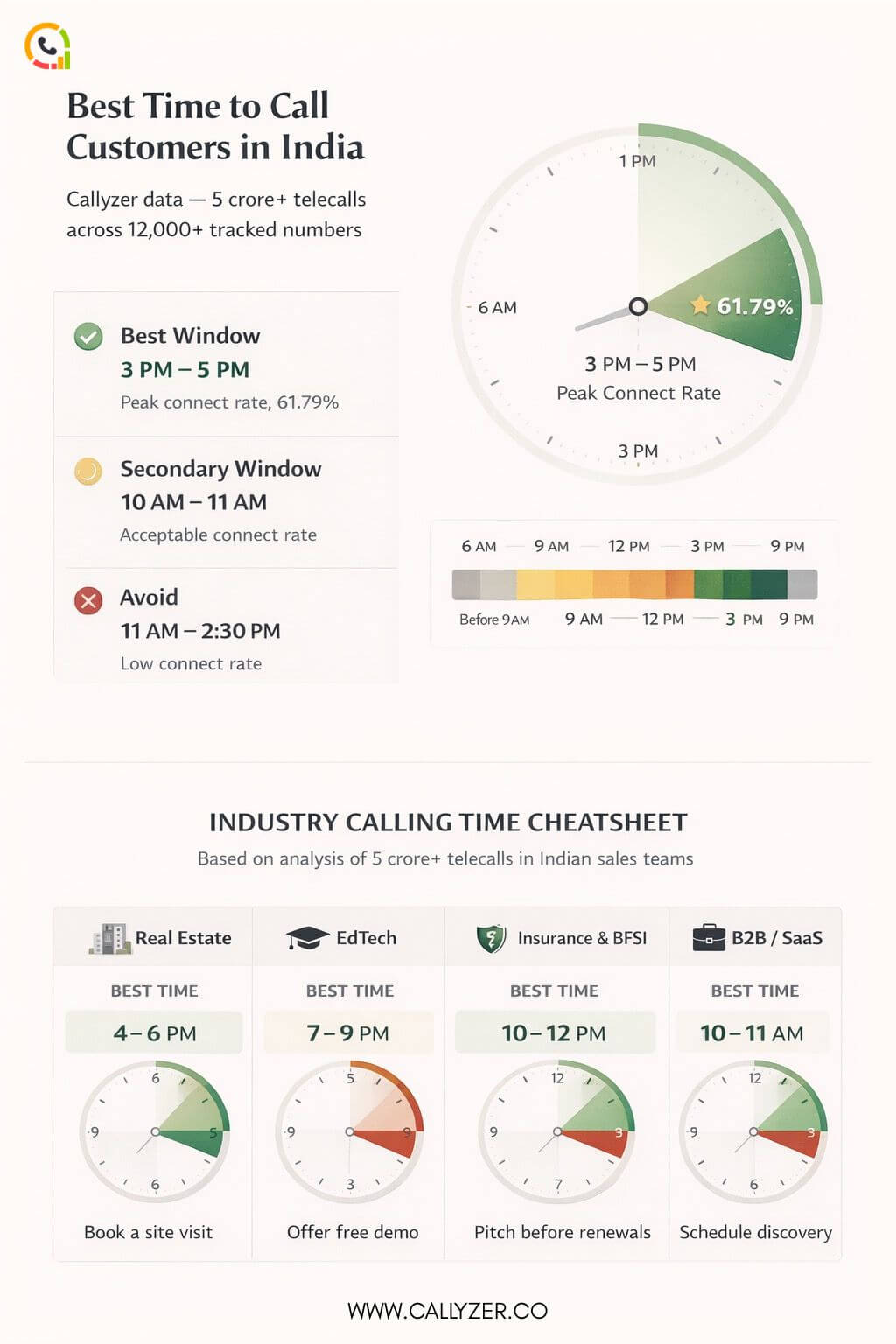
According to Callyzer's internal data from over 5 crore telecalls made across 12,000+ tracked numbers in the last 24 months, the best performing windows are:
Primary window: 3 PM to 5 PM This block consistently delivers the highest connect rates across industries. 5 PM specifically records a 61.79% connect rate — meaning more than 6 out of every 10 calls placed at this time get picked up. Prospects have cleared their afternoon meetings, are wrapping up their workday, and are far more willing to take a call than at any other point in the day.
Secondary window: 10 AM to 11 AM Good for first-touch cold calls, especially in B2B. The morning rush is over, people are at their desks, and they have not yet been worn down by the day. This window works well for reaching decision-makers and managers before their schedules fill up.
If your team has two calling blocks in a day, build them around 10–11 AM and 3–5 PM. Everything else — CRM updates, lead preparation, team huddles — belongs in the hours between.
Once timing is sorted, what you say in the first seven seconds determines whether the call goes anywhere. Most agents who struggle with this do not have a proper sales call script ready before their block starts.
What Is the Worst Time to Make Cold Calls in India?
The best time for cold calling in India is also, counterintuitively, the time most teams avoid — the afternoon. The window most teams default to, 11 AM to 12 PM, is actually the worst.
Here is why. This is the peak calling slot across Indian telecalling teams. Your prospect has already received three to four calls before yours. They are not ignoring you specifically — they are ignoring everyone. According to Callyzer's data, the 11 AM to 12 noon window consistently records the lowest connect rates of any time block.
Three windows to avoid:
- 11 AM to 12 PM — too many teams calling at once, prospects are already screening
- 1 PM to 2:30 PM — lunch break. People in India do not take sales calls mid-meal.
- After 7 PM — unless a warm lead has specifically asked you to call later, evening calls feel intrusive and increase the chance of being flagged on Truecaller
The 1–3 PM block also underperforms for similar reasons. Prospects are slow after lunch and not in a mindset to make decisions.
If you are avoiding the wrong windows but still seeing low pickup rates, timing is probably not the issue anymore. Number flagging, lead quality, and call frequency are the more likely culprits — and improving pickup rates starts with diagnosing which one is affecting your team.
Does the Best Calling Time Change by Industry?
Yes — and this is where most generic timing advice breaks down.
A real estate prospect and an EdTech parent follow completely different daily schedules. The same 10 AM slot that works for insurance will get you ignored by a parent who is dropping their child to school.
Real estate: Many real estate prospects are salaried professionals who browse listings in the evening. The 6–7 PM window works better here than it does for most other sectors. Site visits and property discussions happen when they are home, not in the middle of their workday. Avoid the 1–2:30 PM window entirely — it is consistently dead for real estate outreach.
Want to improve your real estate lead conversions?
Explore Callyzer's Real Estate Call Tracking solution and discover how data-driven call management can help your team close more property deals.
EdTech: Split your timing based on who you are calling. For parents making admission decisions, evenings between 7 PM and 9 PM work well — that is when they are home and have space to talk. For students, late morning around 11 AM to 1 PM catches them during a break. Calling parents between 9 AM and 5 PM rarely leads to a real conversation.
Insurance and BFSI: The 10 to 11 AM window performs well here. These customers are typically salaried professionals who are reachable in the late morning before their day gets hectic. Post-lunch is unreliable. Evening calls after 6 PM can work for relationship managers following up on warm leads, but not for first-touch outreach.
General B2B: Stick to 10–11 AM and 3–4 PM. B2B decision-makers filter out most calls that arrive during lunch or late-afternoon meetings. Tuesday to Thursday outperforms the rest of the week by a noticeable margin.
The principle is the same across every sector: call when your prospect has mental bandwidth, not just when they are physically near their phone.
Which Days of the Week Work Best for Telecalling?
Tuesday, Wednesday, and Thursday consistently outperform the rest of the week for telecalling in India.
Monday is the weakest day for cold calls. Teams are in planning mode, managers are in back-to-back meetings, and most prospects are mentally still catching up from the weekend. Your connect rate on Monday morning will almost always be lower than the same call made on Wednesday.
Friday drops off sharply after 3 PM. Before that, it is fine. After 3 PM on a Friday, decision-making energy is largely gone — even if someone picks up, they are unlikely to engage seriously with anything that requires thought.
Saturday is a grey area that depends on your sector. For consumer-facing products like real estate, EdTech, and insurance, Saturday between 10 AM and 12 PM can actually outperform a weekday slot. Prospects are home, not in office mode, and easier to reach on personal numbers. For B2B, Saturday calling is mostly wasted effort.
If your team runs one focused calling session per week, Wednesday afternoon between 3 PM and 5 PM is where to put it.
Want more answered calls and better sales results?
Callyzer helps sales teams track calls, measure performance, and identify the best times to reach prospects. Get started today and turn every call into an opportunity.
What Should Your Team Do During Low-Response Hours?
Low-response windows are not downtime. Used well, they are what makes your peak windows work better.
Telecalling productivity does not come from filling every hour with calls — it comes from making the right calls at the right time, and being prepared enough to convert when someone picks up.
Here is a simple structure for the hours between calling blocks:
Before 10 AM — lead preparation. Review the day's lead sheet, check Truecaller status on new numbers, and confirm contact details for your priority leads before the first block starts.
11 AM to 12 PM — CRM updates from the morning session. Mark dispositions, flag leads for retry, and note the right callback time for anyone who did not pick up.
1 PM to 2:30 PM — team review or script practice. Use this time to identify which leads need a follow-up call, at what time, and with what opening. Agents who prepare their afternoon calls during lunch consistently outperform those who go back to dialling without a plan.
The teams that improve their connect rates month over month are rarely the ones making more calls. They are the ones making better use of the hours around their calls.
How Do You Find the Best Calling Time for Your Specific Lead Base?
Industry averages give you a starting point. Your own data gives you the answer.
A real estate team in Tier-2 cities may find that 6 PM outperforms 5 PM because their customer base commutes home later. An EdTech team selling to rural families might find that Sunday morning is their best slot. No benchmark will tell you that.
This is exactly what Callyzer's dashboard is built for. Every call your team makes gets logged against a timestamp — connected, missed, or dropped. Over time, that data tells you which hours are producing conversations for your specific lead base, not just for the industry average.
You can pull hourly connect rate reports per agent, spot which time windows are working, and shift your calling blocks based on what the numbers show. If your 10 AM slot is giving you a 35% connect rate but your 4 PM slot is hitting 60%, that gap represents two hours of your team's effort every single day going in the wrong direction.
Start with the 3–5 PM and 10–11 AM windows as your baseline. Run them for two weeks. Then open your Callyzer dashboard, check connect rates by hour, and let the data tell you where to focus next.
FAQs
What is the best time to call customers in India?
Based on Callyzer's analysis of over 5 crore telecalls, the best time is between 3 PM and 5 PM on weekdays. 5 PM specifically records a 61.79% connect rate — the highest of any hourly slot. For first-touch cold calls, the 10 to 11 AM window is a strong secondary option, particularly for B2B.
Is calling between 11 AM and 12 PM a bad idea in India?
For most industries, yes. This is the peak calling window across Indian telecalling teams, which means your prospect has already received multiple calls before yours arrives. Callyzer's data shows this slot consistently underperforms the afternoon window. Use it for CRM updates and lead prep instead.
Does the best time to call change by industry?
It does. Real estate connects better in evenings around 6–7 PM. EdTech needs a split approach — evenings for parents, late mornings for students. Insurance and BFSI respond well to 10–11 AM. B2B generally follows the 10–11 AM and 3–4 PM blocks. For any industry, the 3–5 PM window on weekdays is the safest starting point.
How many call attempts should I make before dropping a lead?
According to Callyzer's internal data, 53% of cold calls go unanswered on the first attempt. Most leads require 12 to 13 touchpoints before converting, but most telecallers stop after 1 to 3 attempts. A missed call is a timing mismatch, not a rejection. Retry in a different time window before writing a lead off.
What is a healthy call connect rate for Indian telecalling teams?
A cold connect rate of 40–48% is typical across Indian telecalling teams, based on Callyzer's aggregate data. Warm leads — existing customers, referrals, or inbound inquiries — tend to connect at 50–60%. If your team is consistently seeing connect rates below 30%, the issue is usually a combination of poor timing, Truecaller flagging, or lead quality.
Should I call on Saturdays in India?
For consumer-facing sectors like real estate, EdTech, and insurance, Saturday between 10 AM and 12 PM can outperform a standard weekday slot. Prospects are at home, not in office mode, and more reachable on personal numbers. For B2B, Saturday calling rarely produces useful conversations. Avoid calling after 1 PM on Saturday — engagement drops sharply.