
- With a SIM-based telecalling CRM, reps call from the business SIM on their Android phone. Every call, recording and follow-up is logged automatically, and calls go through even without the internet.
- VoIP dialers work for desk-based teams that need high-volume auto-dialling or IVR. SIM-based calling fits teams that sell from their phones or in the field, especially where connectivity is patchy.
- A 10-rep team pays about ₹5,200–6,200 a month for SIM-based calling with Callyzer. VoIP costs ₹16,000 or more.
- Check how TRAI classifies your calls before choosing a setup. Its rules restrict 10-digit numbers for promotional calls and for some BFSI calls.
A SIM-based telecalling CRM is a customer relationship management system that allows employees to make business calls using the SIM card on their Android phone while automatically recording and organizing every customer interaction. Calls run on the mobile carrier’s network instead of the internet, which is the key difference from a VoIP dialer. It’s also called a SIM-based calling CRM or SIM-based call management system.
This guide covers how it works, how it compares with VoIP on cost and call quality, what TRAI’s calling rules mean for your team, and when VoIP is actually the better choice.
Choosing a business calling solution isn't just about making calls anymore. It's about giving sales teams room to work the way they already work, while giving managers a clear view into every customer conversation.
Many businesses default to VoIP dialers when they set up outbound calling. But for Indian sales teams already running on business SIM cards, switching to internet-based calling often creates more friction than it solves.
A SIM-based telecalling CRM works with the process teams already follow.
Employees keep dialing from their business SIM cards. The CRM tracks call activity, recordings, follow-ups, and customer history in the background. Nobody has to change how they work — the existing process just gets smarter.
If you're weighing a new telecalling software, or trying to decide between SIM-based calling and VoIP, knowing how each one actually functions will make the decision easier.
What Is a SIM-Based Telecalling CRM?
A SIM-based telecalling CRM is a customer relationship management system that allows employees to make business calls using the SIM card on their Android phone while automatically recording and organizing every customer interaction.
Unlike VoIP dialers, which route calls over the internet, SIM-based calling uses the mobile carrier's network. Employees continue using their phone's native dialer, but every business conversation is automatically linked to the CRM.
Depending on the solution, the CRM can capture information such as:
- Incoming and outgoing calls
- Call recordings
- Call duration
- Customer interaction history
- Follow-up activity
- Employee call logs
For employees, the experience feels familiar because they are calling exactly as they always have. For managers, the difference is significant because they no longer depend on manual updates to understand what happened during the day.
This is what makes a SIM-based call management CRM different from traditional CRMs that rely heavily on employees logging every conversation themselves.
Instead of spending time updating records after each call, sales teams can focus on building customer relationships while the system keeps track of business interactions in the background.
How Does a SIM-Based Telecalling CRM Work?
A rep calls a lead from their business SIM using the phone’s normal dialer, and the CRM logs the call, recording, and outcome against that lead automatically.
One of the biggest advantages of a SIM-based calling CRM is that it fits naturally into existing sales workflows. There is no need to replace the way employees already communicate with customers.
A typical workflow looks like this:
- A lead is assigned to a sales representative.
- The representative calls the customer using their telecalling sim card or business SIM card.
- The conversation takes place over the mobile network.
- The CRM automatically captures call details and recordings.
- Customer history is updated without manual effort.
- Managers can review performance and follow-ups from a centralized dashboard.
Because calls get recorded and organized automatically, businesses see what's actually happening day to day.
Managers no longer wait on employees to update spreadsheets or CRM records after every call. The data's already there, accurate, whenever they want to look.
This is where SIM-based call tracking earns its keep. It shows not just how many calls went out, but how those conversations are actually moving forward.
What Does a SIM-Based CRM Track Automatically?
Each call placed or received through the business SIM is recorded automatically including the number, direction (incoming or outgoing), duration, date and time, status (answered, missed or rejected) along with call recording, all related to the correct lead.
In addition to recording of the call, the CRM maintains the follow-up record and each previous interaction with that particular customer. It means that any representative who will take care of the lead will have the complete context. This is why SIM-based CRMs are also described as SIM-based call logging tools.
Does a SIM-Based CRM Work Without the Internet?
Yes. The call itself runs on the mobile network, so reps can keep calling even in areas with weak or no mobile data. Call logs and recordings are stored on the phone and sync to the dashboard once a connection is available. A VoIP dialer, by contrast, can’t place calls at all without a stable internet connection.
This matters most for field sales teams and for reps in Tier-2 and Tier-3 cities, where mobile data can drop during the day but voice coverage holds.
SIM-Based Telecalling CRM vs VoIP Dialers: What's the Difference?
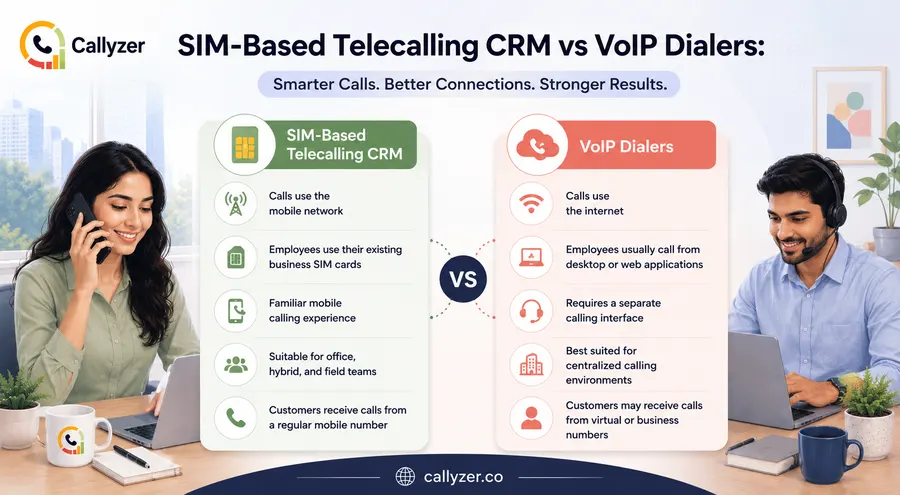
Both SIM-based calling and VoIP handle customer conversations, but they're built for different setups.
VoIP dialers route calls over the internet, and you'll mostly find them in organizations where people work from a central office on desktops and headsets.
A SIM-based Telecalling CRM is built for something else: teams who already run their day on mobile phones. Employees keep calling from their business SIM cards, and the CRM tracks every interaction behind the scenes.
Here's a quick comparison of SIM-based telecalling software vs VoIP dialers:
| SIM-Based Telecalling CRM | VoIP Dialers |
|---|---|
| Calls use the mobile network | Calls use the internet |
| Employees use their existing business SIM cards | Employees usually call from desktop or web applications |
| Familiar mobile calling experience | Requires a separate calling interface |
| Suitable for office, hybrid, and field teams | Best suited for centralized calling environments |
| Customers receive calls from a regular mobile number | Customers may receive calls from virtual or business numbers |
| No internet needed to place calls | Needs a stable internet connection |
| Call cost is covered by the SIM plan | Usually charged per minute |
| Runs on Android phones | Runs on desktop, web or softphone apps |
| Setup: install the app on reps’ phones | Setup: number provisioning, headsets and configuration |
For many Indian businesses, the decision comes down to how their teams actually work.
If employees spend most of their day speaking to customers from mobile phones, a SIM-based solution often requires fewer operational changes while providing the same level of business visibility.
If you’re also weighing virtual numbers, our virtual phone number guide explains how they work and when they make sense.
Why Does a SIM-Based CRM Work Better Than VoIP for Indian Sales Teams?
1. It Fits the Way Indian Sales Teams Already Work
Most sales professionals in India already use dedicated business SIM cards to speak with customers. Whether they are in the office, travelling, or meeting clients, mobile calling remains the most convenient way to communicate.
A SIM-based Telecalling CRM supports this existing workflow instead of replacing it. Employees continue using their phones while the CRM automatically captures business conversations in the background.
Why this matters
- Employees don't need to learn a completely new calling process.
- Existing business SIM cards continue to be used.
- Faster software adoption across teams.
- Works equally well for office, hybrid, and field employees.
Instead of asking teams to change their habits, businesses can improve visibility without disrupting daily operations.
2. Calls Happen Over the Mobile Network Instead of the Internet
Reliable customer conversations matter for every sales team. Internet calling works fine in plenty of situations, but mobile network calling tends to give field employees more room to move. Since calls go through the business SIM card, employees can keep talking to customers whether they're travelling, visiting clients, or working from wherever they happen to be.
Key advantages
- No dependence on desktop-based calling.
- Greater flexibility for mobile sales teams.
- Customers receive calls from a regular mobile number, so the number looks familiar and that helps calls get picked up.
For businesses that rely heavily on field sales or distributed teams, this approach often feels more natural than moving everyone to a desktop-based VoIP workflow.
3. Managers Get Complete Visibility Without Extra Manual Work
As sales teams grow, keeping track of customer conversations gets harder.
Manual CRM updates get delayed, or skipped entirely, and managers lose touch with what's actually happening on the ground.
A SIM-based call management system like Callyzer’s call management app records business call activity on its own — managers get accurate information without piling more admin work onto employees.
Managers can easily review:
- Call recordings
- Call duration
- Follow-up history
- Missed calls
- Customer interaction timelines
- Individual and team activity
Instead of spending time collecting reports, managers can focus on coaching their teams and improving performance.
Businesses that also invest in call tracking software gain even deeper insights into customer conversations, helping them identify missed opportunities before they affect sales results.
4. It Keeps Follow-Ups Organized and Customer History Complete
Very few sales close on the first call. Most deals move forward because someone follows up at the right time, with the right context.
The problem is volume — once call counts climb, nobody remembers every commitment they made. A customer asks for a callback next week, wants a brochure sent over, needs to check with their team first. Miss the follow-through on any of that, and the opportunity quietly disappears.
A SIM-based call management CRM ties every interaction to the customer record, so picking the conversation back up doesn't depend on memory or a stack of notes.
This helps businesses:
- Maintain a complete history of every customer conversation.
- Track follow-ups without switching between multiple tools.
- Give every sales representative the context they need before making the next call.
- Reduce the chances of missed callbacks and duplicate conversations.
This becomes particularly useful for businesses with long sales cycles, where customers may receive several calls before making a purchase decision.
Instead of asking, "Has anyone already spoken to this customer?", the answer is already available inside the CRM.
5. It Gives Managers Better Control as the Team Grows
Managing a team of five telecallers is very different from managing fifty.
At scale, verbal updates and end-of-day check-ins stop working. Managers need numbers, not summaries. A SIM-based CRM automatically logs every call made from business SIM cards and surfaces that data in one place — no manual entry, no chasing reps for updates.
Instead of guessing what's happening on the floor, managers can track:
- Call activity per rep: total calls made, connected calls, average call duration, and unanswered attempts broken down by day or week.
- Effective calling window — which hours of the day produce the highest connection rates. Callyzer’s platform data shows connect rates peak at 5 PM, at 61.79%, so a team still dialling hardest at 9 AM is working against its own data.
- Follow-up compliance — whether reps are calling back leads within the committed timeframe, or letting them go cold.
- Talk time vs dial count — a rep making 80 calls with a 40-second average duration isn't having real conversations. This ratio flags it immediately.
- Lead ageing — leads that haven't been contacted in several days, surfaced automatically so nothing slips without a reason on record.
- Missed inbound calls — customer calls that went unanswered during business hours, with timestamps, so managers can prioritize callbacks.
This kind of calling activity analysis gives managers a complete picture of what's working and what isn't — not just output numbers, but the quality and timing of conversations. For growing or distributed teams, that visibility is what separates a manager from an overseer.
What Connect Rates Do SIM-Based Telecalling Teams Get?
Across 5 crore+ calls made on Callyzer, Indian telecalling teams average a 46–48% connect rate. 53% of calls go unanswered on the first attempt, and connect rates peak at 61.79% at 5 PM. (Source: Best time to call customer)
The takeaway: a SIM-based CRM won’t connect every call, but because every unanswered attempt is logged, teams can see exactly which leads to call back and when. For practical ways to lift these numbers, see our guide on how to fix low call pickup rates.
How Much Does a SIM-Based CRM Cost Compared With VoIP?
The biggest cost difference is how calls are charged. VoIP dialers usually bill per minute on top of the software subscription, while SIM-based calling uses the SIM plan your team already pays for.
Take a 10-rep team making 100 calls a day at 3 minutes each. That’s about 78,000 calling minutes a month over 26 working days.
- VoIP dialer: 78,000 minutes × ₹0.40 + software at ₹1,999 per user per month = ₹51,190 per month (₹31,200 in call charges + ₹19,990 for 10 users)
- SIM-based CRM: 10 business SIM plans at ₹349 + Callyzer at ₹175 per phone per month = ₹5,240 per month, with no per-minute charges (₹6,240 with Airtel’s ₹449 plan)
The more your team calls, the wider this gap gets, because SIM-based costs stay flat while VoIP costs rise with every minute.
When Is a VoIP Dialer the Better Choice?
VoIP is more logical in the case when your workforce uses a desk-based office to work from and requires automatic dialling or predictive dialling due to extremely high volume of calls.
If your reps already sell from their mobile phones, especially in the field or in smaller cities, a SIM-based CRM usually means less disruption and lower calling costs.
Can You Use a Normal SIM Card for Telecalling in India?
It depends on the type of call and the type of business. TRAI has tightened the rules on commercial calling under the Telecom Commercial Communications Customer Preference Regulations (TCCCPR).
Its 2025 amendment bars ordinary 10-digit numbers from being used for telemarketing: promotional calls must come from 140-series numbers, and service and transactional calls are moving to the new 1600 series, starting with government and BFSI entities.
Financial businesses face firm deadlines. TRAI’s November 2025 direction set mandatory 1600-series adoption timelines for entities regulated by RBI, SEBI and PFRDA, and its December 2025 direction required IRDAI-regulated insurers to switch by 15 February 2026.
After those dates, these entities can’t make service or transactional calls from other numbers, even with the customer’s consent.
For the full regulations, see TRAI’s regulations.
Which Businesses Benefit Most from a SIM-Based Telecalling CRM?
A SIM-based Telecalling CRM is valuable for any business where customer conversations happen primarily through mobile phones. It is especially useful for teams that need the flexibility to work from different locations while maintaining complete visibility into customer interactions.
Some of the industries that benefit the most include:
Real Estate
Sales teams often speak with buyers while travelling between project sites and client meetings. Using SIM-based call tracking software for real estate helps managers monitor enquiries, follow-ups, and customer conversations without disrupting how agents already work.
Banking and Financial Services
Loan advisors and DSAs handle hundreds of customer conversations every month. Automatically tracking business calls makes it easier to manage follow-ups, maintain compliance, and review team performance.
Insurance
Insurance advisors usually interact with prospects several times before a policy is purchased. Keeping every conversation in one place helps advisors continue discussions with better context.
Recruitment
Recruiters spend a large part of their day speaking with candidates and employers. A centralized record of every conversation makes candidate management more organized and reduces missed follow-ups.
Education
Admissions and counselling teams regularly nurture enquiries over several weeks. A SIM-based CRM helps them manage these conversations more effectively while giving managers better visibility into team activity.
These are only a few examples. Many industries that use telecalling in India rely on mobile-first sales teams, making SIM-based calling a practical choice for their day-to-day operations.
Ready to Upgrade to a SIM-Based Telecalling CRM with Callyzer?
Keep your existing business SIMs while Callyzer automatically tracks every call, recording, follow-up, and customer interaction, giving your team a smarter way to sell without changing how they work.
Should You Choose a SIM-Based CRM or a VoIP Dialer?
Choose a SIM-based CRM if your reps sell from mobile phones, work in the field or in low-connectivity areas, and you want full call visibility without changing how they call. Choose VoIP if your team is desk-based, needs high-volume auto-dialling, or your calls must go through 140 or 1600-series numbers.
Conclusion
VoIP dialers have their use cases, especially in businesses which use centralized call centers with desktop-based dialing. But that’s not how most Indian sales teams work.
For businesses that use mobiles as the primary tool for communication with clients, a SIM-based Telecalling CRM is the right way to go. Your employees will keep on using their business SIM cards, while you will get visibility into all their calls, follow-ups, recording, and customer history.
This will give you the benefits of accountability without making any changes to your current system. Your employees will have less paperwork, your managers will make informed decisions based on reliable information, and all your customer communications will be well organized from the very first call till the last follow-up.
If your sales teams are mobile-first, choosing a SIM-based Telecalling CRM might be just what you need.
FAQs
What is a SIM-based Telecalling CRM?
A SIM-based telecalling CRM enables employees to make business calls via the existing SIM cards and simultaneously log call activity, customer history, follow-up, and call recordings in the CRM.
What is a SIM-based call management solution?
A SIM-based call management solution helps you manage the conversations with your customers via your employees’ SIM cards. This solution provides you with full visibility of business calls without any manual call logging.
Is SIM-based calling better than VoIP?
That really depends on your workflow. If you have a desk-based call center, then VoIP will be a good choice for you. However, if your company uses mobile devices to call your clients, then a SIM-based approach will work better.
Are SIM-based calls trackable?
Yes, modern SIM-based call tracking systems can help you record all business call details including call duration, time stamps, call recordings, and customer interaction history.
Should the employees adapt to a new way of making calls?
No, one of the major benefits of a SIM-based system is that the employees can continue to utilize their business SIMs and normal calling procedure while the CRM automatically records business data.
What’s the difference between a SIM-based CRM and a call tracking app?
A call tracking app logs calls: who was called, when, and for how long. A SIM-based CRM does that and also manages leads, follow-ups and the full customer history, so every call is tied to a sales opportunity rather than sitting in a standalone log.
Why is call quality better on SIM-based apps vs VoIP in India?
VoIP call quality depends entirely on internet bandwidth. In India, where connection speeds vary - especially outside metro areas - that dependency creates problems. Dropped packets, lag, and choppy audio are common on unstable connections.
SIM-based calls run on the mobile network instead. Coverage from carriers like Jio, Airtel, and Vi reaches well beyond where broadband does, and voice calls over GSM/LTE are designed to hold up even on weaker signals. For field teams or employees in smaller cities, the difference in call quality is noticeable.
Can SIM-based apps record calls for compliance?
Yes. Most SIM-based telecalling CRMs record calls automatically and sync them to the customer record in the CRM — no manual upload, no delay. Once a call ends, the recording is attached to the contact, timestamped, and accessible to managers without any action from the employee.
That said, compliance requirements vary by industry and customer type. If your business operates under specific regulations such as BFSI or healthcare — check that the platform stores recordings securely, supports your retention period, and gives you audit access when needed.
What is the cost difference between SIM-based and VoIP telecalling?
VoIP pricing typically includes per-minute call charges on top of the software subscription. Those costs add up quickly for high-volume outbound teams.
SIM-based telecalling works differently. Calls go through the employee's existing business SIM, so the call cost is whatever your carrier plan already covers — usually a flat monthly recharge. The CRM subscription is separate, but you're not paying extra per minute. For teams making hundreds of calls a day, that structure tends to be cheaper overall.