
VoIP routes calls over the internet. SIM-based calling runs on the mobile network like a regular phone call. For Indian sales teams doing high-volume outbound, VoIP numbers get spam-flagged faster, drop on weak connections, and carry TRAI compliance risk. SIM-based calling delivers higher pickup rates and works offline. The right choice depends on your call volume and sector.
A virtual phone number is a business phone number that routes calls over the internet instead of a physical SIM card or landline.
SIM-based calling uses a physical or virtual mobile SIM card and routes calls through the mobile carrier’s cellular network, exactly like a regular personal phone call.
That one difference affects pickup rates, call quality, spam risk, and cost in ways that matter a lot if your team is doing outbound telecalling in India.
This post breaks both options down honestly, using real data from Callyzer's analysis of over 5 crore calls across 12,000+ tracked numbers in India.
What does outbound telecalling in India actually look like?
Before comparing VoIP and SIM-based, it helps to know the environment your calls operate in.
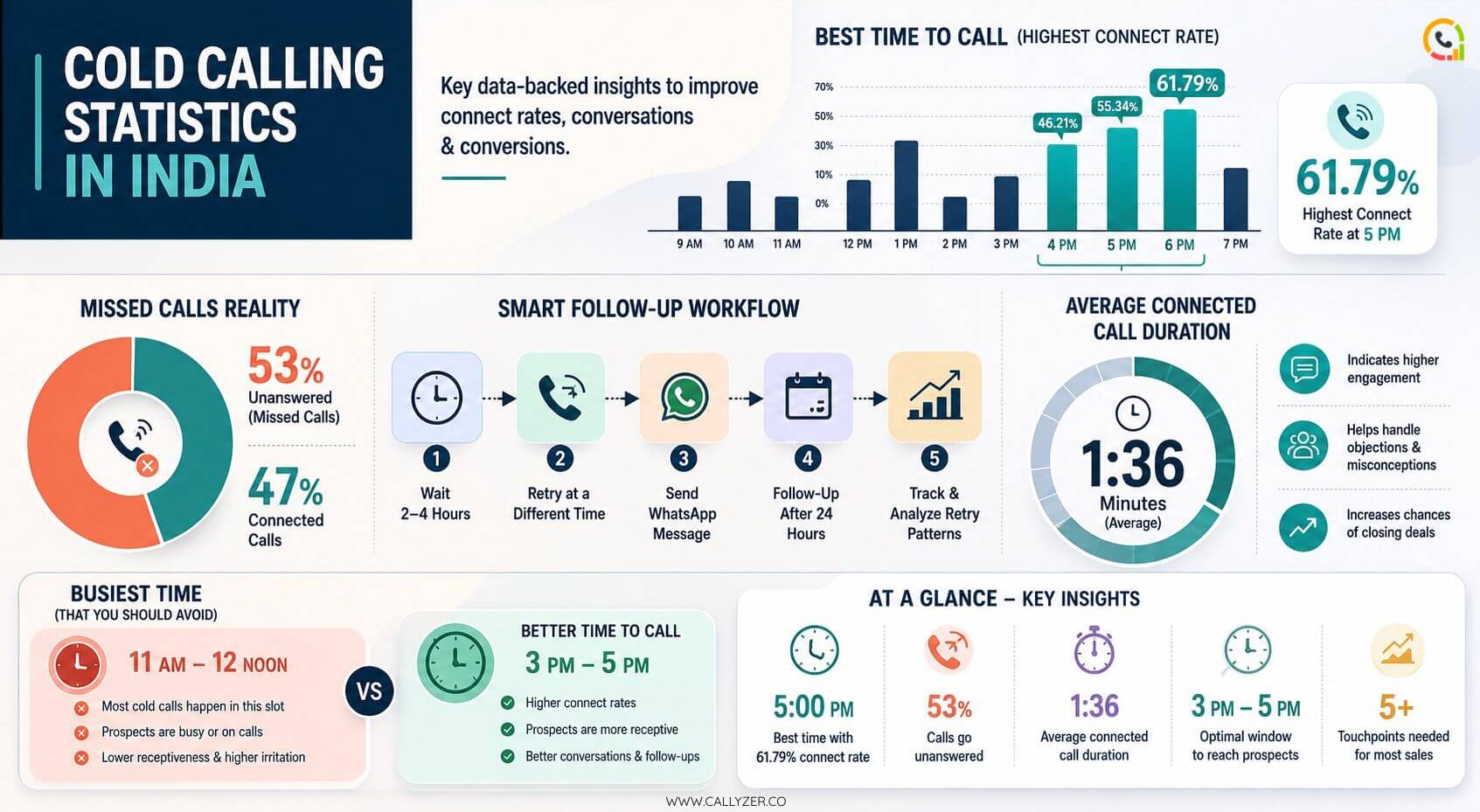
According to Callyzer's data:
- 53% of cold calls go unanswered. On an average day, more than half your dials will result in no pickup, regardless of what you are selling or how good your agents are.
- The best time to call is 5 PM, when connect rates peak at 61.79%. The worst window is 11 AM to 12 noon, when prospects are already swamped with other calls.
- Most leads need 12 to 13 touchpoints before they convert. Most telecallers give up after 3 missed calls.
This baseline matters because VoIP and SIM-based calling affect your connect rate differently. Choosing the wrong setup makes an already tough environment tougher.
What are the advantages of VoIP for sales teams?
VoIP is a good fit for specific types of calling operations. Here is where it genuinely helps.
It is cheaper to set up. No hardware, no desk phones, no installation. You pay a monthly subscription, and new lines get added in a dashboard. For large teams or businesses expanding quickly, this is a real operational advantage.
You can show a local number anywhere. Want your Hyderabad-based agent to call Delhi leads from a Delhi number? VoIP makes that simple. Familiar-looking caller IDs can improve pickup rates for outbound-heavy or enterprise sales operations.
It works well for inbound support. IVR menus, call queuing, department routing, voicemail to email. If your team is primarily handling incoming calls and distributing them across agents, VoIP is built for that.
Remote teams can plug in easily. As long as there is a stable internet connection, agents can make and receive calls from anywhere using a softphone app on their laptop or phone.
Why does VoIP struggle for high-volume outbound telecalling in India?
Most VoIP strengths apply to inbound operations or low-volume outbound. For high-volume outbound in India, three things get in the way.
Call quality depends on your internet
VoIP calls are only as good as the connection they run on. In Mumbai or Bengaluru with strong 4G/5G, that is usually fine. But if your agents are working from a smaller city, from home, or on shared office WiFi, choppy audio and dropped calls become regular problems.
A bad connection in the first 10 seconds of a cold call means the prospect hangs up. That is a lost dial you cannot recover.
Virtual numbers get spam-tagged faster
Carriers like Airtel and Jio now run AI systems that monitor calling patterns in real time. Airtel's system flagged 800 crore spam calls in just 2.5 months after launching.
These systems look at how many unique contacts a number dials per day, how often calls get rejected, and whether the number is registered to a business or a person.
VoIP business numbers trigger these filters faster than personal mobile numbers. Once a number gets tagged as spam on Truecaller or marked "Spam Likely" on Android, your pickup rate drops sharply.
The fix is rotating to a new number, which starts the cycle again.
Financial services and real estate teams have it worse. Callyzer's data shows these two sectors account for 80% of spam call complaints in India.
Regulations have tightened
TRAI has tightened spam and telemarketing rules in India through updates made in 2024 and 2025. Under the current system, promotional sales calls are expected to come from 140-series numbers, while 160-series numbers are mainly reserved for service and transactional calls from regulated sectors like banks and financial institutions.
Boost Your Sales Calls with SIM-Based Calling
Get real-time call tracking, better pickup rates, and reliable outbound calling.
How does SIM-based calling perform differently?
SIM-based calling runs on a physical SIM card in a mobile device, using the same mobile network as a regular personal call. No internet required.
Pickup rates are better. A mobile number from Jio or Airtel looks like a friend calling, not a business line.
Recipients are more likely to answer. Callyzer's connect rate data, which peaks at 61.79% at 5 PM, is based on SIM-based calling behaviour. Teams dealing with spam-flagged VoIP numbers see significantly lower rates at every time window.
Spam risk is lower for high-volume use. SIM-based numbers behave like personal mobile use on the network. As long as daily call volumes stay reasonable, carrier spam filters do not flag them the same way they flag VoIP business numbers.
It works regardless of WiFi. Agents in Tier-2 cities, smaller towns, or working from home get consistent call quality because the call runs on mobile coverage, not broadband.
The trade-off is visibility. A SIM card on its own gives you no data.
You know calls are being made, but you cannot see pickup rates by agent, identify who is going idle, or track which numbers are generating callbacks.
A call monitoring tool fills that gap by pulling call data (duration, pickup, recordings) from the SIM to a central dashboard.
Callyzer, for example, gives managers the same kind of visibility they would get from a VoIP analytics platform, without routing calls over the internet.
Callyzer is a SIM-based outbound calling app that pulls call data directly from the agent's SIM to a central dashboard, giving managers real-time visibility into pickup rates, call duration, and agent activity.
VoIP vs SIM-based calling: how do they compare for Indian teams?
| VoIP / Virtual Number | SIM-Based Calling (Callyzer) | |
|---|---|---|
| Technology | Voice over Internet Protocol (VoIP) | Mobile network carrier |
| Hardware | Laptop or smartphone with internet, softphone app | Mobile phone with a physical SIM card |
| Call Quality | Depends on internet | Consistent, runs on mobile network carriers |
| Works Offline | No | Yes |
| Setup Time | Days to fully configure | Same day |
| Spam Risk | Higher for outbound at volume | Lower, looks like personal mobile |
| Pickup Rate | Lower once spam-flagged | Higher for cold outbound |
| Cost | Rs 500 to 1,500/agent/month with add-ons | From Rs 175/phone/month |
| Call Data Visibility | Built into the VoIP platform | Needs a monitoring tool |
| Best For | Inbound support, IVR, multi-location routing | High-volume outbound telesales in India |
Corporate SIM vs Cloud Telephony: how do they compare for Indian teams?
Go with VoIP if your team handles mostly inbound calls, needs IVR routing, or has agents spread across countries. Also a good fit if your outbound volume is low, say under 30 calls per agent per day.
Go with SIM-based if your agents are making 50 to 150 outbound calls a day, you work in financial services or real estate, your agents are based outside major metros, or you have had VoIP numbers flagged before and seen your pickup rate collapse.
Some teams use both. VoIP handles the inbound customer support line with routing and queuing. SIM-based calling for sales team handles the outbound sales floor with a telecalling CRM layer for visibility. This is fairly common for insurance and real estate teams above 20 agents.
One metric worth checking before you decide: your current pickup rate on outbound cold calls.
The industry average across sectors, based on Callyzer's data, is 46 to 48%. If your team is consistently below 35%, the calling infrastructure is part of the problem.
Frequently Asked Questions
What is the difference between a virtual phone number and VoIP?
VoIP is a technology, calls travelling as data over the internet. A virtual phone number is a number that runs on that technology. All virtual numbers use VoIP, but not all VoIP systems use virtual numbers. The terms get used interchangeably in most business conversations.
Are virtual phone numbers reliable for outbound sales in India?
For low volumes, yes. For high-volume outbound (50 or more calls per agent per day), call quality becomes inconsistent on weak connections, and spam flagging becomes a real operational problem under current TRAI regulations.
Why do virtual numbers get flagged as spam?
Airtel, Jio, and other carriers now run AI systems that track calling patterns. A number dialling hundreds of unique contacts per day, with a high rejection rate, gets marked automatically. Once flagged, it shows as "Spam Likely" on Android or gets Truecaller-tagged, which lowers pickup rates.
The flagging is based on the pattern of calls, not the content of the conversation.
What is SIM-based calling and how is it different from VoIP?
SIM-based calling uses a physical SIM in a mobile device and routes calls through the mobile carrier network, the same way a regular personal call works. No internet needed. Call data gets tracked through a monitoring app rather than through the VoIP platform itself.
Which is better for Indian telecalling teams, VoIP or SIM-based?
For high-volume outbound in India, particularly in financial services, real estate, EdTech, or insurance, SIM-based calling delivers better pickup rates and lower spam risk.
VoIP is better for inbound operations or low-volume outbound. The benchmark to keep in mind: Callyzer's data shows a 46 to 48% average connect rate for outbound calling in India.
Any infrastructure that pushes that number lower is directly affecting your monthly targets.
What is the average pickup rate for cold calls in India?
Based on Callyzer's analysis of over 5 crore telecalls across 12,000+ tracked numbers, the average connect rate for cold calls in India is 46 to 48%.
The peak connect rate is 61.79%, recorded at 5 PM on weekdays. The 11 AM to 12 noon window consistently delivers the lowest pickup rates across sectors.