
Low response rates and spam labelling trace back to trust, not the script: prospects ignore unfamiliar numbers, and TRAI blocks unregistered ones automatically before an app like Truecaller even sees the call. Fix registration first, get every number set up as a Principal Entity on DLT with a 140-series routing, then layer in the right call timing, a verified caller ID, consent, and regular number screening. Callyzer's data puts 5 PM on weekdays at a 61.79% connect rate, the strongest window nationally. Get the order right, and response rates recover without touching the pitch.
This guide is for telemarketing and telecalling teams. Not for individuals trying to block spam calls on their own phone.
If your team dials consistently and pickup rates keep falling, two problems are usually at play. Prospects have stopped answering unknown numbers. And your numbers have started showing up as suspected spam, sometimes flagged by apps like Truecaller, sometimes blocked at the network level before the call even rings through.
Every telecaller in India knows the moment. You dial, you say "Hello, I'm calling from XYZ company," and the line goes dead before you finish the sentence. One bad call is normal. A third of your dials ending that way is a systemic problem, and it needs a different fix than a better opening line.
This post covers what actually causes low response rates and spam labelling for telemarketing teams in India, including the regulatory mechanics most teams never check. It also covers the strategies for low response rates and spam filters that fix the root causes instead of the symptoms: call timing, caller ID trust, consent, number hygiene, and TRAI compliance.
If you're also building out your inbound call strategy, the same trust signals apply on both sides of the phone. A prospect who distrusts your outbound number won't trust a callback from it either.
Why Do Telemarketing Calls Get Low Answer Rates in India?
Low answer rates telecalling problems usually come down to consumer fatigue, not bad luck or a weak list.
This is where telecaller response rates India start to slip. Often weeks before a team notices the trend, because the decline is gradual, not sudden.
Indian consumers get a high volume of unsolicited calls every week, and a meaningful share of those are fraudulent. That's trained an entire market to treat unknown numbers as guilty until proven otherwise. A call from a number with no name, no verified tag, and no prior contact gets silenced or sent to voicemail without a second thought.
Timing makes it worse. A call during a prospect's working hours, a meeting block, or late in the evening gets rejected on reflex, regardless of how strong the offer would have been.
The effect on a telecalling floor compounds across a shift:
- More dials are needed to produce the same number of live conversations, which inflates cost per conversation without changing the pitch
- Reported conversion rates fall even when the script, offer, and list stay the same, making it look like a sales problem when it's really a reach problem
- Agents lose time and morale re-dialing numbers that were never going to connect, and the call logs alone rarely show why a number went cold
Why Do Telemarketing Numbers Get Marked as Spam?
Low answer rates and spam labelling are two different problems, even though they look similar from the outside.
Low answer rates mean a prospect sees your call and chooses not to pick up. Spam labelling means the number itself gets tagged or blocked as spam, sometimes before the prospect even sees it ring. Because the causes are different, the fixes are different too.
A number can get flagged as spam in two ways:
- An app like Truecaller marks it based on reports from recipients
- The telecom network itself blocks it automatically, because the number was never registered correctly
Both are explained below.
How Do Apps Like Truecaller Score a Number?
Apps like Truecaller give each number a reputation score. The score goes up when recipients tag a number as spam.
That happens faster when a number calls a large list repeatedly in a short window. It also happens faster when the list includes numbers on the National Do Not Call (NDNC) registry.
Poor call quality speeds up the same process. A few common triggers:
- Dropped calls or dead air on connection
- Robotic-sounding or overly scripted openers
- Aggressive pitches that don't let the prospect speak in the first few seconds
Each of these sounds like a scam call to the person answering. Over time, it starts to look that way to the app too.
How Does Network-Level Blocking Work Under TRAI Rules?
This second mechanism is less visible, and most teams don't know it exists.
India's telecom regulator, TRAI, set rules for commercial calling called TCCCPR 2018. Here's what those rules require, in order:
- A business making commercial calls must register with a telecom operator as a "Principal Entity"
- That registration happens on a system called DLT, short for Distributed Ledger Technology
- Once registered, promotional calls must go out through a designated 140-series number
If a number skips this registration, it doesn't just risk getting reported inside an app. Telecom operators are required to detect and block it automatically, before Truecaller or any similar app even sees the call.
In practice, this means a team calling from personal SIM cards, or from business numbers that were never registered, is already operating outside the rules. Part of the spam problem may not be about calling behaviour at all. It may simply be a registration gap, and no script rewrite fixes that.
Once a number is flagged, whether by an app or by the network itself, the result is the same. Fewer people answer it, and the ones who do are already primed to distrust the call before it starts.
Low Response Rates and Spam Filters Strategies That Actually Work
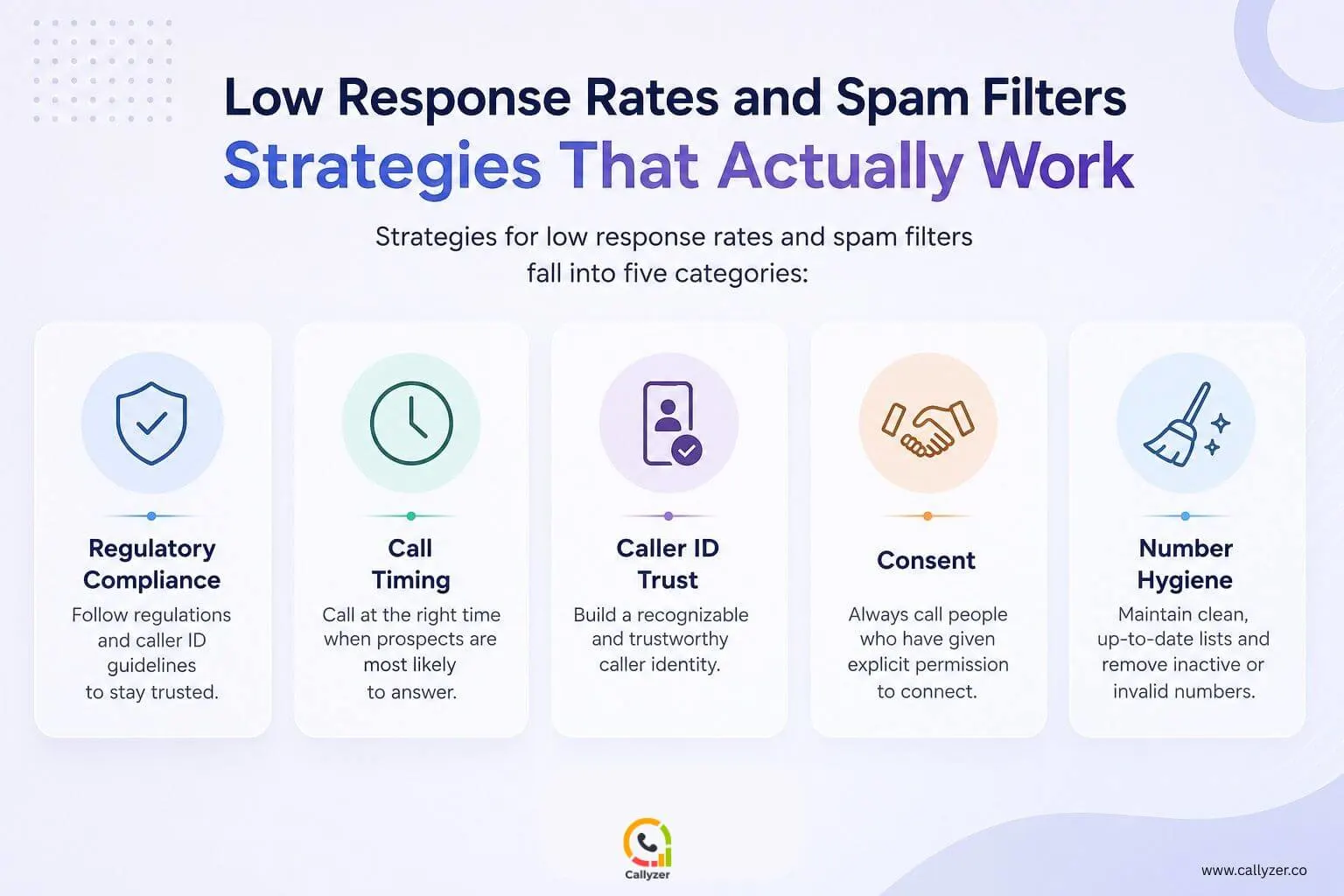
Strategies for low response rates and spam filters fall into five categories:
- Regulatory compliance
- Call timing
- Caller ID trust
- Consent
- Number hygiene
Compliance sits underneath the other four. None of the tactical fixes hold up if the underlying number isn't registered correctly. Together, these five change how a prospect, and the network itself, treats the call before a word is spoken.
How Does TRAI Compliance Affect Spam Labelling?
Regulatory registration is the part most telemarketing teams skip. It looks like a legal formality rather than a response-rate lever. It isn't. It's the foundation the other strategies sit on.
Under TCCCPR 2018:
- Promotional calls must originate from a registered 140-series number, obtained after registering as a Principal Entity on a DLT platform through a telecom operator
- Transactional and service calls, the kind BFSI and similar sectors rely on, route through the 1600 series instead
- Contact lists need to be scrubbed against the NDNC registry before a campaign runs
Mixing up the number series, or skipping registration entirely, doesn't just create legal exposure. It produces the exact symptom this post opened with: connect rates that quietly decline for no apparent reason, because a share of the calls are being filtered before they reach the recipient.
There's also a formal way to get consent, on top of the informal SMS method above.
It's called Digital Consent Acquisition, or DCA. Here's how it works:
- A business asks the prospect for consent
- That consent gets registered on the DLT platform, the same system used for number registration
An SMS opt-in has no official record behind it. DCA consent does. If a business is ever questioned about a call, DCA gives it proof that consent was captured beforehand.
None of this needs an in-house compliance team. It needs knowing the registration exists, confirming your numbers are actually mapped to it, and treating that mapping as ongoing number hygiene rather than a one-time setup task.
What Is the Best Time to Call Prospects in India?
Timing decisions should be built on two inputs: demographic patterns for the audience, and what your own call data actually shows.
Demographic patterns are the starting point:
- Working professionals in urban areas tend to answer more during lunch breaks or after office hours
- Retirees and homemakers are often more reachable earlier in the day
Segmenting a list by these patterns, instead of running every contact through the same schedule, raises pickup odds before anything else about the call changes.
Callyzer's own data, drawn from millions of tracked telecalling records, puts the best time to call prospects in India at 5 PM on weekdays. Connect rates hit around 61.79% in that window, well above the 46 to 48% industry average across other hours. That single data point is worth restructuring a calling schedule around.
Past call data closes the loop and personalises the general pattern to your business. Reviewing pickup rates, call duration, and outcomes by hour and day of week usually surfaces a pattern specific to your own list, different from the market-wide average. A team running call tracking tools can pull this directly from logged data instead of reconstructing it from memory or a spreadsheet that's already stale.
Follow-up timing matters as much as first-attempt timing. Callyzer's data shows callbacks placed in the 4 to 5 PM window convert roughly 71% more effectively than callbacks placed outside it. A team optimising only for first-attempt timing is leaving a bigger lever untouched. Callyzer's reporting surfaces this breakdown automatically, alongside call recording sync, so a manager can hear what actually happened on a call rather than just whether it connected.
How Do You Keep Your Caller ID Trustworthy?
A caller ID that looks unverified gets treated as risk by default, regardless of what the call is actually about. Fixing this is about consistency and registration, not a single trick.
Register business numbers with accurate, complete details:
- The correct business name, with the telecom provider directly
- The same details registered with third-party verification services
- Regular updates so nothing goes stale for months at a time
A number tagged as "Business," or showing a recognisable name on Truecaller, gets answered measurably more often than a bare digit string. That difference usually shows up in connect-rate data within a few weeks of registration.
Truecaller Business is the most widely used route for this in India. Registering surfaces the business name and logo on outgoing calls, which signals legitimacy before the recipient has made any judgment about the pitch itself. This is a separate registration from the TRAI 140-series and DLT process above. A number can be fully TRAI-compliant and still show up as an unverified caller ID if it hasn't also been registered with Truecaller.
Encouraging existing customers to save the business number in their contacts compounds over time too. A saved contact is never marked as spam, no matter how often it is called.
Stop Losing Calls to Spam Filters
Improve answer rates, build caller trust, and track every sales call with Callyzer's SIM-based Telecalling CRM.
How Does Consent Improve Response Rates?
Letting a prospect opt in, even loosely, changes how the next call from that number is received. Both by the person, and increasingly, by the systems tracking the number's behaviour.
An SMS sent before the call works well as an informal layer on top of formal DCA consent. A short message explaining who's calling and why, with a simple way to respond, gives the prospect a chance to expect the call rather than being caught off guard. Indian banks already do this at scale. ICICI, for instance, sends a consent SMS ahead of certain service calls, and that small step measurably changes how the following call is received.
Scheduled callbacks work the same way from the other direction. If a prospect can request a call at a time that suits them, the call stops being an interruption. It becomes something they asked for, which changes both the pickup likelihood and the tone once it connects.
Pairing this with outbound dialers for cold calling & follow-ups makes it far easier to track who requested a callback and confirm it actually happens on schedule, instead of the request getting buried in a shared spreadsheet.
Why Does Number Screening Reduce Spam Flags?
A number pool needs regular checking. Without it, flagged numbers pile up before anyone notices, because one weak number is easy to miss inside a whole team's average.
Four things to check on a routine basis:
- Confirm active numbers are still correctly registered under the DLT and 140-series rules, and recognised properly by carriers and call-blocking apps
- Rotate numbers deliberately, so no single line carries too much call volume
- Track numbers that are picking up spam reports, and pull them for re-verification before they hurt the pool's average connect rate
- Scrub the calling list against the NDNC registry at the same time as these checks, not as a separate task done once a quarter
Third-party verification services can run these checks automatically instead of relying on someone remembering to do them. A telemarketing software platform that logs outcomes by individual number also helps. Rotation becomes a decision based on real data, not a guess about which numbers "feel off."
Training matters too. When agents understand that avoiding spam filters in telecalling is everyone's job, not just a setting someone else manages, they're more careful about which numbers and lists they use.
Takeaway
Low response rates and spam labelling come from the same root cause: trust. Prospects don't trust an unknown number. The telecom network doesn't trust an unregistered one.
Fix both, in this order:
- Confirm TRAI and DLT registration is current for every active number
- Call at the times your own data supports, not a generic industry rule
- Register and maintain a verified caller ID
- Keep the number pool screened on a fixed schedule, rather than after something visibly breaks
None of this replaces a strong script or a well-qualified list. But without it, even a strong script never gets heard. That's the core logic behind every one of these low response rates and spam filters strategies: fix the trust problem first, and the script gets a fair chance to work.
Most strategies for low response rates and spam filters fail for the same reason. They get set up once, then never revisited as the list, the team, and the regulations change.
Calling doesn't have to carry this fix alone. Spreading outreach across other channels, covered in the guide to outbound marketing strategies, reduces how much a single flagged or unverified number can stall an entire campaign.
Small, steady changes move telecaller response rates in India more than one big fix does. Track what's working in the data. Adjust the number pool before a problem shows up in campaign numbers. Keep the compliance layer and the caller ID clean.
Frequently Asked Questions
How do you avoid spam filters as a telecaller?
Start with registration. Your number needs to be set up as a Principal Entity on the DLT platform, routed through a 140-series number for promotional calls. From there, keep your caller ID verified on apps like Truecaller, avoid calling the same list too many times in a short window, and scrub NDNC-registered numbers before a campaign runs. Pull and re-verify any number that starts collecting spam reports instead of continuing to dial from it.
How do you improve telecaller response rates in India?
Call at the times your own data shows people actually answer, not a fixed company-wide schedule. Callyzer's data puts 5 PM on weekdays as the strongest window nationally, with a 61.79% connect rate. Pair that timing with a verified caller ID and consent captured before the call, and response rates improve without changing anything about the script.
Why do customers not pick up sales calls?
Mostly because the number looks unfamiliar. Indian consumers get a steady stream of unsolicited and scam calls, so unknown numbers get ignored by default. Calling at the wrong time, like during work hours, adds to the drop-off.
How many calls per day before a number gets flagged as spam?
There's no fixed number. Apps score a number based on call volume relative to pattern, and how often recipients report it, not a simple daily count. A number calling a small, targeted list a few times a day can stay clean. One dialling a large list repeatedly in a short window gets flagged fast, especially into NDNC-registered numbers or from an unregistered line.