
Learning how to spot burned leads early saves your team from chasing prospects who were never going to say yes again. A burned lead isn't the same as a dead one, it's a prospect who was actually interested until too many calls, a repeated pitch, or a broken callback promise wore them down. Watch for shrinking replies, unread follow-ups, and voicemail patterns instead of waiting for a deal to go quiet for good. Some of these leads are worth one careful re-approach, but only if the next attempt doesn't repeat what burned them the first time.
Every telecalling team has a few numbers in the CRM that nobody wants to dial anymore. The agents know which ones. Called too many times, pitched too hard, or left waiting on a callback that never came, and now the contact just sits there, going nowhere.
Knowing how to spot burned leads early saves your team from chasing prospects who were never going to say yes again. It also frees up hours agents could be spending on fresh, warm contacts instead.
Here's what that actually costs you. An agent making forty calls a day might spend six or seven of those on a contact that's already been over-called, pitched the same way twice, or left waiting on a callback that never came, someone who might have said yes if the process hadn't wrecked it first.
Across a team of twenty agents, that's well over a hundred calls a week spent chasing a problem the team created, not one the prospect brought with them.
And it doesn't stop at wasted minutes. Over a month, that gap shows up in every report a team lead has to defend, connect rates, conversion percentages, average call time, even though the real problem was never how hard the agents were working.
Leadership sees a dip in the numbers and assumes the team got lazy, when really a chunk of the list should've been dropped weeks ago and nobody caught it in time. Before writing off a bigger chunk of your list, it's worth learning to spot low quality leads too, because the two problems tend to travel together on the same call sheet.
So what actually turns a promising lead into a dead end? And how do you catch it before someone burns another week on it?
What is Burned Lead Meaning in Sales?
In plain terms, it comes down to this: a prospect who once showed real interest but has since gone cold because of how they were handled, not because they stopped needing what you sell.
Maybe they were called five times in two days. Maybe every follow-up repeated the same pitch instead of answering the question they actually asked. Maybe they were promised a callback that never came. The interest didn't fade on its own. It was worn down by the process.
That distinction matters. A lead that was never a good fit was always going to go nowhere. A burned lead had a real shot, and something in how it was handled cost you that chance.
How to Spot Burned Leads: 8 Signs Your Team Can't Ignore
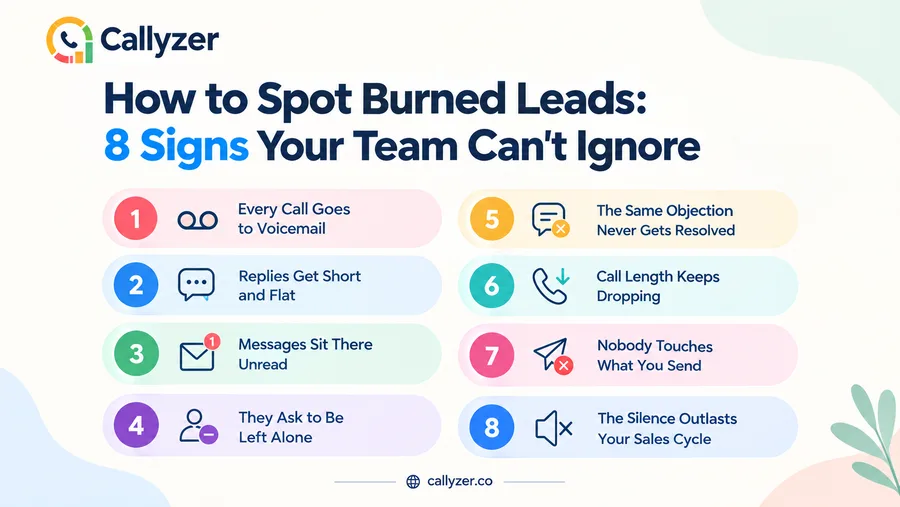
Most agents can feel it when a lead has gone cold. But that instinct doesn't scale across a thirty-person floor, and it definitely doesn't show up in a monthly report. You need patterns you can actually point to. Here are signs a sales lead is burned, the kind that shows up again and again once you start checking call logs.
1. Every Call Goes to Voicemail
One missed call means nothing. People miss calls constantly. However, five consecutive tries during different times of the day – in the morning, during lunch and even in the evening – reveal another picture. This kind of behavior typically signifies the fact that the number is being observed and the call is purposefully ignored. The change needs to be compared to the history of the lead – from answering calls to never picking up – in order to see the signal here.
2. Replies Get Short and Flat
Watch how the actual conversation changes over time, not just whether it happens. Early calls usually run long, with the prospect asking questions and volunteering details about their situation. A burned lead's replies shrink down to "not now," "I'll call back," or a flat yes and no with nothing behind it. The tone stays polite most of the time, which is exactly why teams miss it. It doesn't look like rejection. It looks like a busy person, until you notice it's happened on the last four calls in a row.
3. Messages Sit There Unread
If your team uses WhatsApp or email alongside calls, this one is easy to check and easy to miss. A lead that's genuinely still interested tends to open a message within a few hours, even if they don't reply right away. A burned lead lets read receipts stall for days, or the message sits unopened entirely. Track this alongside call attempts rather than on its own. One unopened message could mean a busy week. A pattern across every channel means the person has mentally checked out.
4. They Ask to Be Left Alone
Some leads say it outright: a polite "please stop calling" or a request to be taken off the list. Others don't say anything and just block the number. Either way, this is the clearest signal on the list, and it's also the one teams are most likely to override because closing the deal still feels possible. It usually isn't. Respecting this signal costs you one lead. Ignoring it tends to cost you a complaint, a bad review, or a referral that never happens.
5. The Same Objection Never Gets Resolved
A single objection is normal. A repeated one that nobody addressed is a warning sign. If a prospect flagged a price concern three calls ago and the last two calls went straight back to the pitch instead of actually answering it, the prospect has likely already made up their mind and is only being polite by staying on the line. Check the call notes for this specifically: an unresolved objection that keeps reappearing word for word is a stronger signal than almost anything else on this list.
6. Call Length Keeps Dropping
Duration is one of the easiest things to track over time, and it's often the first thing to move before anything else looks obviously wrong. A conversation that ran five or six minutes in the first two calls and now wraps up in twenty seconds has lost most of its substance, even if the lead is still technically answering. Falling call length combined with flat responses is a stronger indicator together than either one is alone.
7. Nobody Touches What You Send
Demo links, brochures, pricing sheets, product comparisons, whatever gets sent after a call is meant to move the conversation forward. When none of it gets opened or clicked, despite repeated sends, the lead isn't evaluating your offer anymore. This is worth checking against your CRM or link-tracking tool directly rather than assuming, since agents sometimes keep sending the same materials out of habit long after a lead has stopped looking at any of it.
8. The Silence Outlasts Your Sales Cycle
Every product has a rough average time from first call to close. If that number is three weeks for your team and a lead has gone quiet for six with zero contact, something in the process broke well before this point. Use your own historical average as the benchmark here rather than a generic number, since a three-week cycle and a three-month cycle mean very different things for how long silence should be tolerated before you call it burned.
None of these signs alone means much. But two or three showing up on the same contact at the same time are usually the signs of a burned lead, not just a slow one.
This pattern matters beyond the pipeline, too. When a team keeps working dead contacts without realizing it, targets slip, and agents get blamed for numbers nobody could have hit. That's a big part of what feeds team lead burnout, since managers end up defending performance they never had real control over in the first place.
Catch These Signs Before Your Agents Do It Manually with Callyzer
Callyzer tracks all of this on its own, how often calls happen, how fast replies come back, how long each call runs. So if a lead starts going quiet, it shows up on the dashboard right away, before an agent even notices.
Burned vs Dead: When a Lead Is Actually Gone
It's worth being precise about this distinction, because the two need completely different handling. Dead leads were never going to convert, no matter what your team did, wrong budget, no real authority to decide, or a need your product genuinely doesn't solve. A burned lead is different. Real interest existed at some point, and it wore down because of how the lead was handled, not because the fit was wrong.
| Dead Lead | Burned Lead | |
|---|---|---|
| When it shows | Signs of a dead lead appear on the very first call | Builds up gradually, over several calls |
| Root cause | Mismatch between the lead and the product | Poor handling: over-calling, repeated pitches, broken callback promises |
| Worth reviving? | Almost never | Often, with the right timing |
| What to do | Archive it and move on | One careful, well-timed re-approach before letting it go |
That last row is really the point of the table. A dead lead consumes no more of your time once it's flagged. A burned lead still has value left in it, provided the next attempt doesn't repeat whatever cost you the first shot.
Why Better Qualification Stops Leads From Burning in the First Place
Most of these cases trace straight back to weak qualification at the very start. When agents chase every inbound number with the same urgency, the genuinely good leads get buried under the noise, and they end up over-called or handled carelessly along with everything else.
Proper sales lead qualification comes down to asking the right questions early, before a lead ever lands on someone's daily call list:
- Budget. Can they realistically afford what you're selling, or is this a stretch that stalls out later?
- Timeline. Are they looking to decide this month, or six months from now?
- Decision-maker. Is this person actually the one who signs off, or will the deal need someone else's approval down the line?
- Actual need. What problem are they trying to solve, in their own words, not the version you're pitching?
A lead that's checked against these gets the right amount of attention: not too little, and not so much that it starts to feel like harassment.
Teams that qualify consistently burn far fewer leads, mostly because agents stop guessing who deserves a callback today. If your floor is stretched thin and everyone's just working the list top to bottom, a few sales productivity techniques around call prioritization can cut down on a lot of that guesswork.
Can You Bring a Burned Lead Back? Lead Reactivation That Works
A burned lead isn't always gone for good. Circumstances shift. A budget that didn't exist six months ago gets approved. A competitor lets them down. The person who said no last time gets replaced by someone with a completely different view of the problem.
Reactivation works, but only if it doesn't repeat whatever burned the lead the first time. A few things that actually move the needle:
- Give it time. A week later feels like you never stopped. A few months later feels like a real check-in.
- Lead with something new. A product update, a different offer, or a case study relevant to their situation gives them an actual reason to pick up, instead of the same old pitch.
- Keep the first message short. Nobody wants a long call from a number they already tuned out once.
- Switch the channel. If calls were what wore them down, try a message first. One recent benchmark study of Indian SMBs found WhatsApp messages get opened around 98% of the time versus roughly 22% for email, and that two-thirds of businesses now get more first responses on WhatsApp than on calls. That gap alone makes it worth trying before you give up on a lead.
Getting the first re-approach right matters more than people think. A few solid Sales call scripts built specifically for cold re-engagement can be the difference between a second chance and a second rejection.
Catching a Burned Lead Before It Costs You
The real fix isn't getting faster at reviving cold contacts. It's noticing the pattern before a lead ever gets there, watching call frequency, response gaps, and conversation length as they happen, not three weeks later when someone finally opens the CRM to see what's going on.
That's genuinely hard to track by hand across a floor full of agents making dozens of calls a day. A proper lead management software for telecalling teams gives you visibility into call patterns, response times, and follow-up gaps in one place, so you catch a cooling lead while there's still time to change the approach, instead of finding out only after it's gone quiet for good.
Most leads don't burn themselves. Someone on the team, without meaning to, usually does the burning. Once that pattern is visible early, fewer good leads end up as dead weight nobody noticed until it was too late.
Frequently Asked Questions
What is a burned lead in sales?
This is a prospect who was once interested in your product, but has now lost interest because of the way you treated them and not because they no longer needed the product. There is normally an exact cause for the loss of interest; maybe there have been too many calls made within a short span of time, a repeated pitch that did not answer any question of theirs, or even a call back that never happened. The person didn't just wander off on their own. Something in the process pushed them there.
How can you identify a dead or burned lead?
The two show up differently once you know what to look for. A dead lead reveals itself on the very first call, no budget, nobody with real authority on the line, or a need your product simply doesn't touch. A burned lead is trickier because early on it just looks like someone who's busy: calls that used to get picked up start going to voicemail, replies get shorter and flatter over a few calls, messages sit there unread. One of those alone doesn't tell you much. Two or three of them showing up on the same contact usually does.
Can a burned lead be reactivated?
Often, yes. The interest isn't always lost forever; it's just waiting for a trigger that will reignite it, such as a budget that got approved, a competitor failing to live up to its promises, or someone else taking their place with a new perspective on things from the old contact's previous point of view. Don't try getting through to them by using the same pitch that bored them to tears in the first place. Give it some time and make your next offer new and different.
How can CRM data help identify dead leads?
Most of what you need is probably already sitting in the CRM. Call frequency, gaps in response time, how long conversations are running, whether anyone's actually opening the follow-up material you send, all of that tells you a lot more than one agent's gut feeling about a contact. The part teams usually miss is checking it on a regular schedule instead of only after a deal has clearly gone cold for months, by which point it's often already someone else's win.
How can sales teams reduce wasted calls to unqualified leads?
Mostly by qualifying properly before a lead ever lands on someone's daily call sheet, not three weeks into chasing it. A handful of questions up front, budget, timeline, who actually makes the decision, what problem they're really trying to solve, keeps agents from putting equal effort into every number regardless of how likely it is to go anywhere. Teams that build this in from the start end up with far fewer calls going to people who were never going to say yes in the first place.