
Most credit card sales calls fail in the first 10 seconds. This blog breaks down exactly why and what to do instead. This guide covers the top mistakes to avoid, a proven 4-step sales framework, WhatsApp + call combo strategies, and ready-to-use scripts to handle the most common objections for improving credit card sales.
Everyone hates spam calls bugging them in the middle of their work day. It’s a fact you cannot ignore.
But you have to call, convince, and sell credit cards to make a living. Right? So, how to convince customers to buy a credit card on a call?
To convince, ask about their spending habits before you pitch anything. Listen to their answers. Then talk about what fits them.
A homemaker? Talk about grocery cashback. A business owner? Talk about the fuel surcharge waiver. A first-time cardholder? Talk about fraud protection.
Not every call ends in a sale. That's normal. But you can get better at this. Learn the right tactics. Follow a proven framework.
Below, you'll find common mistakes to avoid. A framework for how people decide to buy. And scripts and pitches you can use on your next call."
TLDR
- People hate credit card sales calls.
- You need to be valuable and creative in your opening line.
- Introduce yourself (not your company) and share references in the first 10 seconds of getting on a call.
- Personalise your 'standard’ script to cater to their problem;
- Rope in their interest and keep following up.
- The biggest lesson in how to sell credit card on call is simple: stop sounding like a scripted sales agent and start sounding human.
Mistakes to Avoid While Trying to Convince a Customer
Most credit card sales pitch calls I receive every day follow a similar pattern:
- Say their name and bank name.
- Ask if I need a credit card.
You know the result: I either don't pick up, or when I do (when I am in the middle of deep work, even to not look at the TrueCaller spam reminder), I say 'nahi chaiye' and cut the call.
Do you know why you also receive the same treatment?
Well, because you are not making any effort to make it about your prospect. Here are three mistakes you might make (like millions of other telecallers trying to push an average Indian to buy a credit card).
Telecalling Mistake #1: Trying to Sell Straightaway
No one cares about what you want to sell them, even if it’s for free. You can’t just blurt out your offer and get done with it.
Telecalling Mistake #2: Not Giving Enough Context
Most telecallers just start pitching without explaining why they called or how they got your number. No context, no reason, no introduction. Even your closest friends say "bhai, ek kaam tha" before calling. Why should a sales call be any different?
Want to improve your credit card sales conversions?
Use smart call tracking, team monitoring, and real-time analytics to understand customer conversations and close more deals faster.
Telecalling Mistake #3: Not Valuing Other’s Time
Most people you call are in their office, just like you. Imagine how your manager would feel if you were busy chattering with a random dude on call during work hours. (The reason why you get an unresponsive tone or hasty disconnects.) Try to get into their shoes and find another way to be more valuable.
So, what to do then?
Well, first of all, understand their pain point and context and gather some good reasons to be calling.
Then, follow the framework below:
A Proven Framework to Improve Your Chances of Sales on a Call
You can keep playing the calling game blindly or improve your odds by trying something that has worked for millions of successful teams around the globe.
Here are some practical credit card sales tips that can genuinely improve your conversion rate on calls.
Step 1: Always confirm their name
Don’t be a parrot when calling a prospect. Instead of just blurting out your sales script, be human and sound like one.
Slow down, and always confirm their name when they pick up your call. You can use an opening line like the one below:
“Hello! Kya Meri Baat ‘xxxxx’ (Your Prospect’s Name) Ji Se Ho Rahi Hai? |
This helps you create a sense of familiarity with your prospect, which will reduce the chances of the call being disconnected by the prospect.
Here's a sample credit card sales script for telecallers that can assist you in persuading your customers:
Anjali: Good Morning! I'm Anjali. Am I speaking to Mr. Raj Patel?
Raj: [Wait for the response]
Anjali: Thank you, sir. You're one of our most valued customers, so I'd like to share an exclusive offer with you. Do you have two minutes to hear me out?
Raj: [Wait for the response]
Anjali: Our Platinum Credit Card offers some great benefits like extra rewards on online spends, food delivery, and travel. Since you frequently shop online, this could save you quite a bit every month.
[If Negative Response]Anjali: No worries, sir. Even if you're not interested now, just let me know if you change your mind, or share with someone who might be interested.
Raj: [Wait for the response]
Anjali: Thank you, sir. Have a great day!
[If Positive Response]Anjali: Glad to hear that, sir! Let me send you all the details and benefits on WhatsApp right now so you have everything in front of you. Once you've gone through it, I'll call you back to answer any questions. Does tomorrow at a convenient time work for you?
Raj: [Wait for the response]
Anjali: Perfect! I'll send the details right away. Once you're comfortable and happy with everything, we can take the next step together — the application process is very simple and can be done from home with minimum paperwork.
Raj: [Wait for the response]
Anjali: Thank you for your time, sir. I'll follow up tomorrow. Feel free to reach out on WhatsApp anytime before that. Have a wonderful day!
Looking for opening lines to convince customers to buy a credit card? Check our recent blog on the best opening lines to convince a customer on call.
Step 2: Introduce yourself and your references, if any
If you want to overcome objections in sales, it’s always good to have a reference or two when you call a cold lead. It helps turn them into a warm lead.
For example, when you call someone and start sharing your offer, they are mostly confused or irritated about why you called them in the first place.
But when you tell them that you got their number from a 'so and so' person as they were looking for a credit card, they are more attentive to hear (as you are talking about a solution useful to them). You can use a sales script as below:
Anjali: Hello Sir, I'm Anjali, and I represent XYZ Bank. I got your reference from Mr. Samir Ahuja, he mentioned that you are looking for a platinum credit card.
[Wait for the response]
Anjali: Our company has been serving customers like yourself for 20+ years. Today, I'm excited to share valuable information regarding our platinum credit card offerings.
Step 3: Show Them You Know Them and Personalise
As said earlier, most telecallers are in a rush to blurt out their dull 'calling script'. Well, that's a blunder in 2026 when customers prefer brands and businesses personalising everything.
Indian consumers are notorious for not being loyal. We all know how soon we can ditch a brand if competitors offer better deals. Remember this while calling a prospect, personalise whatever deal you offer.
A good way is to show them that you know what they need (be empathetic) and personalise the offer.
For example, if you know that the prospect loves to travel, tell them how much they can save when they pay using your credit card.
A big part of learning how to sell a credit card to a customer is understanding their lifestyle before pitching benefits.
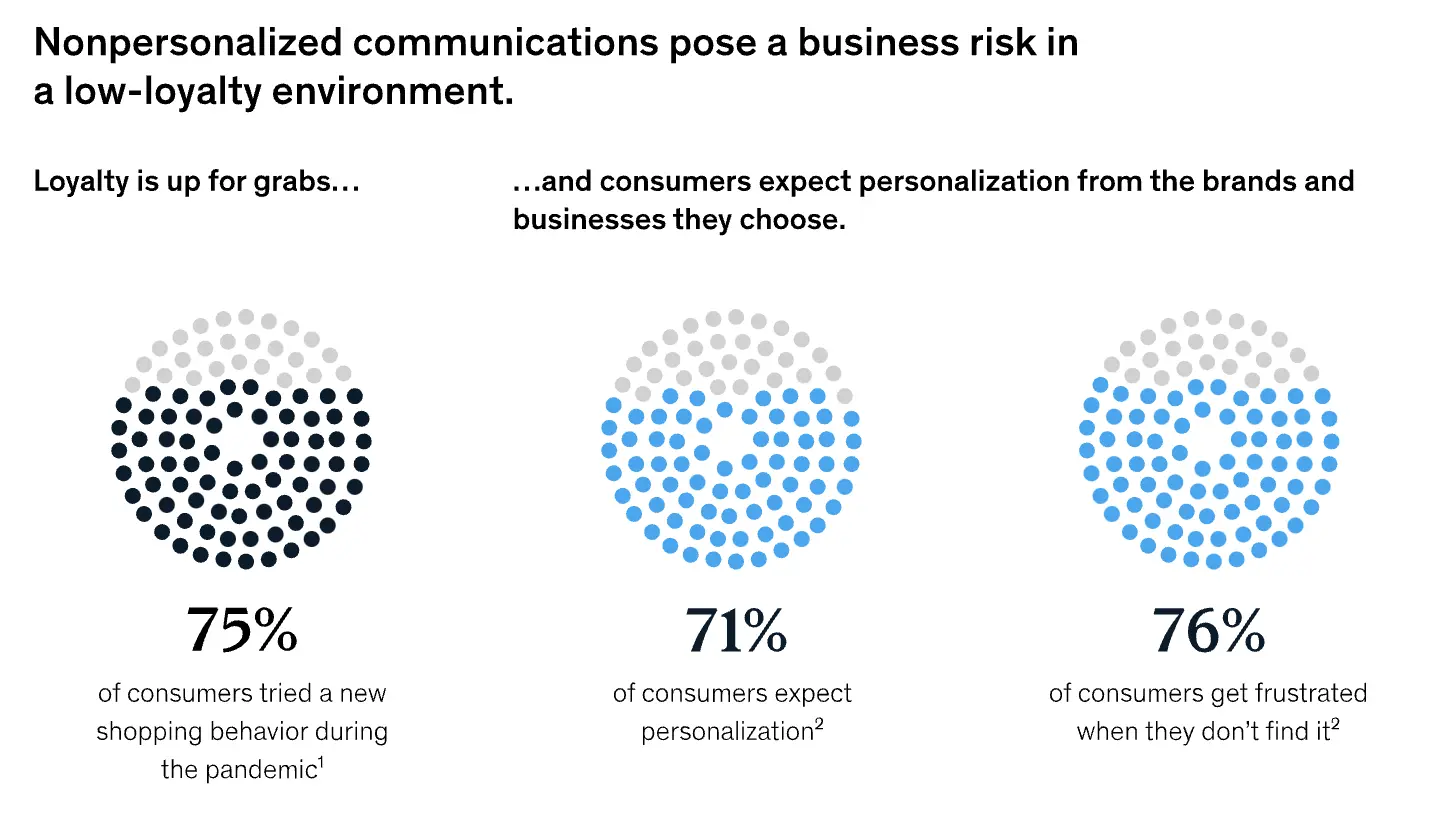
(Source: McKinsey on Personalization)
You'll need to do a bit of research on what they are looking for before even hopping on a call. This is called audience research and is an important element of succeeding as a sales or telecalling representative.
Step 4: Find a reason to follow up and continue the conversation.
The majority of Indians are not quick decision-makers, which means no one will agree to buy after just a few minutes of conversation. Instead, they need time to evaluate their options, think about them, and finally proceed with the decision.
In such a situation, you can push hard to 'close' right on the call and fail miserably or open an opportunity to schedule a call with them again. You need to be attentive to understanding their objections and grab the opportunity to call them again.
For example, if they say that they are in the office and are busy, ask them for a suitable time to call tomorrow (or on the weekend). Most of the time, this works. Plus, you get to research them more and personalise your offer further.
Anjali: I completely understand, Raj. Since you're busy at the office, how about we schedule a call for tomorrow when you have some free time? Or perhaps the weekend would be more convenient for you?
Raj: Yes, that sounds like a good idea. Can we schedule a call for tomorrow afternoon around 3 PM?
Anjali: Of course, I'll make a note of that. Before I let you go, do you have any specific preferences or questions you'd like me to address during our call tomorrow?
Raj: Actually, I'm particularly interested in learning more about the travel benefits of the platinum credit card you mentioned.
Anjali: Perfect. I'll be sure to provide you with detailed information about that. Also, feel free to let me know if there's anything else you'd like me to look into. I'll make sure to personalise our conversation based on your interests and preferences.
Raj: Thank you, Anjali. I appreciate your understanding.
Anjali: It's my pleasure, Raj. I'll follow up with you tomorrow at 3 PM. Have a great day!
Raj: You too, Anjali. Goodbye!
It might sound counterintuitive to not 'close' the sale immediately, but trust me; the customer would appreciate the time you give them. This can even result in a good relationship, which opens up the gates for multiple referrals in the future.
Credit Card Sales Pitch Examples for Different Customer Types
For a Young Salaried Professional
Anjali:Good morning! Myself Anjali, calling from [Bank Name]. Am I speaking with Priya?
Priya: Yes, speaking.
Anjali: Priya ma'am, I got your number through the pre-approved customer list, based on your account history. Two minutes of your time? (Tells her exactly why she's being called — gives her a reason not to hang up.)
Anjali: Quick question, ma'am — do you order more on food delivery apps, or shop online more?
Priya: Food delivery, mostly.(One either-or question. Whatever she says decides which benefit I lead with next.)
Anjali: Then you'll like this — want to know how to get cashback every time you order in?
Priya: Yeah, tell me.(Asking if she wants to know more,but do not dump every feature on her at once.)
Anjali: 5% cashback on food delivery and online shopping, up to ₹1,000 a month.
Priya: Only up to ₹1,000? And what's the fee?
Anjali: ₹499 a year, waived completely once you cross ₹1,00,000 in spending — at your ordering pattern, that happens faster than you'd think.
Priya: Okay, makes sense.
Anjali: I'll send the link right now — confirm your details, and the card reaches you in 3-4 working days.
For a Self-Employed / Small Business Owner
Anjali:Good afternoon, sir! Myself Anjali, calling from [Bank Name]. Am I speaking with Suresh ji?
Suresh: Yes, tell me.
Anjali: Sir, I have your details from our merchant records — you run a shop, correct? Two minutes? (Grounds the call in something real about him, not a random pitch.)
Anjali: Quick question, sir — right now, are supplier bills and fuel mostly cash, or do you already use a card for that?
Suresh: Mostly cash only, for now. (His answer tells me exactly which pain point to hit — fuel surcharge, no expense tracking.)
Anjali: Then this could actually save you money — want to know how business owners like you are cutting fuel costs with this card?
Suresh: Go on.
Anjali: Zero fuel surcharge, higher credit limit for supplier payments, and every transaction tracked separately from personal spends.
Suresh: Sounds good — what's the annual fee? (He's asking about cost now, not whether he wants it — that shift means he's already decided.)
Anjali: ₹999, sir, waived if business spending crosses ₹2,00,000 in the year — for a running shop, that's usually a few months, not a full year. Suresh: Okay, sounds reasonable.
Anjali: Sending the application on WhatsApp now — fill in your basic details, and someone collects your documents from the shop directly.
For a Homemaker Managing the Household Budget
Anjali:Namaste, ma'am! Myself Anjali, calling from [Bank Name]. Am I speaking with Meena ji?
Meena: Yes, who is this?
Anjali: Ma'am, calling about an offer for existing account holders — two minutes?
Meena: Haan, tell me.
Anjali: Quick question, ma'am — is most of your monthly spending on groceries and bills, or a bigger chunk on things like school fees?
Meena: Mostly groceries, milk delivery, electricity bill only. (Her answer decides whether I pitch daily-spend cashback or a card built for occasional big expenses.)
Anjali: Then this is built for exactly that — want to know how you get cashback every time you pay for groceries or bills?
Meena: Yes, tell me.
Anjali: 5% back on groceries and utility payments, and you can add your husband as a secondary cardholder free — his spending earns rewards too.
Meena: Achha, but any yearly charge?
Anjali: ₹499, ma'am, but you'll get that back in cashback within a few months at your spending pattern.
Meena: Let me discuss it with my husband once.
Anjali: Of course. Should I call back tomorrow evening, once you've both spoken? (Not pushing for a yes on the spot — locking a specific follow-up instead of leaving it open.)
For a Senior Citizen / First-Time Card Holder
Anjali:Good morning, sir! Myself Anjali, calling from [Bank Name]. Am I speaking with Mr. Sharma?
Mr. Sharma: Yes, speaking.
Anjali:Sir, two minutes — is that alright?
Mr. Sharma: Okay, go ahead.
Anjali: Sir, can I ask — do you already use a credit card, or would this be your first one?
Mr. Sharma: No, never used one. Not really interested also, to be honest.(A direct no needs a direct question back, not a pitch.)
Anjali: Fair enough, sir — can I ask why? Haven't needed one, or is it more about safety?
Mr. Sharma: Mostly worried about fraud only, and don't want anything complicated, beta.
Anjali:That's exactly what this card is built around — want to know how it keeps you protected?
Mr. Sharma: Go on.
Anjali:Every transaction sends an instant SMS alert, and there's a direct helpline if anything looks wrong — no app needed.
Mr. Sharma: And if I don't understand how to use it? (He's asking about using it now, not whether he wants it — that's the shift that matters.)
Anjali:Exactly like your debit card, sir — tap and pay, or hand it over at the counter. Our helpline team can walk you through it in Hindi too.
Mr. Sharma: Okay, that sounds fine.
How Do You Combine WhatsApp and Calls to Convert Credit Card Leads?
You're good at your job. You know the product, you know the pitch, and you genuinely want to help your prospect get a great deal.
But none of that matters if they don’t pick up your call. Indian prospects receive countless spam calls every day, which makes them naturally cautious.
Many new telecallers ask: how do you sell a credit card to a customer who never answers unknown calls? The answer is simple — stop sounding like a stranger before the conversation even begins.
That’s exactly what the WhatsApp + Call strategy below helps you do.
The 3-Step Combo That Actually Works
Step 1 — Warm them up on WhatsApp before calling
Don't let your number be just another unknown caller. Send a short, friendly message first so when you call, they already know your name.
"Hi [Name] ji, I'm Anjali from XYZ Bank. I have a quick offer on our Platinum Credit Card that I think you'll genuinely find useful, especially the travel rewards. Can I call you for 2 minutes at your convenience? "
Short. Friendly. No pressure. That's all it takes.
Step 2 — Call within 30 minutes of the message
Strike while the message is fresh. The moment they read it, you're no longer a stranger, you're someone they're expecting. When they pick up, reference your message immediately:
"Hi [Name] ji, I'm Anjali — I just sent you a WhatsApp message. Did you get a chance to see it?"
That one line removes all the awkwardness. You're not cold calling anymore, you're following up. Big difference.
Step 3 — No answer? Follow up on WhatsApp — not with another call
This is where most telecallers go wrong, they call again and again until the prospect blocks the number. Don't do that. Instead, send a warm WhatsApp follow-up:
"Hi [Name] ji, I tried calling just now — no worries at all! I'd love to share details about our credit card offer whenever you're free. Just reply here and I'll call you back at a time that works for you!"
You've kept the door open. You've shown respect for their time. And you've given them a reason to come back to you.
Quick Tips to Make Every WhatsApp Message Count
- Keep it under 3 lines — anything longer gets ignored
- Always use their first name — it immediately feels personal
- Never send PDFs or brochures in the first message — it feels like spam
- Never message after 8 PM — respect their personal time
- Always give them the choice to respond at their convenience — it builds trust
Remember: every "no answer" is not a rejection. It's just a door that hasn't opened yet. Your job is to keep knocking but smartly!
At the end of the day, learning how to convince customers to buy a credit card is less about pressure and more about trust, timing, and personalisation.
What's the Best Time to Call Indian Customers for Credit Card Sales?
Call between 11 AM–1 PM or 4–6 PM — according to Callyzer's own data research on the best time to call customers in India, these windows consistently see higher pickup and connect rates than early mornings or late evenings.
Avoid lunch hours (1–2 PM) and Sunday mornings, when pickup rates drop sharply.
Before you dial, confirm the number isn't on the DND registry for promotional calls, and keep the card's fee structure and eligibility criteria open in front of you — Indian customers ask about hidden charges almost immediately, and hesitation on your end kills trust fast.
Credit Card Sales Scripts for Handling Objections
Most telecallers struggle with how to convince customer to buy credit card offers after the first objection appears.
Objections are not rejections. They are questions in disguise. Knowing how to overcome objections in sales is what separates average telecallers from high-performing ones.
Here are the 5 most common objections you'll face while selling credit cards and learn how to overcome them:
Objection 1: "I already have a credit card."
"That's great, sir/ma'am! Most of our best customers already have a card. The reason I'm calling is that our Platinum Card offers [specific benefit — e.g., higher reward points / lower interest / better travel perks] that most existing cards don't. Can I take just 2 minutes to show you the difference?"
Objection 2: "I don't need more credit / I don't believe in credit cards."
"I completely understand, sir/ma'am and I respect that. Our card isn't really about credit — it's more about saving money on things you already spend on, like groceries, fuel, and travel. You pay the full bill every month and still earn rewards. Would that kind of card interest you?"
Objection 3: "I'll think about it."
"Of course, sir/ma'am — it's an important decision. Can I ask what's holding you back? I'd love to address any doubts right now so you have all the information you need. And if it's okay, can I follow up with you tomorrow at a time that suits you?"
Objection 4: "I'm too busy right now."
"Absolutely, I understand — I'll be very quick. Just 60 seconds, and if it doesn't sound useful, I won't call again. Or if you prefer, can I WhatsApp you the details and call at a time that works better for you?"
Objection 5: "I've had bad experiences with credit cards / hidden charges."
"That's a very valid concern and honestly, I hear it a lot. Our card has zero hidden charges and a completely transparent fee structure — I'll send you the full details on WhatsApp so you can read it yourself before deciding anything. Fair enough?"
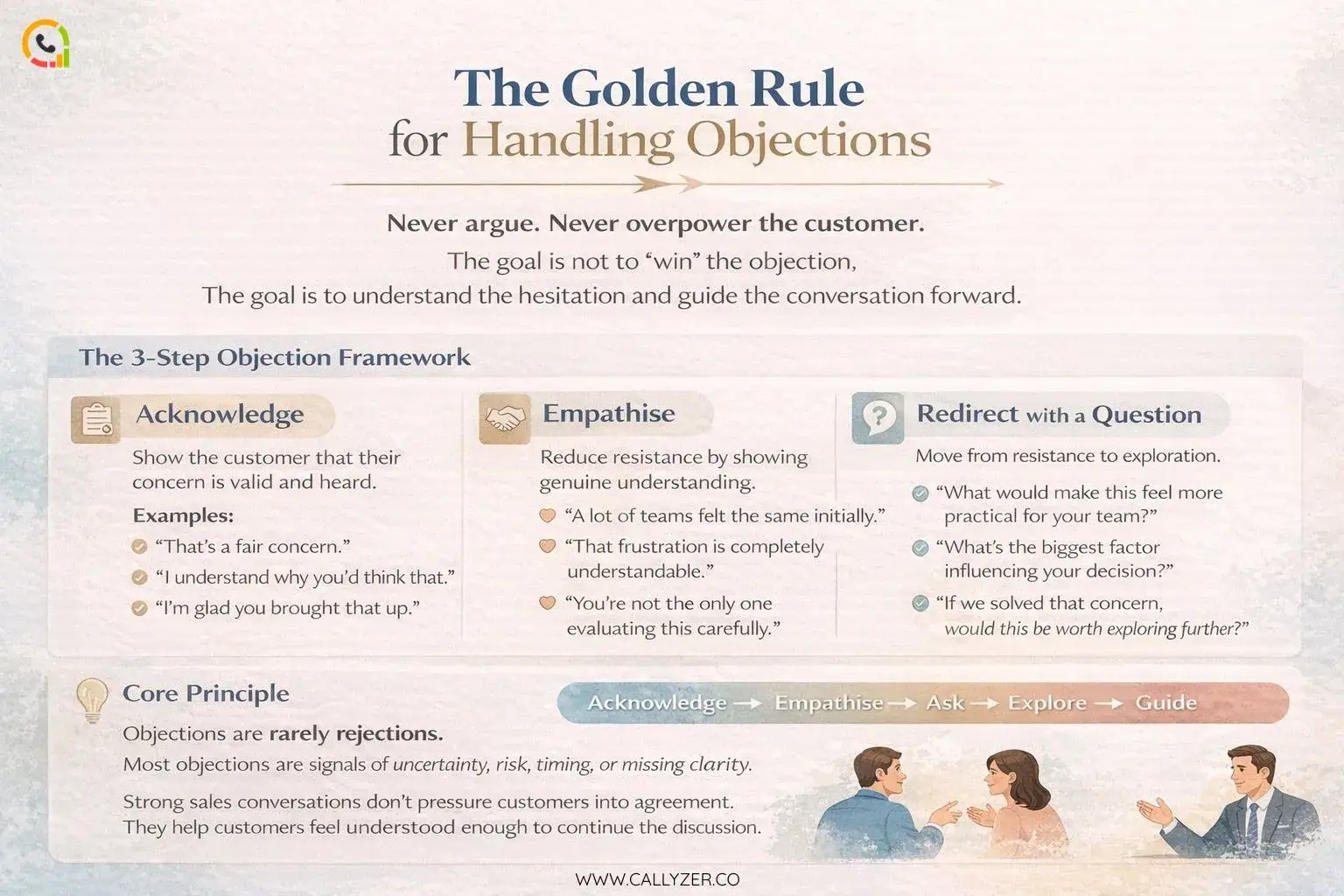
Understanding how to sell credit card to customer without sounding aggressive is what separates average callers from high performers.
Resources to Help You Convince Your Customers
Stop Guessing - Start Selling More Credit Cards with Callyzer
You now have the framework, scripts, follow-up strategies, and objection handling tricks. The next step? Getting full visibility of your calling activities to close even more deals.
That's exactly where Callyzer comes in.
For Telecallers
Selling credit cards is already tough so don't make it harder by losing track of your leads.
Callyzer helps you:
- Never miss a follow-up — get automatic reminders so no warm lead goes cold.
- Know your own numbers — see how many calls you made, connected, and converted into sales.
- Stay organised — all your leads and call history in one place, right on your phone. Instead of juggling sticky notes and spreadsheets, modern sales teams rely on telemarketing software to manage leads, track calls, and improve follow-ups efficiently.
- Improve your pitch — listen back to your own calls and spot where prospects drop off. This helps you improve your conversation ability.
The best telecallers don't just call more — they call smarter!
For Sales Managers
Managing a team of telecallers without visibility is like driving blindfolded. Callyzer gives you the dashboard you've always needed. For growing telecalling teams, using the best call monitoring software can significantly improve follow-ups, agent coaching, and overall conversion rates.
Callyzer helps you:
- Track every agent's activity — Every agent’s calling activity, their call duration, how many leads are pending to be contacted.
- Spot your top performers — Spot your top performers by comparing key metrics side by side — total calls made, average call duration, connection rate, follow-ups completed, and leads converted. See exactly which agent is doing what — and replicate that winning behavior across your entire team.
- Coach in real time — Your agents could be in the next room or another city — Callyzer lets you review their call recordings and performance metrics and give precise feedback without ever being physically present.
- Reduce lead leakage — Callyzer's Follow-Up Alerts and Not Connected Reports show you exactly which leads haven't been reached yet, while Lead Management Reports track every prospect's follow-up status and call history — so no credit card sale ever goes cold.
- Make data-driven decisions — Callyzer's automated Daily Reports, Lead Conversion Stats, and Hourly Performance Insights tell you exactly what's working and what needs to change.
Your team is only as good as the system behind them.
Works on Your Android Smartphone — No Expensive Setup or Complex Hardware Required
Whether your telecallers are working from the office, home, or field — Callyzer works entirely from their Android smartphone. No desktop, no lengthy onboarding, no IT team needed. Every call tracked, every lead updated, in real time.
👉 Try Callyzer Free — See Your Team's Performance Today
FAQs
What role does call monitoring play in credit card sales?
Credit card sales live and die on conversations. Call monitoring lets you go back and listen to what actually happened on a call, not what you think happened. Over time, patterns emerge and you start seeing exactly where prospects lose interest, what objections keep coming up, and which openings work best.
How can telecalling software improve credit card conversion rates?
More often than not, a sale is lost not because the prospect said no but because nobody followed up at the right time. Telecalling software keeps your entire pipeline organised, reminds your team who to call and when, and makes sure no interested prospect is ever forgotten. Consistency is what converts, and software helps you stay consistent.
Can call analytics improve credit card sales performance?
When you start looking at your call data honestly, it changes how you work. You begin to see which agents are connecting more, which time slots get better responses, and how call duration relates to conversion. Instead of pushing your team harder, you start directing them smarter. That shift alone makes a real difference.
Why is conversation tracking important in selling financial products like credit cards?
Selling a credit card is not a one-call job. Prospects take time, ask questions across multiple conversations, and make decisions gradually. Conversation tracking makes sure your team always knows the full history before dialing again. It turns every follow-up call from a cold restart into a warm, informed continuation of an ongoing relationship.
How to improve credit card sales through telecalling?
The fundamentals matter more than most people admit. Call with context, personalise your pitch to the prospect's lifestyle, follow up without being pushy, and handle objections with patience rather than pressure. None of this is complicated but very few teams do all of it consistently. Build that discipline and the results take care of themselves.
How do you convince a customer to get a credit card?
Ask one question before you pitch anything — how they usually spend, cash or card — and let the answer decide which benefit you lead with. A generic pitch about rewards and points loses people fast; a specific one about cashback on the grocery or fuel spending they just described gets their attention. Give exact numbers only once they ask, not upfront — a customer asking "what's the fee" or "how much cashback" has already decided this is worth their time. Close with one clear next step, start the application now or book a callback for a specific time, rather than leaving it open.
What's the best time to call customers about credit card offers in India?
According to Callyzer's data research on the best time to call customers in India, calls between 11 AM–1 PM and 4–6 PM see the highest pickup and connect rates. Avoid lunch hours and Sunday mornings, when pickup drops sharply.