
- Track key sales call metrics such as call volume, connect rate, average call duration and conversion rate to measure dialing performance.
- Monitor conversation quality, follow-ups and speed to lead to understand how effectively your team handles potential customers.
- Review daily metrics to spot gaps and weekly trends to identify areas for improvement.
- Compare employee-wise performance to understand who needs support, better calling strategies or coaching.
- Use call reports and recordings to identify what is working and improve your team's sales conversations.
Making more calls does not always lead to more meetings or sales. What matters is how many people answer those calls, how many become interested, and how many agree to take the next step.
A study by Belkins analysed more than 175,000 cold calls. It found that only about 1 in 10 calls reached a real person, and only about 1 in 370 calls resulted in a booked meeting.
This shows why counting calls alone is not enough. Sales teams also need to understand what happens after each call.
Are people answering?
Are conversations lasting long enough?
Are callers following up with interested prospects?
This is where call tracking metrics help. They show how well your team is performing at each stage of the calling process. They also help managers identify problems, improve calling strategies and set better sales targets.
In this guide, we will cover eight important call tracking metrics for outbound sales teams. You will learn what each metric means, how to calculate it, what the benchmarks tell you and what you can do to improve the results.
Quick Answer: Which Call Tracking Metrics Should Sales Teams Measure?
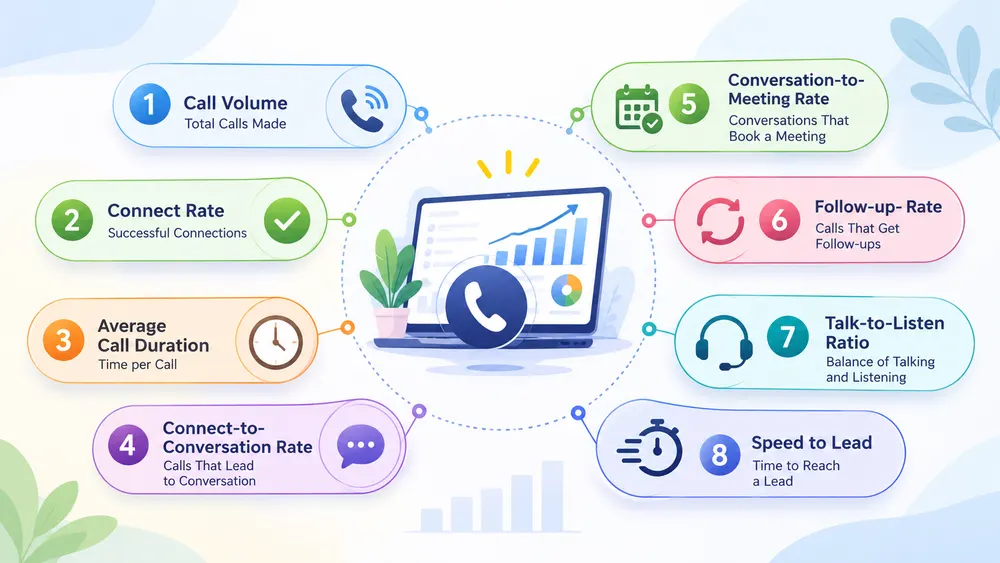
Here are eight important cold calling metrics that help you understand your team's calling performance:
- Call volume: The total number of calls made by an employee or the entire team.
- Connect rate: The percentage of calls that reach a live person.
- Average call duration: The average time spent on connected calls.
- Connect-to-conversation rate: The percentage of connected calls that turn into meaningful conversations.
- Conversation-to-meeting rate: The percentage of meaningful conversations that result in a meeting or demo.
- Follow-up rate: The percentage of leads that receive their scheduled follow-up on time.
- Talk-to-listen ratio: The amount of time callers spend speaking compared with the time prospects spend speaking.
- Speed to lead: The time taken to contact a new lead after receiving an enquiry.
A few benchmarks worth knowing:
- Cold calling: Belkins found that approximately 1 in 10 cold calls reached a live person, while 1 in 370 resulted in a meeting.
- Indian calling data: Callyzer's analysis of more than 5 crore (50 million) calls found an average connect rate of 46–48%.
- Best calling time in India: Callyzer's data shows that 5 PM on weekdays has the highest connect rate, at 61.79%.
- Biggest improvement areas: Check your contact list, calling time, phone number reputation and follow-up process before changing your sales script.
What Are Call Tracking Metrics?
Call tracking metrics are measurements that show how effectively your sales team handles business calls. They help managers understand how many calls employees make, how many people answer, how long conversations last and how many calls lead to a business opportunity.
For example, imagine that a salesperson makes 100 calls in a day. Out of these, 40 people answer, 20 have meaningful conversations and 3 agree to a product demo.
Each of these numbers tells you something different about the salesperson's performance.
- The number of calls shows how active the salesperson is.
- The number of connected calls shows how many people the salesperson reaches.
- The number of meaningful conversations shows how well the salesperson engages prospects.
- The number of demos booked shows how effectively those conversations lead to the next step.
A call tracking system records call details automatically and uses this information to calculate different call performance metrics. Managers can then review these numbers through reports and dashboards instead of depending entirely on manual updates from employees. This visibility is a big part of why call tracking matters for growing sales teams.
One important distinction: The term call tracking has two common meanings. Some marketing platforms use it to identify which advertisement or campaign generated a phone call. This is called marketing call attribution.
This guide focuses on a different use of call tracking: outbound call tracking, which measures sales calls made by employees to customers and prospects.The goal is to understand calling performance and improve the sales process.
What Does a Healthy Sales Calling Funnel Look Like?
Before looking at individual sales dialing metrics, it helps to understand how a sales call moves towards a meeting.
Not every call reaches a customer. Not every connected call becomes a conversation, and not every conversation leads to a meeting.
This step-by-step process is called a sales calling funnel. It shows how prospects move from the first call to the final outcome.
A Belkins study of more than 175,000 cold calls made in 2025 provides a useful example of this funnel.
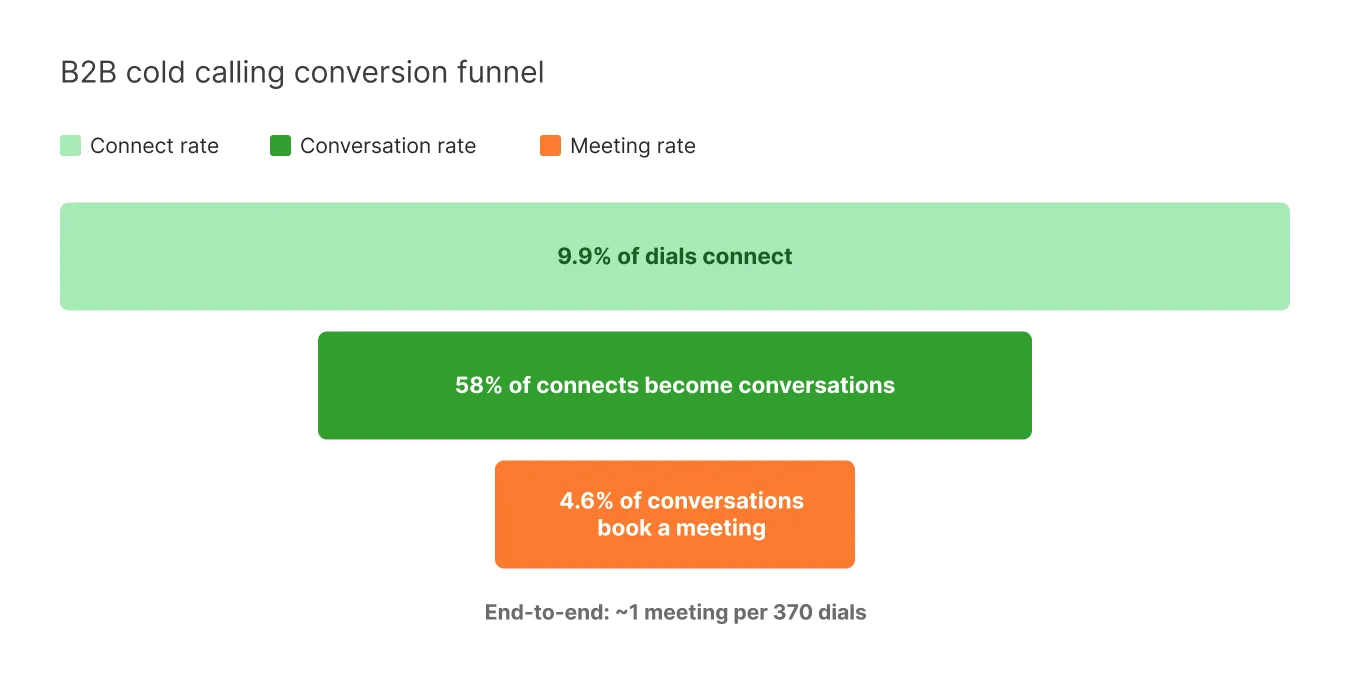
How to understand these numbers
The study shows that:
- Approximately 1 in 10 calls reaches a live person.
- Of the connected calls, around 58% turn into meaningful conversations. These are conversations where the prospect engages with the caller instead of ending the call after a greeting.
- Around 4.6% of meaningful conversations result in a booked meeting.
This means that a team can make hundreds of calls and still book only a few meetings. The biggest challenge may not be reaching people. It may be turning conversations into business opportunities.
Why Do Call Connect Rate Benchmarks Differ?
You may notice that different research reports show very different connect rates. This happens because studies use different datasets, countries and definitions of a connected call.
For example:
- Belkins reported a connect rate of approximately 9.9% in its cold calling study.
- Callyzer's analysis of more than 5 crore Indian calls found an average connect rate of 46–48%.
These numbers should not be compared directly. The first two studies mainly cover cold calling campaigns in Western markets, while Callyzer's data represents business calling activity in India. The contact lists, calling practices and definitions of a successful connection may also differ.
Use these figures as reference points rather than fixed targets. Your team's own performance over the first month should become the baseline for future comparisons.
Ready to Improve Your Sales Team's Calling Performance?
Track Calls, Monitor Performance, and Convert More Leads with Callyzer.
Which 8 Call Tracking Metrics Should You Track?
Each metric helps you understand a different part of your sales calling process. Below, we explain what each metric means, how to calculate it, and what you can do to improve it. You will also find practical tips to help you get more value from your call data.
1. Call volume
Call volume is the total number of outbound calls made by a caller or an entire sales team within a specific period, such as a day, week or month. It helps you understand how many calls your team is making and whether they are meeting their daily calling targets.
However, a high call volume does not always mean better sales performance. You also need to know how many of those calls reached potential customers and resulted in meaningful conversations.
Formula: Call volume = Total outbound calls made during a specific period
Example: A caller makes 60 calls every day for five working days. Their weekly call volume is 60 × 5 = 300 calls.
What to do if it is low:
- Check how much time callers spend on tasks other than calling, such as searching for phone numbers, updating records or writing call notes.
- Set fixed calling hours so that callers can focus on making calls without frequent interruptions.
- Prepare calling lists in advance so that callers do not waste time finding the next number.
Pro tips:
- Do not judge a caller's performance by call volume alone. Compare it with connect rate and conversion rate to understand the actual results.
- If a caller makes many calls but books very few meetings, check the contact list, calling time and sales pitch before assuming that the caller is not putting in enough effort.
- Review daily call volume for each caller to identify changes in calling activity early.
2. Connect rate
Connect rate is the percentage of calls that are answered by a live person. Calls that go unanswered, reach a switched-off phone or end without anyone answering are not counted as connected calls.
You can measure connect rate in two ways:
- Per-call connect rate: The percentage of total calls that connect. It helps you understand how well your contact list, phone numbers and calling times are performing.
- Per-person connect rate: The percentage of unique people your team reaches at least once, even if it takes multiple attempts. It shows how many people from your contact list are actually reachable.
Formula: Connect rate = (Connected calls ÷ Total calls made) × 100
Example: A caller makes 200 calls, and 40 are answered. The connect rate is (40 ÷ 200) × 100 = 20%.
What to do if it is low:
- Check whether your contact list is updated. If many calls reach wrong or switched-off numbers, clean the list before making more calls.
- Compare connect rates across different hours and weekdays. Schedule more calls during the time slots when people are more likely to answer.
- Check whether your business numbers are marked as spam by caller identification apps or phone networks. If a number is flagged, review its calling activity and take steps to improve its reputation.
- Do not call unanswered numbers repeatedly within a short period. Try again at a different time when the person is more likely to answer.
Pro tips:
- Track both per-call and per-person connect rates. This helps you understand how many additional people your team reaches through follow-up attempts.
- Monitor the wrong-number rate as well. It shows the percentage of calls that reach an incorrect number or the wrong person. A high rate usually means your contact data needs attention.
- Keep warm and cold leads in separate reports. Warm leads are people who already know your business or have requested a call, while cold leads are people your team is contacting for the first time. Their connect rates can be very different.
3. Average call duration (connected calls only)
Average call duration tells you how long your connected calls last on average. It helps you understand whether callers are having meaningful conversations or whether people are ending calls shortly after answering.
Calculate this metric using connected calls only. Including unanswered calls would reduce the average and give you an incorrect picture of how long actual conversations last.
Formula: Average call duration = Total talk time ÷ Number of connected calls
Example: A caller handles 10 connected calls with a combined talk time of 30 minutes. The average call duration is 30 ÷ 10 = 3 minutes.
What to do if it is low:
- Listen to the first 15 seconds of call recordings to understand why people are ending calls early.
- Improve the opening of the sales pitch. Clearly introduce yourself, explain why you are calling and give the prospect a reason to continue the conversation.
- Ask an open-ended question early in the call. This encourages the prospect to participate instead of simply listening to the pitch.
Pro tips:
- Compare the average duration of calls that resulted in meetings with calls that did not. This helps you understand what a productive sales conversation looks like.
- If one caller consistently has shorter conversations than others, review their call recordings and coach them on their opening pitch.
- Do not ask callers to make every conversation longer. A short call that ends with a clear next step is more valuable than a long call that leads nowhere.
4. Connect-to-conversation rate
Connect-to-conversation rate measures how many connected calls turn into meaningful conversations.
Not every answered call becomes a conversation. Sometimes a receptionist or assistant answers instead of the decision maker. In other cases, the person answers but disconnects before the caller can explain the purpose of the call.
This metric helps you understand how effectively your team turns answered calls into actual conversations with potential customers.
Formula: Connect-to-conversation rate = (Real conversations ÷ Connected calls) × 100
Example: A caller has 50 connected calls, out of which 30 turn into meaningful conversations. The rate is (30 ÷ 50) × 100 = 60%.
What to do if it is low:
- Review the opening lines of your sales pitch. Make sure callers explain the purpose of the call clearly and give people a reason to continue listening.
- Try to get the direct contact number of the decision maker instead of relying only on the company's main phone number.
- Train callers to handle conversations with receptionists and assistants politely. They can ask for the decision maker's availability or the best time to call.
Pro tips:
- Record calls answered by receptionists or assistants as a separate outcome. This helps you understand how often your team reaches someone other than the intended contact.
- Review the first 30 seconds of calls that ended early. Look for common problems in the introduction, tone or opening pitch.
- Identify the opening lines used by your best-performing callers and share them with the rest of the team.
5. Conversation-to-meeting (conversion) rate
Conversation-to-meeting rate measures how many meaningful sales conversations result in a booked meeting, product demo or another agreed next step.
This metric helps you understand how effectively your callers turn conversations into sales opportunities. Since it focuses on what happens after a person answers and engages with your team, it gives you a better idea of how well your sales pitch and objection-handling skills are working.
Formula: Conversation-to-meeting rate = (Meetings booked ÷ Real conversations) × 100
Example: A caller has 40 meaningful conversations and books four meetings. The conversion rate is (4 ÷ 40) × 100 = 10%.
You should also measure the meeting hold rate. Booking a meeting is only the first step. You also need to know how many prospects actually attend.
Formula: Meeting hold rate = (Meetings attended ÷ Total meetings booked) × 100
What to do if it is low:
- Compare recordings of your best and weakest callers through regular sales call monitoring. Pay attention to the questions they ask, how they explain the product and how they respond to customer objections.
- Train callers to handle common objections. An objection is a concern or reason a prospect gives for not moving forward.
- Encourage callers to end every meaningful conversation with a clear next step, such as booking a meeting or scheduling a product demo.
Pro tips:
- Use this metric to evaluate your sales pitch and conversation skills. A low conversion rate may indicate that callers need better product knowledge or objection-handling training.
- When you update your sales script, test the new version with a small group of callers for a week. Compare the results before introducing it to the entire team.
- If many booked meetings are not taking place, send a confirmation message immediately after booking and a reminder before the scheduled meeting.
6. Follow-up rate
Follow-up rate measures how many leads receive a follow-up within the expected time.
Not every prospect is ready to buy during the first conversation. Some may ask you to call later, while others may not answer your first few attempts. If your team does not follow up at the right time, these potential opportunities can easily be missed.
Tracking this metric helps you ensure that interested prospects and pending callbacks do not get forgotten.
Formula: Follow-up rate = (Leads followed up on time ÷ Total leads requiring follow-up) × 100
Example: Out of 20 leads that requested a callback, your team follows up with 15 within the agreed time. The follow-up rate is (15 ÷ 20) × 100 = 75%.
What to do if it is low:
- Set automatic reminders whenever a prospect requests a callback.
- Review pending and overdue follow-ups every morning so that callers know which leads need attention.
- Set a clear follow-up rule for your team. For example, every requested callback should be completed on the day agreed with the prospect.
Pro tips:
- Count callback requests and follow-up requests as positive outcomes. They show that the prospect is open to another conversation, even if a meeting has not been booked yet.
- Do not treat every unanswered call as a lost lead. The person may be busy or unavailable. Keep such leads in your follow-up list and try again at a different time.
- Send a short WhatsApp message between call attempts when appropriate. It can remind the prospect about your call and make the next conversation easier.
7. Talk-to-listen ratio
Talk-to-listen ratio measures how much time the caller speaks compared with how much time the prospect speaks during a conversation.
For example, a 60:40 ratio means the caller speaks for 60% of the conversation, while the prospect speaks for the remaining 40%.
This metric helps managers understand whether callers are having two-way conversations or spending most of the time explaining the product without understanding the prospect's requirements.
You can measure this using call recordings or conversation analytics software. Conversation analytics is one of the trends shaping the future of call tracking.
Formula: Caller talk ratio = (Caller talk time ÷ Total conversation time) × 100
Example: During a 10-minute call, the caller speaks for six minutes and the prospect speaks for four minutes. The talk-to-listen ratio is 60:40.
What to do if it is weak:
- Train callers to ask questions and give prospects enough time to answer instead of explaining every product feature.
- Prepare three open-ended questions that callers can use to understand the prospect's needs.
- Keep product explanations short. After explaining an important feature or benefit, ask a question to check whether it addresses the prospect's requirements.
Pro tips:
- Look for consistency across calls. A caller whose talk-to-listen ratio changes significantly may need help balancing product explanations with customer questions.
- Do not treat one particular ratio as a fixed target for every conversation. The ideal balance depends on the purpose of the call and the prospect's requirements.
- Review this metric along with call outcomes. If a caller spends less time speaking but still fails to move the conversation forward, the questions may not be effective.
8. Speed to lead (for inbound leads)
Speed to lead measures how quickly your sales team contacts a person after they show interest in your business.
For example, someone may fill out a form on your website, submit an enquiry through IndiaMART or request a product demo. The time between receiving that enquiry and making the first call is your speed to lead.
This metric is especially important for inbound leads because the person has already shown interest. A quick response helps your team connect while the enquiry is still fresh.
Formula: Speed to lead = Time of first call − Time the lead was received
Example: A person submits an enquiry through your website at 10:00 AM. Your sales team makes the first call at 10:04 AM. Your speed to lead is four minutes.
What to do if it is low:
- Automatically assign new enquiries to available callers and notify them as soon as a lead arrives.
- Assign a backup caller who can handle new enquiries when the primary caller is busy or unavailable.
- Create a process for enquiries received outside working hours. For example, add them to the top of the next working day's calling list.
Pro tips:
- Track the median response time, which is the middle value when all response times are arranged from shortest to longest. Also monitor the slowest 10% of responses to identify leads that take too long to reach.
- Set a response-time target for your team and review how often callers meet it.
- Prioritise calling new enquiries instead of relying only on emails or messages. A direct conversation gives your team an opportunity to understand the prospect's requirements and answer questions immediately.
Why Is Your Connect Rate Dropping?
A falling connect rate means that fewer outgoing calls are reaching live people.
The first reaction is often to increase the number of calls. However, making more calls will not solve the problem if the underlying issue is poor contact data, unsuitable calling times or phone number reputation.
Before increasing calling targets, check these five areas.
- Is your contact data outdated?
Incorrect phone numbers, inactive contacts and duplicate entries can reduce your connect rate.
Check how many calls are reaching the wrong person or an inactive number. If these numbers are high, update your contact list before making more calls.
- Are employees calling at the wrong time?
Prospects may be available at different times depending on their work schedules and industry.
Review your hourly and weekday reports to identify when people are more likely to answer. If most employees make calls during the same busy period, shifting some calls to another time slot may improve results.
- Are your business numbers being marked as spam?
People are less likely to answer numbers that appear as spam on their phones.
Frequent outgoing calls, low answer rates and customer complaints can affect the reputation of a business number. Check how your numbers appear on caller identification platforms such as Truecaller and review any available spam warnings.
- Are too many calls being made from one number?
Making a high number of calls from a single phone number can affect its reputation.
Review calling activity across your business numbers and avoid concentrating all outgoing calls on one number. Distribute calling activity responsibly and follow applicable telecom regulations.
- Are you mixing cold and warm leads?
Cold leads are people who have not interacted with your business before. Warm leads are people who have already shown interest, requested information or interacted with your company.
These two groups usually have different connect rates.
If you calculate one average for both groups, you may not understand how each group is performing. Measure them separately to get a clearer picture.
What Should Employees Do When a Prospect Does Not Answer?
An unanswered call does not necessarily mean that a prospect is not interested. The person may simply be unavailable.
I recommend the following retry routine as a starting point:
- Wait before calling again: Leave a gap of approximately 2–4 hours before the first retry instead of immediately redialling.
- Try a different time: If the first call was made in the morning, try again during the afternoon, preferably between 3 PM and 5 PM.
- Send a short WhatsApp message: A brief message explaining who you are and why you called can help the prospect recognise your number.
- Keep the lead in your follow-up list: Do not remove a lead simply because the first few calls went unanswered. Continue following up according to your sales process.
How Can Callyzer Help You Monitor These Call Tracking Metrics?
Knowing which call metrics to measure is only the first step. Sales managers also need a reliable way to review these numbers, compare employee performance and understand where their team is losing potential opportunities.
This is where Callyzer helps.
Callyzer turns everyday business calls made through regular SIM cards into structured reports that managers can use to monitor calling activity and sales performance. Employees continue using their existing Android phones and business SIM cards.
The Callyzer Biz app captures call activity and syncs the data with a central web dashboard, giving managers a clear view of team performance without depending on manual updates.
With Callyzer a call tracking software India, managers can:
- Measure calling activity: Review incoming, outgoing, missed, rejected and connected calls to understand how actively employees are handling business enquiries.
- Evaluate call connections: Compare connected calls with total calls to understand how often employees reach customers. This helps managers spot differences across employees and identify calling patterns that may need attention.
- Understand calling duration: Review total talk time, average call duration and individual call details to understand how much time employees spend speaking with customers.
- Compare employee performance: Access employee-wise reports to compare calling activity, connected calls, call duration and other key indicators. Managers can identify who may need support or coaching.
- Identify the best times to call: Analyse calling patterns by day and hour to understand when customers are more likely to answer. Teams can use these insights to plan calling schedules and follow-ups.
- Review actual customer conversations: Access call recordings along with call details to understand how employees handle enquiries, explain products, respond to questions and move conversations forward.
- Monitor lead follow-ups: Use lead management features, reminders and follow-up status to keep enquiries from being overlooked and give managers better visibility into the next action for each lead.
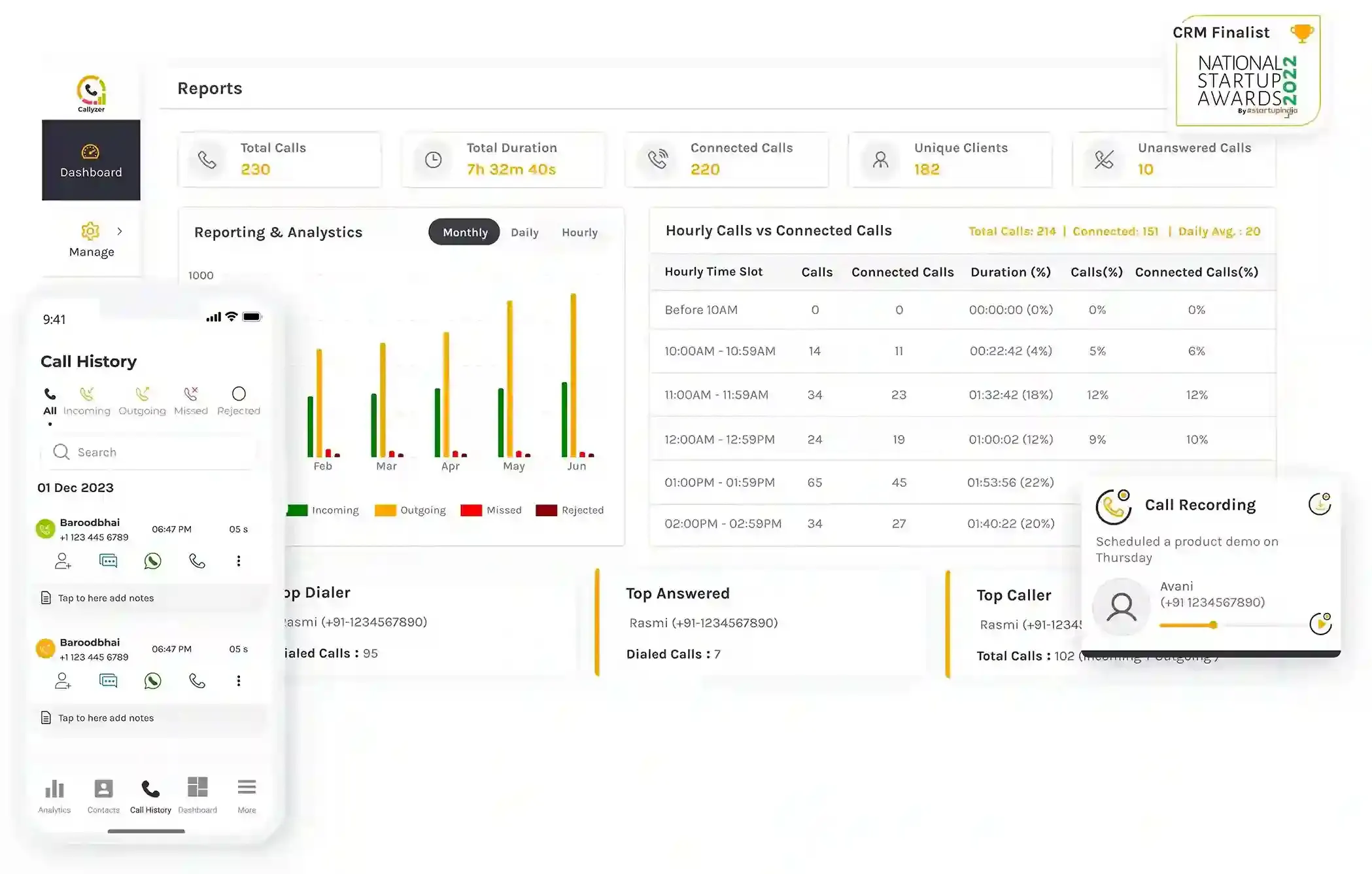
Together, these insights help managers look beyond the number of calls made. They can understand whether employees are reaching customers, how conversations are being handled and where the team needs to improve.
What is a simple daily and weekly metrics routine?
You don't need to review every sales call metrics every day. A simple routine helps managers spot problems early and understand overall team performance.
| Frequency | What to check | What to look for |
|---|---|---|
| Daily | Total calls, connected calls and missed calls | Check whether employees are making enough calls and reaching customers. |
| Daily | Follow-ups due and completed | Find leads that need attention or have been missed. |
| Daily | Call duration and working hours | Spot unusual changes in calling activity. |
| Weekly | Connect rate and conversation rate | Understand how effectively employees are reaching and speaking with customers. |
| Weekly | Meetings booked and follow-ups | Check whether customer conversations are leading to the next step. |
| Weekly | Employee-wise performance | Compare results and identify where coaching or support is needed. |
If you want a longer list of call tracking KPIs with formulas, read Callyzer's guide to telesales KPIs every telecalling team must track. For the full set of Indian numbers, see cold calling statistics in India.
Frequently Asked Questions
What are call tracking metrics?
Call tracking metrics are measurements used to understand business calling activity and performance. They include call volume, connect rate, average call duration, follow-up rate and conversion rate.
How do you measure sales dialing performance?
Measure sales dialing performance by reviewing calls made, connected calls, connect rate, average call duration, conversations, meetings booked and follow-ups completed. These metrics show both calling activity and the results it generates.
What are the most important sales call metrics to track?
The key metrics include call volume, connect rate, average call duration, conversation rate, meeting conversion rate, follow-up rate, talk-to-listen ratio and speed to lead.
What are the key KPIs for outbound calling teams?
Outbound calling teams should monitor total calls, connect rate, meaningful conversations, meetings booked, follow-up completion and conversion rate. These KPIs help managers understand how effectively the team reaches and engages potential customers.
What is a good average call duration for sales calls?
There is no fixed ideal call duration. It depends on the product, customer interest and purpose of the call. Instead of targeting longer calls, focus on whether conversations address customer needs and lead to a clear next step.