
Cold calling in India has a 46 to 48% average connect rate, based on Callyzer's analysis of over 5 crore telecalls across 12,000+ tracked numbers. The best time to call is 5 PM on weekdays, recording a 61.79% connect rate, while the 11 AM to 12 PM window delivers the lowest pickup rates. On average, 53% of cold calls go unanswered, and most leads require 12 to 13 touchpoints before converting. Financial services and real estate account for 80% of spam calls in India, making number hygiene a critical factor for teams in those sectors.
Every day, Indians receive thousands of cold calls from eager telecallers, giving the industry a notorious reputation for being ‘spammy’. People hate getting cold calls. But do you know who hates it more, the person making the cold call?
Imagine trying to dial and reach out to hundred prospects in less than 8 hours. That too, with high chances of rejection, prospects not picking up, or giving you a hard time.
Seems scary, right?
But do you know a telecalling team can phenomenally improve their performance by using data to your advantage?
Today, you can keep track of the best time to call, predict chances of success, and more, all using cold calling statistics.
At Callyzer, we are driven to make telecalling efforts more fruitful by sharing a detailed list of insights based on 5 crore telecalls made during the last 24 months.
So, bookmark this page and keep coming back to get the best insights to drive your telecalling efforts to success.
1. Best Time to Call in India
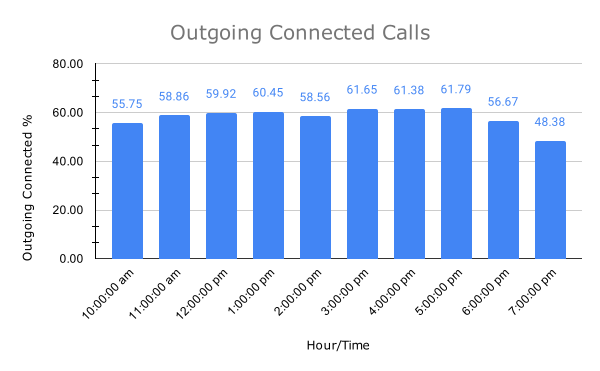
According to the cold calling statistics gathered after analyzing multiple industries, we've discovered the best time to call a prospect is 5:00 pm on a weekday. This is when cold calls register the highest connected rate, i.e., 61.79%.
This means you are highly likely to be connected to your prospect when you call at 5:00 pm. Apart from this time, here are some more cold calling slots with high connect rates:
- 3:00 PM
- 4:00 PM
- 5:00 PM
Searching for data to validate these calling slots. Check out our blog on the best time to call as a telecaller in India.
2. Dealing with Missed Calls
It hurts to waste time as a telecaller in India. But do you know what hurts more — when you spend time gathering all the data, organizing your calling flow, and get a ‘no response’ tone at the end? The whole momentum gets lost.
According to our internal data, approx 53% of cold calls are missed by customers. That’s more than half of the calls you make every day. Do you know what to do with this information?
Well, if you are aiming for a monthly sales target and believe that you need a fixed number of prospects in your pipeline, multiply it by 2. Anyway, 50% or more of your calls are gonna get missed.
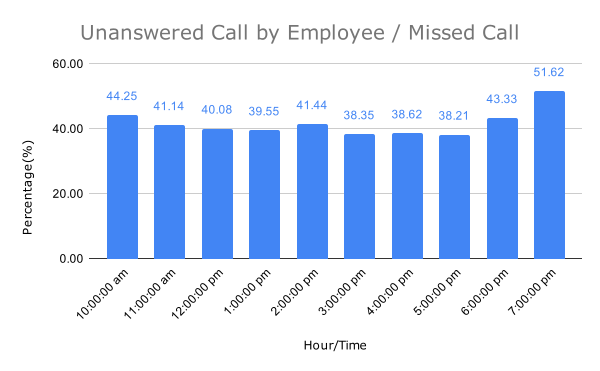
So, why not prepare from the beginning? This will save you from disappointments and improve your sales productivity.
What Should You Do After a Missed Call?
Knowing that 53% of cold calls go unanswered is only half the picture. The more important question — the one most telecallers skip — is: what do you do next?
Here are some cold calling tips derived from statistics on cold calling by Callyzer that can help you improve your follow-ups after a missed call:
Step 1: Wait 2–4 hours before the first retry Calling back within minutes signals desperation and increases the chance of being tagged as spam on Truecaller. Give the prospect time to finish what they were doing.
Step 2: Change your calling slot on the retry If you called at 11 AM and got no response, do not retry at 11:30 AM. Switch to the 3–5 PM window, which consistently delivers higher connect rates based on our cold calling statistics.
Step 3: Send a WhatsApp message before the second retry A short, non-salesy WhatsApp text — "Hi [Name], I tried reaching you earlier regarding [topic]. Happy to call at a time that suits you." — warms the number before your next dial. This reduces the chance of the second call being ignored.
Step 4: Mark the lead for a 24-hour follow-up, not a write-off Most telecallers abandon a lead after 1–3 missed calls. Based on industry data, 80% of sales require 5 or more touchpoints. A missed call is not a rejection — it is a scheduling mismatch.
Step 5: Track your retry patterns If a specific lead segment consistently goes unanswered during a particular time window, that is a calling strategy problem — not a lead quality problem. Use call data to spot the pattern early.
For a deeper breakdown of how to structure your daily calling approach, read our guide on best cold calling tips for Indian telecallers.
3. Average Call Duration
The time you spend on a call is the most important data point as a cold caller. It tells you about the engagement rate of your prospect list, how eager the receiver is to listen to your pitch. If the outgoing calls you make are lengthier, this means you (and your teammates) are doing a good job explaining the product and have a higher chance of closing a sale.
According to industry data and broader B2B cold calling statistics, the average length of a connected outgoing call is 1.6 minutes. This is a generalized figure for multiple industries and tells that the callers and receivers hold a conversation for 1 minute 36 seconds whenever they connect.
It’s natural to assume that they are handling misconceptions, sales objections, and making the prospect aware of the benefits of a product or service.
Most telemarketing software India tracks call duration automatically, which means you can spot this problem at the team level before it starts affecting monthly numbers.
4. Busiest Time to Reach Out to a Prospect (that you should avoid)
Most cold calls in India happen between 11:00 am and 12 noon. This means your prospects will already be on a call or actively trying to avoid the calls during this time.
Ideally, you should not call your prospects during this time as they will already be bored/irritated/frustrated to listen to your pitch. Rather, you should pick a better time to call (as we shared above).
This will ensure that the prospect is sufficiently interested in listening to whatever you have to tell them. Also, this will give you an opportunity to nurture the leads better and find an opportunity to set up a follow-up call.
Common Mistakes That Kill Your Connect Rate
The cold calling data from thousands of Indian sales teams points to the same set of mistakes — repeated daily, across industries. Here are the most common ones and how to stop them from sabotaging your connection rate.
Mistake 1: Calling during the 11 AM–12 PM rush: This is the busiest calling window in India. Your prospect has already received 3–5 calls before yours. They are primed to reject or ignore. The cold calling data is clear — your connection probability drops significantly during this window. Shift your primary dialing block to 3–5 PM instead.
Mistake 2: Using a number that Truecaller has flagged: If your SIM has been tagged as "Telemarketer" or "Spam" on Truecaller, your connect rate collapses — regardless of what time you call or how good your script is. Rotate numbers regularly and monitor your spam status. This is especially critical in real estate and financial services, which together account for 80% of spam complaints in India.
Mistake 3: Not accounting for the 53% unanswered rate in your daily targets Most TLs set a target of "100 connected calls" without building in the buffer. If only 47 out of every 100 dials result in a connection, you need to plan for 212 dials to hit 100 conversations. Not accounting for this in your cold calling data for real estate or any high-volume sector leads to teams consistently underperforming targets that were unrealistic to begin with.
Mistake 4: Treating the first call as the only call Conversion rarely happens on the first touchpoint. Teams that abandon leads after one missed call are leaving the majority of their pipeline untouched. A proper follow-up process can turn a 2% conversion rate into 6%.
Mistake 5: Ignoring call duration as a feedback signal If your average call duration is below 1 minute, your opening is failing — not your product. The average connected call in India lasts 1.6 minutes. Calls significantly shorter than this indicate the prospect is disengaging early, which points to a script or pitch problem, not a market problem.
For industry-specific calling strategies, check out our cold calling data for real estate teams to see how top-performing agents structure their outreach.
5. Spam Calls
Everyone hates receiving spam calls. But more than 60% of Indians receive at least three or more spam calls every day.
According to Statista’s data, 51% of the spam calls received by prospects are from the financial services industry, followed by 29% for real estate services.
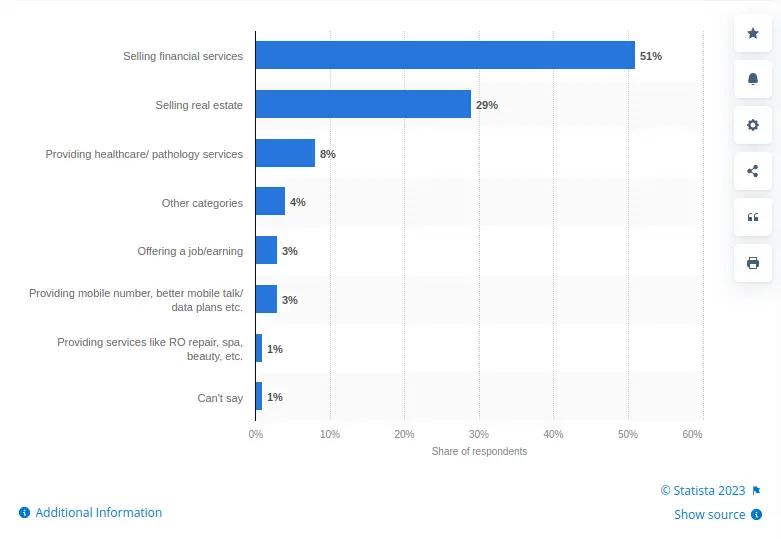
Source: Statista
If you are in these industries, you need to be really careful in planning your cold-calling campaigns. In the age of Truecaller, you risk not getting an adequate response for your telecalling operations or being blocked.
You need to be really careful in improving your telecalling reputation, following best practices, and really warm up your telecalling stats. Here are a few resources to help you out:
- Overcoming Objections in Sales
- Opening Lines to Convince a Customer on Call
- How to Pitch Your Product As a Telecaller in India
- Does Cold Calling Really Work?
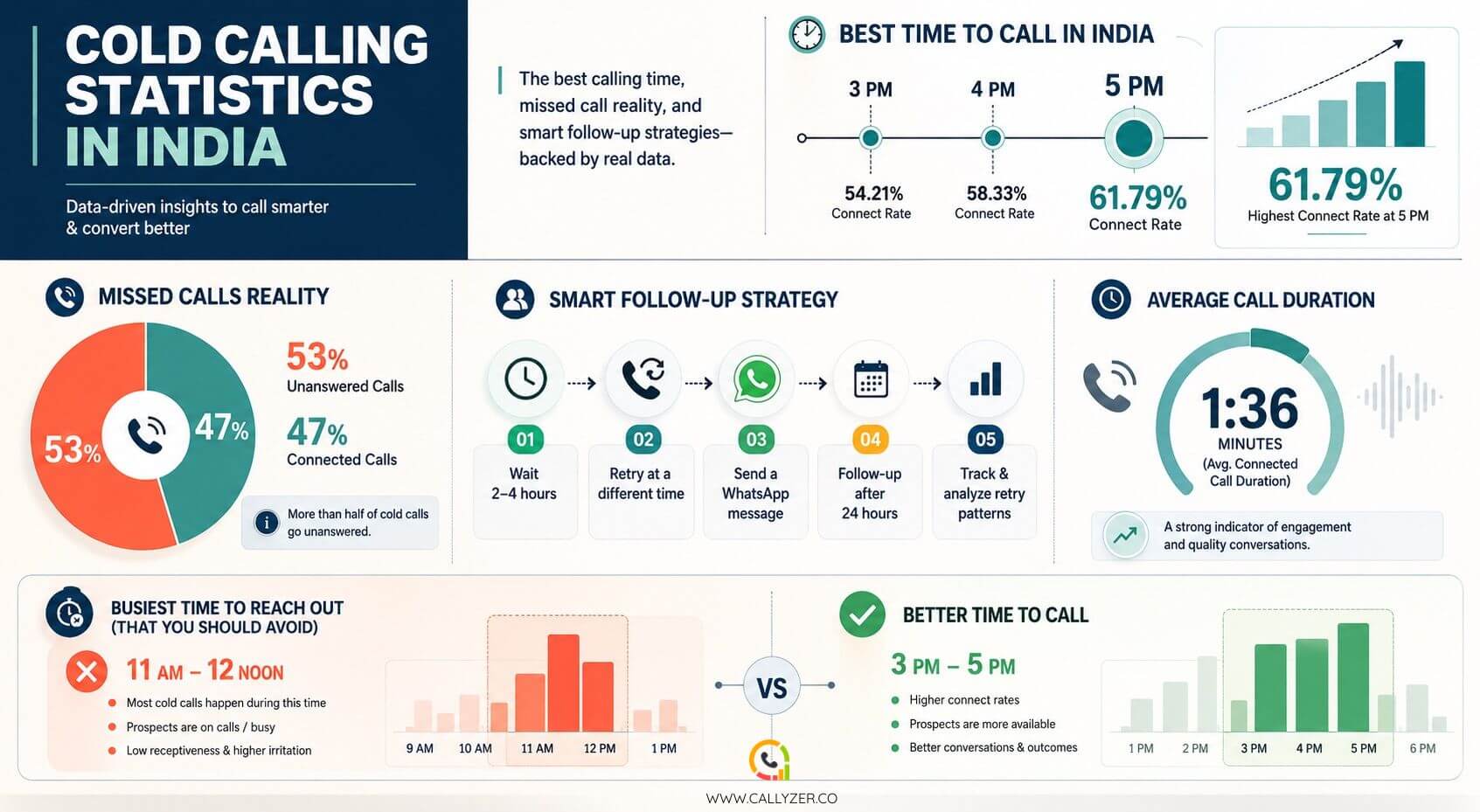
Cold Calling Checklist for Indian Telecallers (Based on the Data)
This cold calling data list is derived entirely from the statistics covered in this post. Print it, share it with your team, or paste it into your daily standup. Every item here is backed by real cold call statistics India from telecalling operations.
✅ Before You Start Dialing
- Block your primary dialing sprint between 3:00 PM and 5:00 PM
- Avoid bulk dialing between 11:00 AM and 12:00 PM (highest competition window)
- Check your number's Truecaller status — especially if you are in finance or real estate
- Set your daily dial target based on 2× your connected call goal (to account for ~53% unanswered rate)
- Have your WhatsApp message template ready for post-missed-call follow-up
✅ During the Call
- Aim for a minimum call duration of 1.5 minutes per connected call
- If the prospect picks up — you have roughly 7 seconds to hold their attention with your opener
- Do not pitch — qualify first. The goal of call one is call two.
- Note the outcome immediately in your CRM after every call (do not batch-update at end of day)
✅ After the Call
- Missed call? Wait 2–4 hours before the first retry
- Retry in a different time slot — do not call at the same time again
- Send a WhatsApp message before your second dial attempt
- Mark the lead for follow-up — not removal. Plan for 12–13 touchpoints before a final decision
- Track your call duration trend weekly. A drop signals a script problem, not a market problem.
✅ Weekly Review (Team Lead)
- Review connect rate by time slot — are your agents dialing in the right windows?
- Check average call duration across the team — who is losing prospects in the first 60 seconds?
- Identify leads that have received fewer than 5 touchpoints but have not been followed up
- Review missed call retry rate — are agents actually calling back, or silently dropping leads?
Want to know which calling patterns are helping you close more deals?
These patterns become even clearer when you start tracking your own calling data with Callyzer.
Supercharge your Telecalling Operations using Data with Callyzer
Your cold-calling team needs relevant data to perform better in 2026. If you are a telecalling team/sales team/support team and wish to get focused insights using your own operational data, try using Callyzer.
Callyzer helps teams improve performance by combining insights with an efficient outbound dialer for cold calling, ensuring agents spend more time talking and less time manually dialing numbers.
Callyzer connects to all your employee's Android smartphones and gives you real-time insights, data, and information on how to improve your calling operations.
Make data your guiding light in the world of spam callers and stand out from the competition. Learn more about how Callyzer helps teams like yours.
FAQs
How do I use cold calling statistics to improve sales performance?
Start with the number that exposes your biggest leak. Low connect rate? Your calling window is wrong, not your script. Good connections but poor conversions? The problem is in the conversation.
For Indian teams, three stats move the needle fastest: connect rate by time slot, average call duration, and follow-up attempt count. Fix one at a time.
What are the latest cold calling statistics in India?
From Callyzer's analysis of 5 crore telecalls across 12,000+ tracked numbers:
- Peak connect rate: 61.79% at 5 PM on weekdays
- 53% of cold calls go unanswered
- Average connected call duration: 1.6 minutes
- 12 to 13 touchpoints needed to convert most leads
- 4 to 5 PM callbacks are 71% more effective than morning slots
- Financial services accounts for 51% of spam calls in India; real estate, 29%
How does call analytics help improve cold calling performance?
It tells you which variable is broken. Low connections, short calls, and poor follow-up depth all look like "bad performance" from the outside, but each has a different fix. Analytics separates them so you stop applying the wrong solution.
What is a good cold call connect rate for Indian telecallers?
45 to 55% is a reasonable baseline. Callyzer's data puts the average at 46 to 48% across sectors. Below 40% usually means wrong calling window, a ruecaller-flagged SIM, or a cold lead list.
Fix the time slot first. It's the fastest variable to change.
How does Callyzer collect its cold calling statistics?
Callyzer logs calls directly through each agent's Android SIM, no VoIP, no manual entry. Every outbound call is captured automatically: timestamp, duration, and connection status. That's what makes the data reliable. Manual CRM logs depend on what agents choose to record. SIM-level data doesn't.
What is the best time to make cold calls in India?
5 PM on weekdays. That's when Callyzer's data records the highest connection rate at 61.79%. The 3 to 5 PM window holds up consistently across sectors. Avoid 11 AM to 12 PM. That's when competition from other callers is highest and spam flags are freshest.
How can call analytics improve cold calling ROI?
Three ways: shifting dials to high-connect time windows (free, immediate), setting follow-up floors so agents don't abandon leads at 2 to 3 touches, and using call duration to separate script problems from objection-handling problems. Same team, same leads, different results.
How can data improve cold calling ROI?
It tells you which of two problems you have: calls not getting answered, or conversations not converting. Each needs a different fix. Without data, managers guess wrong and apply the wrong solution. Cold calling statistics don't change what's happening. They tell you what to stop guessing about.