
A sales pipeline is only as strong as the data behind it. When call activity is tracked manually, that data starts losing accuracy almost immediately.
Calls are not always recorded in real time, follow-ups depend on memory, and reporting becomes a mix of actual activity and assumptions. Over time, this creates gaps that are hard to notice but costly to ignore.
The impact is clear. Leads are missed, response times increase, and teams spend more time fixing data than improving performance. Managers, in turn, are left making decisions based on incomplete information.
This is where manual call logging starts breaking the system. Not because teams are not working hard, but because visibility into actual call activity is limited. Which is exactly what a structured call monitoring system is designed to solve.
How Manual Call Logging Weakens Data and Impacts Your Pipeline
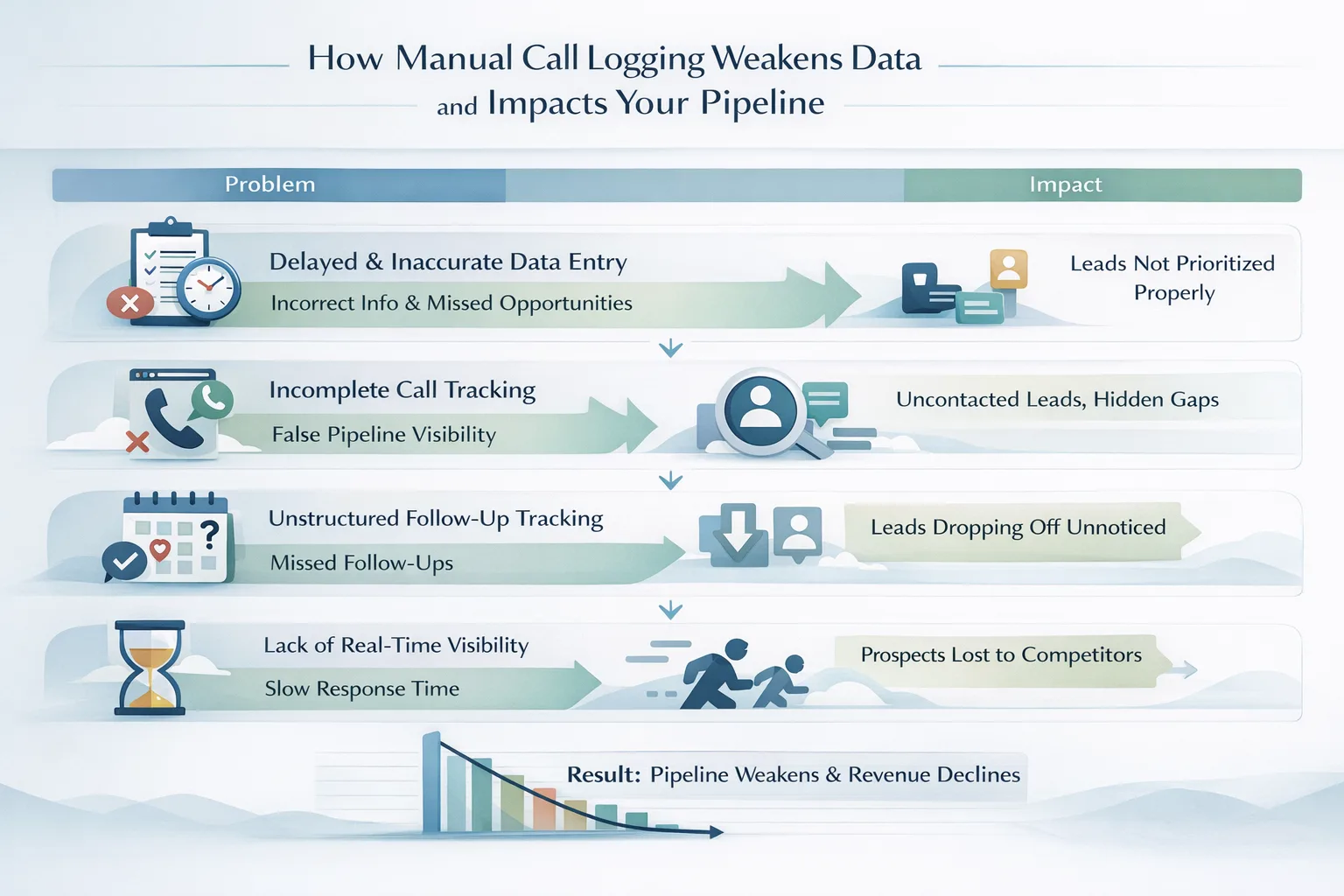
In a call-driven sales process, the pipeline depends on how accurately and consistently call activity is captured.
Manual call logging affects this at the source, and the impact is not limited to data quality. It directly influences how leads are handled, how quickly teams respond, and how reliably performance can be measured.
Each gap in data creates a corresponding gap in the pipeline.
Delayed and Inaccurate Data Entry → Loss of Context and Missed Opportunities
Call details are often recorded after the interaction instead of during it. This delay reduces accuracy because important context is either forgotten or simplified.
In practice, this leads to:
- Incorrect call status, such as marking partial conversations as completed
- Missing details about customer intent or urgency
- Follow-up actions being recorded vaguely or not at all
Impact on the pipeline: When this data is used for decision-making, leads are not prioritized correctly. High-intent prospects may not be followed up in time, while low-priority leads continue to occupy space in the pipeline. Over time, this reduces conversion efficiency.
Incomplete Call Tracking → False Pipeline Visibility
Manual systems do not consistently capture every call event. Some interactions are missed or underreported, including:
- Missed calls that were never logged
- Unanswered inbound inquiries
- Multiple attempts recorded as a single interaction
Impact on the pipeline: This creates a misleading view of activity. The pipeline may appear well-covered, but in reality:
- Some leads were never contacted
- Some inquiries were never responded to
- Actual effort is underrepresented
This gap leads to lost opportunities that are not even visible in reports.
Unstructured Follow-Up Tracking → Drop in Conversion Consistency
Follow-ups are critical for closing deals, but manual logging does not enforce a structured process. Tracking depends on individual discipline rather than system-driven visibility.
This results in:
- Follow-ups being delayed or completely missed
- No clear visibility into pending actions
- No accountability for incomplete follow-ups
Impact on the pipeline: Leads start dropping off silently. Since most conversions happen after multiple interactions, inconsistent follow-ups directly reduce win rates.
The pipeline weakens not because leads are poor, but because they are not handled consistently.
Lack of Real-Time Visibility → Slower Response and Lead Decay
Manual logging does not provide immediate visibility into call activity. Missed calls and new inquiries are often identified with delay.
Impact on the pipeline:
- Response time increases
- Prospects lose interest or move to competitors
- High-intent leads decay before action is taken
In time-sensitive sales environments, even small delays can significantly affect outcomes.
Inconsistent Data → Limited Ability to Improve Performance
When call data is incomplete or inaccurate, performance analysis becomes unreliable.
Teams struggle to clearly understand:
- Which leads are converting and why
- How many attempts are required per conversion
- Where exactly leads are dropping off
Impact on the pipeline: Without clear insights, optimization becomes guesswork. Teams may increase effort, but without addressing the underlying gaps, results remain inconsistent.
Operational Impact on Sales Teams
Manual call logging also affects how teams function on a daily basis.
Reduced Productivity: Agents spend time updating logs instead of focusing on conversations. Therefore:
- Less time spent on actual selling
- Increased administrative workload
Higher Managerial Overhead: Team leads are required to manage data instead of performance. Therefore:
- Reviewing and correcting entries
- Compiling reports manually
- Resolving inconsistencies
Decline in Data Trust: When data is frequently questioned or corrected:
- Managers lose confidence in reports
- Agents feel their efforts are not accurately reflected
This affects both decision-making and team morale.
Why the Problem Increases with Scale
As teams grow, the limitations of manual logging become more visible.
- More agents lead to inconsistent logging practices
- Higher call volumes increase the chances of missed entries
- Faster lead flow reduces the margin for delayed follow-ups
At scale, the system stops providing a reliable view of reality.
How Callyzer Fixes Data Gaps and Strengthens Your Pipeline
The core problem with manual call logging is not effort, but the lack of a system that can capture and structure call activity in real time. This is where a SIM-based call monitoring solution - Callyzer changes how the entire process works.
Since Callyzer operates directly at the SIM level, it automatically captures every call without requiring manual input. This ensures that call data is complete, time-stamped, and consistently available across the system.
Automatic Call Capture → Complete and Reliable Data
Callyzer records all incoming, outgoing, and missed calls in real time, without relying on agents to log them manually.
This ensures:
- No call goes unrecorded, including missed and unanswered calls
- Every interaction is time-stamped and structured
- Call activity reflects actual effort, not reconstructed data
Impact on the pipeline: With complete data, teams no longer operate on assumptions. Every lead interaction is visible, which removes hidden gaps and improves overall pipeline accuracy.
Real-Time Visibility → Faster Response and Better Control
With cloud call monitoring, managers get real-time visibility into call activity instead of waiting for end-of-day reports.
This allows:
- Immediate identification of missed calls
- Faster callback actions while lead intent is still high
- Live monitoring of team activity
- Can track team’s productivity
Impact on the pipeline: Response times improve significantly, which increases the chances of connecting with prospects and reduces lead drop-offs.
In-Call Notes and Tagging → No Loss of Context
Callyzer allows telecallers to add notes and tags during the ongoing call itself. This removes the dependency on memory and ensures that every important detail is captured at the right moment.
This helps in:
- Recording accurate customer intent and requirements
- Structuring follow-up actions clearly
- Maintaining consistency in how leads are handled
Impact on the pipeline: Leads are prioritized correctly, follow-ups are more relevant, and the chances of conversion improve because context is not lost.
Call Recording Sync → Better Follow-Up and Coaching
With call recording sync, conversations can be reviewed whenever required.
This enables:
- Better understanding of customer conversations
- More effective follow-up planning
- Data-backed coaching for agents
Impact on the pipeline: Teams improve not just in tracking, but also in execution. Conversations become more effective, which directly impacts conversion rates.
Detailed Analytics → Clear and Actionable Insights
Callyzer provides structured analytics based on actual call activity, not manual entries.
Teams can clearly understand:
- Call volumes and patterns
- Response and follow-up behavior
- Performance at an individual and team level
Impact on the pipeline: Decisions are based on reliable data. Bottlenecks can be identified early, and strategies can be adjusted with clarity.
Stop relying on manual logs.
Use Callyzer to track every call and improve follow-ups in real time.
What This Changes for the Team
When these capabilities come together, the improvement is not limited to tracking. It changes how the team operates.
- Agents spend more time on conversations instead of updating logs
- Team leads focus on coaching and performance improvement
- Managers rely on data that accurately reflects ground activity
Most importantly:
- Follow-ups happen on time
- Lead handling becomes consistent
- Conversion opportunities are no longer missed due to visibility gaps
Final Thoughts
Manual call logging does not fail suddenly. It creates small gaps that grow over time and affect data accuracy, response speed, and team efficiency.
What appears to be a performance issue is often a system limitation.
To improve outcomes, teams need more than effort. They need visibility, accuracy, and real-time tracking.
Next Read
If you're exploring ways to improve visibility while staying compliant, it’s important to understand the legal side of call monitoring as well.