
This blog is a legal compliance guide for Indian sales managers on how to monitor employee call logs without violating the DPDP Act — covering consent, policy setup, what data is trackable, and what happens when an employee leaves.
Legally monitoring employee call logs using call monitoring software means tracking call data: duration, frequency, timestamps, and call outcomes with employee consent and in compliance with India's Digital Personal Data Protection (DPDP) Act, 2023.
For telecalling teams, this applies to business call records and call metadata, not personal messages or private conversations. A compliant monitoring setup requires a written policy, informed consent from every employee, and defined data storage limits before any tracking begins.
Why Employee Call Monitoring Has Become Standard in Indian Sales Teams
Monitoring employee call logs is now standard practice across Indian sales teams. A decade ago, most team leads tracked performance by sitting next to agents or checking end-of-day call sheets. That stopped working when teams spread across cities and remote locations.
A 2018 Gartner survey found 30% of employees were comfortable being monitored by their employer, up from 10% in 2016. The change was not about surveillance becoming more acceptable. Employees simply got clearer on what monitoring actually involves: call counts, duration, pickup rates. Not messages, not personal calls.
The pandemic accelerated this. Team leads managing 20-30 agents from a central office had no way to see who was calling, who was idle, and where pickup rates were dropping without a dashboard in front of them. Call log monitoring apps went from a niche tool to a default part of how Indian telesales teams operate.
One thing has not changed: agents who know upfront what is tracked are far less resistant than those who find out later.
Is Employee Call Monitoring Legal in India?
Yes. Employee call monitoring is legal in India, provided employers meet specific conditions under the DPDP Act, 2023, and existing labour regulations.
Indian law does not prohibit employers from monitoring work-related communications on company-provided devices. Article 21 of the Indian Constitution grants the right to privacy, but courts have consistently held that this right has reasonable limits in a professional context, particularly when employees use company-owned equipment during business hours.
Here is what the law requires:
- Informed Consent Employees must be told what is being monitored, why, and how the data will be used. This consent should be documented in writing before monitoring begins. Verbal assurances are not enough.
- Purpose Limitation Monitoring must serve a specific business purpose: performance tracking, compliance, training, or quality assurance. Collecting call data beyond what is needed for those purposes creates legal exposure.
- Data Protection Under the DPDP Act, 2023, employers handling employee data must implement security safeguards, define how long data is retained, and restrict access to authorised personnel only. Employees have the right to know what data is held about them.
- Written Workplace Policy A monitoring policy should be documented, communicated to all employees, and updated whenever the scope of monitoring changes. This policy is your primary legal protection if a dispute arises.
- Proportionality Monitoring should match the business need. Tracking call duration and call counts for a telecalling team is proportionate. Recording every audio call without disclosing it is not.
What Does the DPDP Act, 2023 Mean for Employee Call Monitoring?
The Digital Personal Data Protection Act, 2023 is India's first comprehensive data protection law and it changes how employers need to think about call monitoring.
Before the DPDP Act, employers operated in a grey zone. There was no single law governing employee data. The DPDP Act closes that gap.
Key obligations for employers under DPDP:
- You must obtain free, informed, and specific consent before collecting employee call data
- You must tell employees what data is being collected and for what purpose
- Employees have the right to access their own data and request corrections
- You must delete data when it is no longer needed for the stated purpose
- A data breach involving employee records must be reported
The practical implication: your call monitoring policy is no longer optional. It is a legal document.
What Call History Data Does Employee Monitoring Actually Show?
This is a question most managers do not ask before they start monitoring. It matters for both legal compliance and team trust.
When you use a SIM-based employee call tracking system, here is what the call log data shows:
- Phone number dialled or received
- Call direction (incoming or outgoing)
- Call duration
- Date and timestamp
- Call status (connected, missed, rejected, not answered)
Here is what it does not show:
- The content of the conversation
- Personal calls made outside working hours (if your policy covers business hours only)
- WhatsApp messages or chat history
- SMS content
This distinction matters legally. You are collecting operational metadata, not personal communications. Under the DPDP Act, metadata about work calls on company devices is far easier to justify than recording audio content.
In analyzing call logs using call management software, managers should focus on the following items: total number of calls per day, average time of calls, percentage of missed calls, peak hours for calling, and poor performing agents in connect rates.
What Is the Ethical and Legal Way to Monitor Telesales Calls?
It is very simple – tell everyone what you intend to do prior to doing it. In the case of call monitoring of your staff members, transparency from day one will always pay off.
It is incumbent upon employers to communicate to their telesales agents that there will be call monitoring with reasons being to improve connect rates, identify areas needing training, or ensure compliance.
Written consent from all of your employees is a minimum standard. Customers should also be informed if calls are being recorded. A brief disclosure at the start of the call covers this: "This call may be monitored for quality purposes."
Monitoring should cover work-related calls only. Personal calls outside business hours, or calls on personal SIM cards, are out of scope unless your employment contract specifically states otherwise.
Data collected through monitoring should be stored securely, accessible only to managers and authorised personnel, and retained only for as long as your policy states.
The test for ethical monitoring is simple: would you be comfortable telling your team exactly what you can see and when? If the answer is yes, your monitoring setup is on solid ground.
Ready to monitor employee calls legally and efficiently?
Explore how Callyzer helps businesses monitor calls, improve performance, and stay compliant.
What Can a Manager Legally Track, and What Are Off-Limits?
What you can track (with consent and a written policy):
- Call counts per agent per day
- Average call duration
- Missed and rejected call rates
- Peak call hours and idle time
- Which numbers were called and when
- Call recording (with separate disclosure)
What is off-limits:
- Personal calls on personal devices outside work hours
- Monitoring without prior written consent
- Sharing call data with third parties beyond the stated purpose
- Retaining data beyond the period specified in your policy
- Using monitoring data for purposes other than what employees were told
The clearest legal risk is scope creep: starting with performance tracking and gradually using the same data for disciplinary action without telling employees that was a possible use. Your policy should state upfront what decisions monitoring data can inform.
How Do SIM-Based Call Logs Differ from VoIP or Cloud Call Records?
This distinction has legal implications most monitoring guides do not address.
SIM-based monitoring tracks call metadata through the phone's mobile network carrier. The app on the employee's Android phone syncs call logs (duration, number dialled, timestamps) to a central dashboard. No audio is captured unless a separate call recording feature is enabled.
VoIP and cloud calling systems route calls through internet servers. These systems can record audio by default, and the recordings are stored on the provider's servers, not on the employee's device.
From a compliance standpoint, SIM-based monitoring has a simpler consent process. You are collecting call metadata, not conversation content. The employee's SIM card stays on their phone; the data syncs to a dashboard you control.
Cloud-based VoIP recording involves a third party storing audio content, which creates additional obligations under the DPDP Act, specifically around data processor agreements and cross-border data transfer if servers are outside India.
For most Indian telecalling teams, SIM-based tracking is both easier to implement and easier to keep compliant. There is no VoIP dependency, calls go through Jio, Airtel, or BSNL networks as usual, and setup takes minutes rather than weeks.
How Do You Get Valid Employee Consent Before Monitoring Calls?
Consent under the DPDP Act must be free, informed, and specific. That rules out consent buried in a long employment contract that employees sign without reading.
Here is a practical process for Indian telecalling teams:
Step 1: Create a call monitoring policy: This will be a one-page document describing what information is being monitored, why it is being monitored, who is accessing the data, for how long the data will be stored, and what can an employee do if they have any issues about the policy.
Step 2: Conduct a team briefing: You must brief your employees regarding the policy before the monitoring takes place. Employees need to know that they are monitoring their call frequency and duration, and not their phone conversations or messages, unless both are being monitored.
Step 3: Get written consent: This may simply be the sign off from each employee that they have read and accepted the policy terms.
Step 4: Update consent when the scope changes If you add call recording after initially tracking only metadata, that is a change in scope. You need fresh consent for the new capability.
Step 5: Make the policy accessible Employees should be able to refer back to the monitoring policy at any time, not just when they are onboarded.
This process takes less than a day to set up and protects the business if a monitoring dispute goes to HR or legal.
What Should Your Call Monitoring Policy Include?
A call monitoring policy for an Indian telecalling team should cover these points at minimum.
- What data is collected: call logs, duration, recordings (specify which)
- Which devices and numbers are covered (company SIM cards, company phones)
- Business hours during which monitoring applies
- Who can access the monitoring dashboard and call data
- How long data is stored before deletion
- What the data will be used for (performance review, training, compliance)
- Employee rights under the DPDP Act (access, correction, deletion requests)
- How to raise a concern or dispute about monitoring data
Keep it in plain language. A policy written in legal jargon that agents cannot understand does not constitute informed consent in any meaningful sense.
Benefits of Employee Call Tracking and Monitoring
For most Indian telecalling teams, the case for monitoring is not about distrust. It is about visibility. The right employee call monitoring software gives managers the data they need without adding manual reporting overhead to agents.
For agents: When call data is transparent, agents can see their own performance without waiting for a manager's assessment. They know their pickup rate, their average call duration, and how their numbers compare to the team average. Managers can identify specific agents who need support rather than running blanket training for the whole team.
For team leads: A call monitoring dashboard removes the dependency on self-reported call logs. Team leads managing 20+ agents cannot listen to every call. Seeing call counts, idle time, and missed call rates from a central dashboard is how they identify which agents need attention at 9 AM without waiting until end-of-day reports. That saves roughly two hours of daily administrative work that would otherwise go into chasing manual updates.
For the business: Consistent call monitoring creates a data trail that supports decisions: which agents to promote, which calling hours produce the best connect rates, and whether a particular lead list is worth continuing. These decisions stop being gut calls and start being driven by actual call history data.
Steps to Monitor Employee Calls Using Callyzer
Callyzer is a SIM-based employee call tracking system designed for Android phones. It tracks call metadata through the employee's existing SIM card. No VoIP setup, no additional hardware, no IT configuration required.
Setup takes three steps.
Step 1: Install Callyzer Biz on the Employee's Phone
Download the Callyzer Biz app from the Google Play Store on each Android phone your team uses for calling. The app runs on the employee's existing SIM card and mobile carrier network: Jio, Airtel, BSNL, or any other Indian carrier.
Step 2: Sync the Employee's Number with the Cloud Dashboard
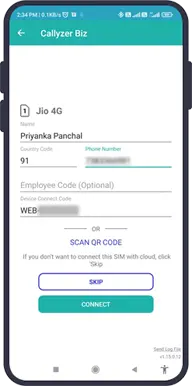
Open Callyzer Biz and enter the employee's name, mobile number, and optional employee code. The app connects to the cloud dashboard using a Device Connect Code provided by the admin. Once synced, the number appears on the central dashboard.
Step 3: Monitor and Generate Reports
The Callyzer dashboard shows call data in real time. Managers can view:
- Total calls and total duration per agent
- Incoming vs outgoing call split
- Missed, rejected, and never-answered calls
- Connected calls and unique clients contacted
- Agent working hours based on call activity
- Top callers, top dialers, and top answered numbers
Reports can be pulled daily, weekly, monthly, or annually without manual data entry from agents.
Callyzer also supports call recording sync. Recordings made on the device are uploaded to the cloud dashboard where managers can listen, download, and review them. Call recording requires consent from employees and disclosure to customers before it is enabled.
Callyzer's data security follows internationally accepted standards for storage and access control. Call data is stored behind restricted access, available only to the admin and managers you authorise.
Transparent Monitoring Builds Better Teams
The biggest mistake Indian sales managers make with call monitoring is treating it as a surveillance tool rather than a performance tool.
Teams respond differently to monitoring when they understand what is tracked, have access to their own data, and see managers use the data to help rather than penalise. Transparent monitoring improves team morale when the data is shared with agents, not just used against them.
The legal framework (consent, purpose limitation, data rights) maps closely to what good management practice looks like anyway. Telling your team what you monitor and why is not just a compliance step. It is how you run a team that trusts the process.
FAQs on Monitoring Employee Call Logs Legally in India
Q: How do I get employee consent for call monitoring?
Write a one-page monitoring policy stating what data you collect, why, who can access it, and how long you keep it. Hold a team briefing before monitoring starts. Then collect a signed acknowledgement from each agent confirming they have read the policy. Keep those sign-offs on file. Verbal consent is not enough under the DPDP Act, 2023.
Q: Can managers listen to employee calls without informing them?
No. Monitoring without prior disclosure violates the DPDP Act. Employees must be told what is being monitored before it begins, not after. If you are tracking call metadata only, say so. If you are recording audio, that requires a separate disclosure to both the employee and the customer.
Q: What data is captured when monitoring employee calls?
A SIM-based monitoring app captures call direction (incoming or outgoing), the number dialled or received, call duration, timestamp, and call status (connected, missed, rejected). It does not capture the content of the conversation unless call recording is separately enabled. Personal calls outside business hours are out of scope if your policy limits monitoring to work hours.
Q: How long can I legally store employee call recordings in India?
The DPDP Act does not specify a fixed retention period, but it requires you to delete data once the purpose for collecting it is served. Your monitoring policy should state a specific period — 6 months or 12 months is common for telecalling teams — and you must delete recordings when that period ends. Storing recordings indefinitely is not compliant.
Q: What is the difference between call monitoring and call recording?
Call monitoring tracks metadata: who called whom, when, for how long, and whether the call connected. Call recording captures the actual audio. Both require employee consent, but recording carries stricter obligations. If recordings are stored on a third-party server (as with VoIP systems), you also need a data processor agreement with that vendor under the DPDP Act.