
"Call me later" is the most common lead killer in telecalling, and most agents don't realize it's happening. This blog breaks down what the “Call me later” phrase actually means, how to respond in the next 10 seconds to lock in a real callback time, and the exact follow-up technique to use over 10 days. It also covers the timing mistake most teams miss. Calling back at the wrong hour, even when the lead was genuine, quietly kills more pipelines than bad scripts ever will. Backed by Callyzer's connect rate data from Indian telesales teams.
Most telecallers get confused the moment they hear “call me later.” Some treat it like a clear instruction to follow-up. Others assume it’s a rejection in disguise. And that confusion is exactly where most leads slip away.
The real skill is knowing the difference in the moment. Is the prospect genuinely busy, or are they trying to leave the conversation without saying no? Because what you say in those next few seconds often decides whether your follow-up will get answered or ignored.
This blog breaks down how to spot the difference, what to say before ending the call, and how to structure follow-ups that actually lead to conversations.
What "Call Me Later" Actually Means
It's not a rejection. It's not a yes either. Most agents treat it as a callback and move on. Most prospects intend it as a polite exit they don't have to explain.
Here's roughly how these calls split in practice:
About 20 to 25% are genuinely busy. They picked up out of habit, realized they were in the middle of something, and needed to end the call. These leads do convert, but only if you reach them at the right time and open with context the second time, not a fresh pitch.
About 40% are on the fence. Something in the call didn't turn them off immediately, but they're not ready to engage. They're not saying no. They just need a better moment and, often, a slightly different approach.
About 35 to 40% are using it as a soft exit. They'd rather defer than decline directly. They won't pick up next time unless something about your approach changes.
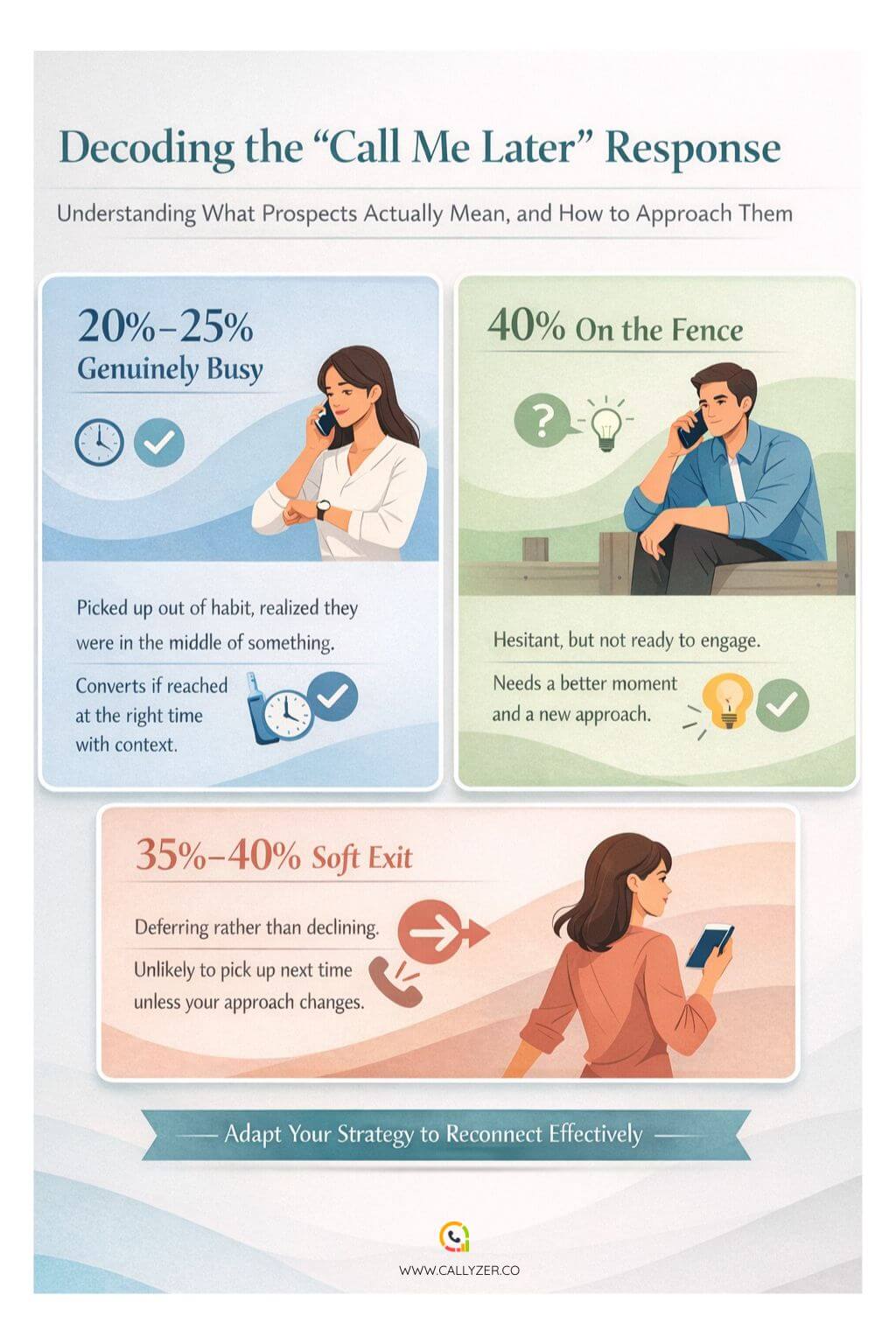
The problem is you can't tell these three groups apart in real time. So most agents respond the same way to all three, and lose all three.
There is one signal that separates genuine interest from deflection almost every time.
Did they give you a specific time?
"Call me later" with no time attached is almost always a soft no. "Call me after 5" or "call me Thursday morning" is almost always real.
That one detail changes everything about how you should respond.
Why Most Agents Lose These Leads Immediately
Two responses are most common, and both of them kill the lead.
The passive response: "Okay, I'll call you this evening." The call ends with no confirmed time. The agent follows up two days later at a random hour. The prospect doesn't pick up. The lead quietly dies.
The pushy response: The agent tries to keep the prospect on the line. "Just two minutes, I'll be very quick." This irritates someone who was already trying to exit politely. Now they associate your number with pressure, which makes the next call harder to answer, not easier.
What’s missing is a balanced approach. A way to end the call smoothly without pressure, but still agree on a specific time to reconnect. It’s not complicated, it just needs practice until it becomes a habit.
What to Say in the Next 10 Seconds as you hear “Call Me Later” from your prospect
The moment you hear “call me later,” the pitch is no longer the focus. Your job now is simple: secure a convenient time to reconnect.
Here's what to say:
“Of course. Just so I don’t catch you at a bad time again, would morning work better, or would evening be more convenient?”
If they give you a time, confirm it out loud:
"Perfect. I'll call you on [day] at [time]. I'll also send a quick WhatsApp so you have my number saved."
If they say "anytime" or stay vague, push once:
"I want to make sure I reach you when you're actually free. Would [specific day and time] work?"
Most people will either agree to a specific time or clearly show they’re not interested. Both responses help you move forward.
What you should avoid is ending the call with a vague “call me later,” because that leaves things unclear and often leads to losing the lead.
One phrase to stop using: “I’ll try to reach you.” The word “try” makes the follow-up sound optional for both you and the prospect.
The Message to Send Before You Dial the Next Number
Don't wait an hour. Don't save it for the end of your shift. Send this within five minutes of the call ending.
The message has one job: make your number recognizable when it rings again.
Here's what works:
"Hi [Name], this is [Your Name] from [Company]. We spoke briefly just now. You mentioned calling back later. I'll reach you on [day] at [time] as we discussed."
Under 40 words. No pitch. No product features. No PDF attached.
If you want to add one more line, make it something specific to them. Not a generic benefit statement.
If they are in real estate, mention something relevant to their current situation. If they are in insurance, bring up something that actually applies to their case. Just one simple line that shows you were paying attention.
What doesn’t work is long messages with paragraphs and bullet points. Even if they are personalised, they still feel like a mass message, and prospects tend to treat them that way too.
In industries like real estate and EdTech, one thing worth trying is a short voice note instead of a text. Keep it under 30 seconds and say the same thing. It feels more personal, is harder to ignore, and doesn’t sound like a template.
Example (real estate): “Hi, just following up on our call. Since you mentioned you’re looking in the Andheri area, I thought I’d share this option that just came up. Let me know if you want me to check availability for you.”
How Many Follow-Up Attempts Is the Right Number
Research on B2C telesales shows that 07 to 12+ touches are needed to convert a lead who didn't commit on the first call. Most agents stop after one or two.
But 12 touches doesn't mean 12 back-to-back calls. It means a mix of calls, messages, and useful information spread across about 10 days. Here's a telecalling follow-up technique that works without crossing into harassment:
Day 0, same day as the original call: Send the WhatsApp message as above.
Day 1: Call at the agreed time. If no answer, leave a short voicemail or send a one-line follow-up message.
Day 3: Second call attempt. Try a different time of day than the first two attempts.
Day 5: Send a WhatsApp with something genuinely useful. A relevant stat. A short example from their industry. Something that gives them value before you ask for anything. Not a "just checking in" message. Those get ignored.
Day 8: Third call. Keep the opener light. "I know the timing hasn't worked out. I wanted to give it one more try before I stop following up."
Day 10: Close the loop. "I'll stop reaching out for now, but if you'd like to reconnect, I'm here." This message gets a response more often than most agents expect.
Six attempts over ten days. After that, move the lead out of active follow-up and into a long-term list. Chasing someone past day 10 does not improve conversions. It fills your pipeline with dead weight and leaves less time for leads that are actually moving.
The Timing Problem Most Teams Don't Notice
This is where most teams lose these leads even when they do everything else right.
A lead who said "call me after 5" and got called at 11 AM the next day is not a follow-up lead. They're an annoyed prospect who now has a reason not to pick up.
Timing matters more than most agents think.
Callyzer's data across Indian telesales teams shows that 4 to 5 PM callbacks produce 71% higher connect rates compared to morning follow-ups on the same leads.
The 5 PM slot specifically shows a 61.79% connect rate, which is among the highest points in the day. Morning callbacks on leads who asked for evening calls perform much worse. You also lose goodwill and create a poor first impression.
If a lead gives you a specific time, call at that time. If they didn't, late afternoon is your safest default for Indian B2C leads.
For team leads, this is worth watching in your dashboard. Which agents are calling back at the agreed time, and which ones are dialing whenever it's convenient for them?
That pattern explains more variation in callback conversion rates than script quality does. A team that gets timing right consistently will outperform a team with a better script but inconsistent follow-up, every time.
Are bad callback timings costing you leads?
Good timing converts leads. Bad timing loses them forever. Callyzer makes sure your team always knows the difference.
What to Say When They Actually Pick Up the Second Time
Most agents make one consistent mistake on the callback. They restart the pitch from the beginning.
The prospect has already heard it. If you start fresh, it shows you either weren’t listening earlier or you’re using a fixed script for everyone. That only reinforces the doubt they already had during the first call.
Instead, open with context:
"Hi [Name], this is [Your Name] from [Company]. We spoke on [day]. You asked me to call back this evening. Is now a good time?"
That's enough. Let them settle into the conversation before you move toward the product.
And if they say it's still not a good time, go back to the same move. Ask for a specific slot, confirm it, send the message. You haven't lost anything. You've just moved the timeline.
FAQs
What's the best response when a prospect says "call me later"?
Stop the pitch and ask for a specific time. "Would morning work better, or is evening more convenient?" keeps the lead alive without pressure. You're not asking if they want a callback. You're asking when. That small shift in framing makes a real difference.
How many follow-up attempts should I make after a postponed call?
Six attempts over ten days is a reasonable window for active follow-up. Most conversions from "call me later" leads happen within the first five days. After day 10, move the lead to a long-term nurture list rather than daily chase.
Should I send a WhatsApp right after the call ends?
Yes, within five minutes. Keep it under 40 words. One line confirming who you are, one line confirming when you'll call. No pitch in the message.
How do I know if “call me later” is genuine interest or a polite rejection?
Ask for a time to call back. A specific time with a day and hour is almost always genuine. "Anytime" or a repeated vague "later" with no detail is almost always a soft no. Treat the two differently from that point forward.
What time should I call back prospects if they didn't give me a specific slot?
4 to 5 PM on weekdays shows the highest connect rates for Indian B2C telesales. Avoid calling back within the first 30 minutes of the original call. It reads as ignoring what they asked.
What should I say when prospects pick up on the callback?
Reference the previous conversation first. "We spoke on [day], you asked me to call back this evening." That context is enough to re-open. Don't restart the pitch. Let them settle in before you say anything about the product.
Also worth reading:
Handling "call me later" is one piece of the puzzle. What you say in the first 7 seconds decides whether you even get that far. To master the opening script read: 7-Second Opener Scripts That Stop the Hang-Up
And when objections come up mid-call, having a ready response is what keeps the conversation alive. To tackle objections well read: Mastering Sales Objection Scripts to Overcome Common Sales Objections