
Here we will discuss top 30 telecaller interview questions and answers which are asked by companies during telecaller interviews for fresher, experienced, telecaller team lead and telecaller manager positions. This article will let you know how the recruiters analyse a candidate's communication skills, customer handling skills, sales methodology, follow-up skills and leadership instincts through an interview.
We have provided well crafted answers for these questions along with effective tips to crack the interview, mistakes to avoid during interview and high-impact questions to boost your preparation for telecalling interviews.
Telecaller interviews have become much more than speaking smoothly on calls.
Employers are now seeking candidates who sound conversational on calls, deal with customers professionally, maintain regular follow-ups, and most importantly remain composed even during tough calls.
Interviews for fresher's mostly focus on communication, confidence and attitude. While telecaller interviews for professionals primarily focus on conversion handling, customer retention, team handling, follow-ups system and your performance strategy.
The best thing about telecaller interviews is that there are no rigid textbook answers.
An interviewer is mainly interested in understanding your thought process, communication skills and your take on a real customer scenario.
Here, we've compiled top telecaller interview questions and answers that candidates actually face, offering simple, useful tips to go with them.
Section 1: Basic Telecaller Job Interview Questions and Answers for Freshers
These are some of the most common telecaller interview questions for freshers asked during entry-level telecaller interviews.
1. Tell me about yourself.
Sample Answer: "So I recently graduated and one thing I've always been good at is talking to people. Like, conversations don't make me nervous, I actually enjoy them. During my studies I worked on listening better and explaining things in a way people actually understand. That's kind of what pulled me toward customer service on calls.
I want a job where I'm actually doing something, building real experience, getting better at communication. I want to grow and this kind of role feels right for that."
Quick Tip: Don't over-prepare this answer till it sounds like a script. Just be clear about who you are and why you're here. Interviewers notice very quickly if you're reciting something.
2. Why do you want to work as a telecaller?
Sample Answer: "Honestly I like talking to people. And with telecalling, every call is different, every person is different, so you're always figuring things out. You get better without even realizing it. Communication, patience, handling tricky situations — all of that just builds over time. That's what I want."
What Recruiters Observe: They just want to see that you're actually okay talking to strangers all day. Not nervous about it, not faking it.
3. What do you know about our company?
Sample Answer: "I went through your website before coming in. Got a decent understanding of what you offer and I could see customer communication is something you take seriously. That stood out to me."
Quick Tip: Five minutes of research goes a long way. Interviewers can immediately tell when someone hasn't bothered.
4. What are your strengths?
Sample Answer: "I don't panic in difficult conversations, that's one thing. I stay calm and I listen before I say anything back because that usually helps more than jumping in fast. And I pick up new things quickly. New place, new people, I settle in without making a big deal of it.”
5. What is your biggest weakness?
Sample Answer: “One weakness I’ve noticed in myself is that sometimes I spend extra time trying to make sure my work is done properly, especially when I’m learning something new. Over time, I’ve been improving at balancing accuracy with speed and becoming more efficient with experience.”
Interview Insight: A good “weakness” answer should sound honest while also showing self-improvement.
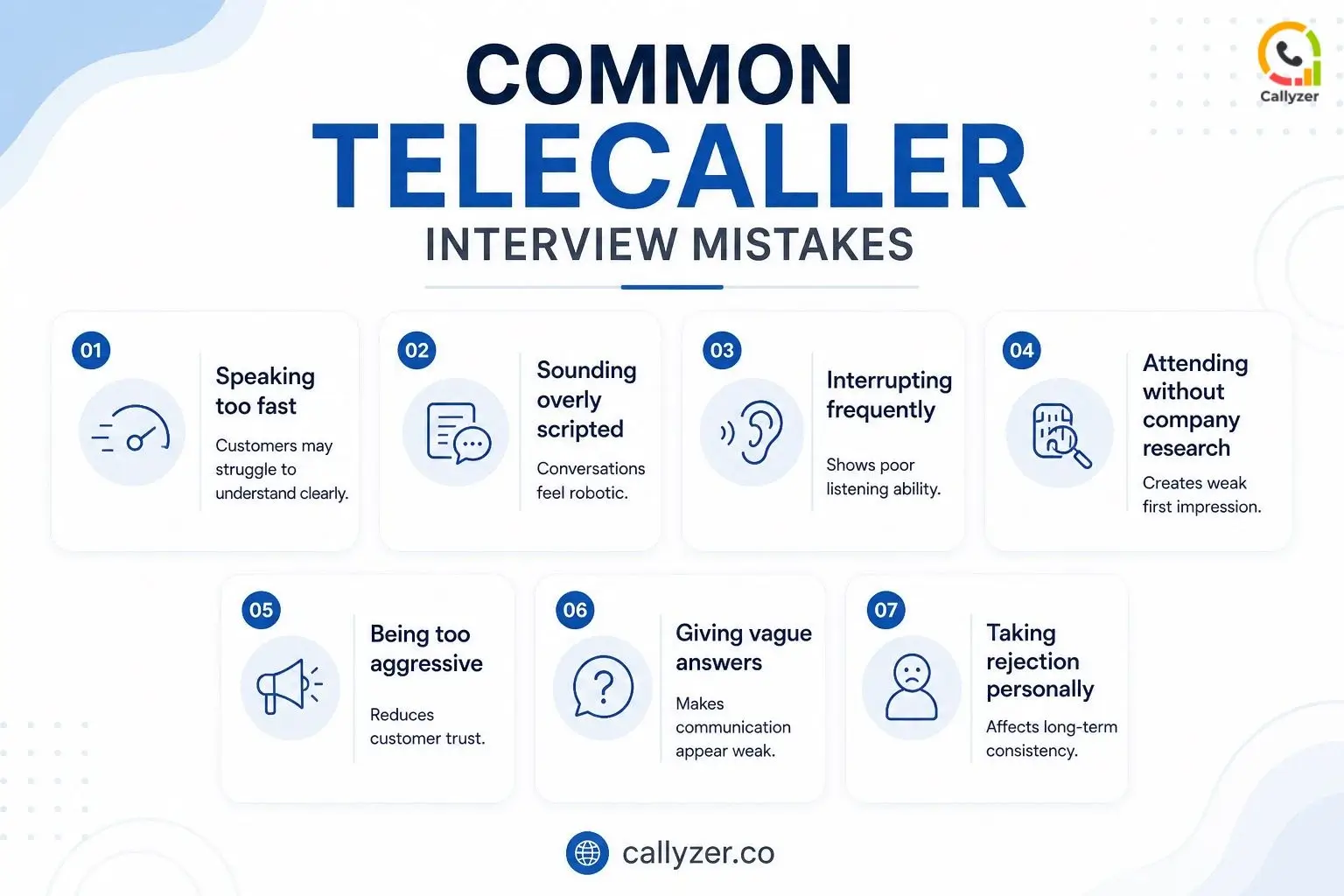
Section 2: Telecaller Interview Questions and Answers for Communication & Customer Handling Questions
This section tests how professionally you can handle real customer conversations.
6. How would you handle an angry customer?
Sample Answer: "Okay so the first thing I do is let them talk. Like fully. Don't interrupt, don't try to explain yourself in between, just let them get it all out. Because most of the time they're not even that angry they just feel like nobody's listening to them. Once they're done I'll calmly say okay I hear you, let's figure this out."
Recruiter Insight: They're not testing your problem solving here. They want to see if you stay normal when someone's yelling at you. That's it.
7. What would you do if a customer disconnects suddenly?
Sample Answer: “Sometimes customers disconnect suddenly because they get busy, lose network, or simply aren’t interested at that moment. I wouldn’t overthink it. I’d usually try calling once again later at a better time. If they still don’t respond, I’d update the status properly and move on to the next call. In telecalling, not every conversation goes perfectly, so staying calm and consistent is important.”

8. How do you convince a customer on a call?
Sample Answer: “First I’d understand why the customer is unsure. Some people worry about price, some don’t trust easily, and some just don’t understand the product or service properly yet. So I’d listen first and then explain how the product or service actually helps with their problem or requirement.
I don’t think talking too much or forcing work on calls. If the customer feels you’re actually listening and giving relevant information instead of a scripted pitch, the conversation usually goes much smoother.”
Practical Tip: The moment you start pushing too hard the customer checks out. Just be straight with them. That works way better.
9. How would you introduce a product to a customer?
Sample Answer: “I would keep the introduction simple and relevant. Instead of immediately explaining every feature, I would first understand the customer’s requirements and then explain the benefits that are most useful for them.”
10. What would you do if the customer says they are busy?
Sample Answer: “I would respect their time and politely ask for a better time to reconnect. Customers usually respond more positively when communication feels respectful instead of pushy.”
Interview Insight: This question checks professionalism more than sales ability.
Section 3: Sales & Target-Based Interview Questions
These call center interview questions for telecaller are commonly asked for telesales and performance-driven telecalling roles.
11. Are you comfortable working with targets?
Sample Answer: “Yes. I understand targets are part of sales and telecalling roles. I actually feel targets help maintain focus and consistency because they encourage continuous improvement.”
12. How do you handle rejection in telecalling?
Sample Answer: “I understand rejection is a normal part of telecalling. Every customer will not be interested, and that’s completely fine. I focus on learning from conversations and maintaining the same energy for the next call.”
Real Industry Insight: Strong telecallers recover quickly after difficult calls instead of carrying frustration into the next conversation.
13. What motivates you in a telesales role?
Sample Answer: “I enjoy seeing measurable improvement in performance. Positive customer responses, successful follow-ups, and achieving goals motivate me more than simply making a large number of calls.”
14. How would you sell a product over a phone call?
Sample Answer: “I’d first introduce myself properly and make the customer comfortable instead of directly starting the sales pitch. Then I’d ask a few questions to understand what they need. Once I know that, I’d explain the product in a simple way and focus on the parts that are actually useful for them.
If the customer has doubts, I’d answer them patiently instead of arguing or forcing the sale. On calls, tone and communication matter a lot because the customer can’t see you. So I’d try to sound confident, clear, and genuine throughout the conversation.”
Practical Tip: The moment a customer feels pressured they're gone. But if they feel like you actually get their problem they'll stay on the call and they'll listen.
15. What would you do if you failed to achieve your target?
Sample Answer: "Okay so first I'm not going to just feel bad about it and move on. I'd actually go back and look at what happened. Was I losing people mid call? Was my follow up too late? Were the leads just not the right fit? Something always explains it. Once I know what it is I fix that specific thing. Stressing about the missed target is pointless. Figuring out why it happened, that's what actually helps next time."
Section 4: Practical Scenario-Based Questions
These questions test how candidates handle real-world telecalling situations.
16. What would you do if a customer keeps interrupting you?
Sample Answer: “If a customer keeps interrupting, I just stop and let them talk. Usually they’ve got something on their mind and want it answered first. I’ll deal with that first, then continue what I was saying.
No point trying to talk over them or rush it. Once they feel heard, the call settles down and it becomes easier to continue.”
17. How would you handle a customer who says your product is expensive?
Sample Answer: “If a customer says the product is expensive, I don’t jump into defending the price. First I try to understand what they are comparing it with or what part feels costly to them.
Then I calmly explain what they get in return and how it helps them in their use case. I also highlight the value they might be missing, rather than just talking about cost. In my experience, once the customer clearly sees the benefit, price becomes less of a concern.”
Practical Tip: Price is rarely the real problem. They just don't trust it enough yet. Work on that first.
18. What would you do if you don't know the answer?
Sample Answer: "I'd just be straight about it. I'd tell them look, I don't want to give you wrong information so let me check and come back to you. Simple as that. Nobody expects you to know everything. But if you make something up and they find out later that's it, trust is gone.”
Interview Insight: Saying I don't know but I'll find out is way better than guessing and getting it wrong.
19. How would you manage multiple follow-ups in a day?
Sample Answer: "I keep notes. Every call, every conversation, I write down what was said and when to follow up. Because when you're doing 30-40 calls a day it all blurs together fast. If I'm not tracking it properly something important is going to slip through. So I stay on top of it, check my list, know who needs a call and when. That's the only way it works."
Practical Tip: Good telecallers don't rely on memory. They rely on their notes. That's just the reality of the job.
20. What would you do if a customer is not interested?
Sample Answer: “I would remain professional, thank them politely for their time, and close the conversation respectfully. Ending conversations properly is important because customer impressions still matter even when sales don’t happen.”
Ready to improve your telecalling performance?
Track, analyze, and optimize every call. Start your free trial today!
Get Free Demo
Section 5: Advanced Questions for Experienced Telecallers
These questions are commonly asked for senior telecaller and telesales positions.
21. How do you improve conversion rates?
Sample Answer: “I look at where I’m losing people in the call. Sometimes it’s the opening, sometimes I’m not catching what the customer actually wants, or I’m not handling their doubts properly. So I try to fix those small gaps instead of just pushing more calls.
And I’ve seen follow-ups play a big role too. If they’re done properly and at the right time, conversions naturally improve.”
Interview Tip: Experienced candidates should focus on process improvement, not just hard work.
22. How do you manage pressure during high call volumes?
Sample Answer: During high call volumes, I try to stay calm and organized instead of rushing through conversations. I focus on listening properly, speaking clearly, and handling one call at a time. I’ve noticed that maintaining consistency and patience usually gives better results than trying to finish calls too quickly.”
23. How do you build customer trust quickly during calls?
Sample Answer: “I focus on sounding natural and transparent instead of overly scripted. Customers usually trust conversations that feel genuine and solution-focused.”
24. What metrics do you regularly track?
Sample Answer: “I regularly track metrics like follow-up rates, response time, conversions, call outcomes, and lead movement through the pipeline. I also pay attention to conversation quality because good engagement usually improves overall conversions and customer trust.”
Recruiter Insight: Strong candidates understand that telecalling performance is not just about call volume, but also about consistency, conversions, and lead progress.
25. What is the biggest mistake telecallers make during follow-ups?
Sample Answer: “One of the biggest mistakes telecallers make during follow-ups is treating every follow-up like a reminder call instead of a meaningful conversation. Many people repeat the same script without understanding the customer’s concern, timing, or interest level. Good follow-ups should feel relevant and helpful, otherwise customers quickly lose interest or stop responding.”
Section 6: Team Lead & Telecalling Manager Interview Questions
These expert-level questions are usually asked during leadership interviews.
26. How do you manage underperforming telecallers?
Sample Answer: “I first try to understand the actual reason behind low performance. Sometimes the issue is communication confidence, sometimes process understanding, and sometimes motivation. Once the root cause is clear, I focus on coaching, call feedback, and gradual improvement instead of immediate pressure.”
Leadership Insight: Good managers improve people before replacing them.
27. How do you maintain team motivation in target-driven environments?
Sample Answer: “I believe constant pressure alone reduces performance over time. Teams perform better when goals are realistic, communication stays positive, achievements are recognized, and managers remain approachable.”
28. How do you monitor telecalling team performance?
Sample Answer: “I focus on both numbers and communication quality. Along with conversions, I monitor follow-up discipline, customer handling quality, response time, and overall consistency.”
Practical Tip:Managers who track only targets often miss deeper operational issues.
29. How would you handle customer escalations?
Sample Answer: “When handling customer escalations, I first focus on listening patiently without interrupting. Most frustrated customers want to feel heard before discussing solutions. I try to understand the exact issue, acknowledge their concern calmly, and avoid becoming defensive. Once the situation is calmer, I explain the next steps clearly and make sure the customer feels that the issue is being taken seriously.”
30. What strategies would you use to improve overall team conversions?
Sample Answer: “I would focus on improving lead quality analysis, call handling techniques, follow-up systems, objection handling training, and regular performance reviews. Small process improvements usually create stronger long-term conversion growth than aggressive pressure tactics.”
Recruiter Insight: Leadership interviews often evaluate thinking ability more than textbook answers.
Skills Companies Expect From Telecallers Today
Telecalling today is not just about talking on calls. Companies look for specific telecaller skills that directly impact results.
Here are the key skills they expect:
- Communication skills: It's basically about talking in a way the other person actually gets. Not fancy words, not corporate language, just clear and confident. The customer should never have to ask you "wait what did you mean?" That's the whole thing.
- Active listening: Understanding customer needs without interrupting or assuming
- Persuasion skills: Explaining value in a way that builds interest and trust
- Time management: Handling multiple leads without delays or confusion
- Attention to detail: Keeping accurate notes and updating lead information properly
- Adaptability: Adjusting tone and approach based on different customers
- Emotional control: Staying calm during rejection and handling difficult conversations
- Basic tech skills: Being familiar with different tools used in telecalling, such as dialers, lead management systems, and telemarketing CRM software, to manage calls, track follow-ups, and stay organized.
Final Thoughts
Telecaller interviews are usually not about giving perfect answers.
Recruiters mainly look for communication clarity, professionalism, confidence, patience, consistency, and customer handling ability.
Understanding the role of telecalling team in a company also helps candidates align their approach with real business expectations.
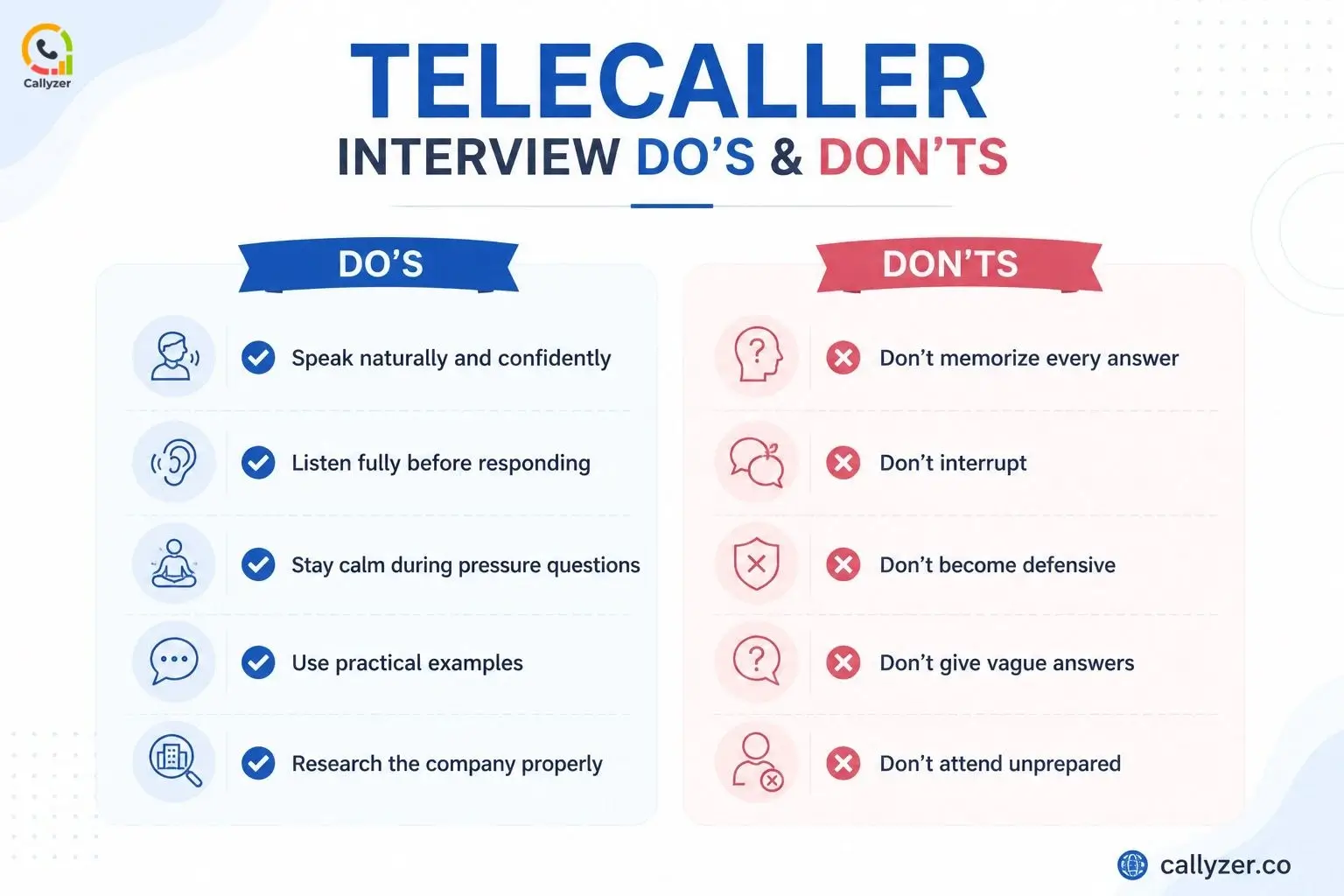
Freshers should focus on speaking naturally and confidently instead of memorizing lines.
Experienced professionals should focus more on communication strategy, performance improvement, customer handling, and leadership thinking.
The best preparation is not learning scripted answers word-for-word. It is learning how to communicate clearly, professionally, and naturally during real conversations.
Explore More: Monitoring Telecaller Performance A practical read on how telecalling teams track performance, improve consistency, and maintain quality without creating unnecessary pressure.