
Struggling to find telecallers who actually stick around? This guide covers 8 platforms ranked for Indian hiring, a 5-step process to screen and onboard the right people, and how to track performance from day one. Built for sales managers who are tired of hiring in circles.
If you have ever posted a telecaller job and got 200 applications in two days, spent a week shortlisting them, called 30 people, got 8 to show up for an interview, hired 3, and had 2 quit within the month — you already know that hiring telecallers is a different beast from hiring for almost any other role.
This guide is for anyone building or scaling an outbound telecalling team in India. We'll cover the eight platforms actually worth your time, a few sourcing channels most managers overlook, and a hiring process that helps you pick people who will actually stick around.
The 8 Best Platforms to Hire Telecallers in India
Before we go through each one, here's the quick summary:
| Platform | Best for | Cost |
|---|---|---|
| Naukri.com | Volume hiring, all experience levels | Paid plans |
| WorkIndia | Tier-2/3 cities, regional languages | Freemium |
| ApnaJob (Apna) | Entry-level, metro cities | Free to post |
| Indeed | Multi-city, remote roles | Free + pay-per-click |
| Hirect | Quality over volume | Subscription |
| Senior hires, team leads | Premium | |
| Foundit (ex-Monster) | 1 to 4 years experience | Paid plans |
| Quikr Jobs | Backup channel, Tier-2/3 | Free |
1. Naukri.com

If you ask any HR manager in India where they go first for telecaller hiring, nine out of ten will say Naukri. The candidate volume here is just in a different league compared to everything else.
The filter that saves the most time is "last active date."
Telecaller candidates on Naukri are often passive — they uploaded a resume in 2022 and never came back.
Filter for people who logged in within the last 30 days and you immediately cut through the noise. The paid resume database is worth it if you are hiring more than five people, because you can reach out to candidates directly instead of waiting for applications that may never come.
One thing to watch: resume quality is all over the place. Do not read resumes too literally here. A candidate whose resume looks thin might be excellent on a call. Do a quick phone screen before you decide.
Best for: Any business that needs to hire fast and at volume, across one city or many.
2. Foundit (formerly Monster India)
Monster India rebranded to Foundit a few years back and genuinely changed how it works. It is less of a job board now and more of a career platform, which sounds like marketing speak but actually means something useful: the candidates here tend to be more serious about their job search than the passive profiles you find elsewhere.
What Foundit does well that most platforms skip is employer analytics. You can see how your job post is performing against similar listings in your city and industry.
If applications are slow, you will know whether it's your salary range, your job title, or just low traffic at that time. That visibility is handy when you are trying to troubleshoot a post that is not getting traction.
Best for: Companies looking for candidates with one to four years of experience who care about how they come across as an employer, beyond just getting listings out fast.
3. WorkIndia

If you are hiring in any city outside the top five metros, WorkIndia is probably your best bet.
Most of the big platforms are built around Mumbai, Delhi, Bangalore, Hyderabad, and Pune. WorkIndia actually works well in Ahmedabad, Jaipur, Nagpur, Lucknow, Surat, and similar markets.
More usefully, it lets you filter by regional language, which matters a lot when you need someone who can call leads in Gujarati or Marathi rather than just English or Hindi.
It is free to post, which helps if you are running lean. The paid plans give you more visibility in search results but the free tier is usable.
Best for: Tier-2 and Tier-3 city hiring, any role where regional language matters.
4. Indeed

Indeed is the biggest job platform in the world and India is no exception.
If you are hiring telecallers across multiple states, or running a remote or work-from-home calling team, Indeed's reach is hard to match.
It is free to post, with pay-per-click boosts available if you want more visibility. The company reviews work in your favour over time, candidates read them and self-select, so you tend to get fewer completely wrong-fit applications as your rating improves.
The downside is that India-specific filters are less detailed than Naukri or WorkIndia. It is better for experienced candidates than freshers, and better for metros than Tier-2 cities.
Best for: Large call center telecalling team, multi-state hiring, remote telecalling roles.
5. ApnaJob (Apna)
Apna is probably the most underrated platform on this list for telecaller hiring.
Unlike Naukri or Indeed where candidates just upload a resume and disappear, Apna is built around communities. Candidates join groups based on their actual job type — telecaller, BPO executive, customer support agent.
So when your posting shows up for them, they are already in a "I'm actively thinking about my next telecalling job" headspace. That context matters.
Profiles are verified through phone numbers and sometimes documents, which cuts down on fake or inactive applications. And it is free to post, which is a genuine advantage if you are hiring five people, not fifty.
Best for: High-volume fresher and mid-level hiring in metro cities, especially when the budget is tight.
6. Quikr Jobs

Quikr is worth mentioning but with a caveat: it is quieter than it used to be. The job section has slowed down compared to five years ago when it was genuinely competitive with Naukri in some markets.
That said, it still has decent reach in smaller towns and cities where the bigger platforms have thin candidate pools. If you have already posted on WorkIndia and Apna and need a third channel at zero cost, Quikr is a reasonable option.
Best for: Backup channel for Tier-2/3 markets. Do not rely on it as your primary source.
7. Hirect

Hirect uses AI to match candidates to roles, which in practice means you spend less time wading through applications that have nothing to do with telecalling.
The thing that makes it genuinely useful is the built-in messaging and scheduling. When a candidate applies, they get notified right away, you can message them in the same thread, and both sides can see where the conversation is. It sounds simple, but it cuts out the endless back-and-forth that slows down hiring for most managers.
Ghosting — candidates who agree to come in and never show — is also noticeably lower here than on the bigger platforms.
Best for: Businesses that want fewer but better applications and a cleaner hiring process.
8. LinkedIn

LinkedIn is not where you go to hire a telecaller for ₹12,000 a month. But if you need a team lead, a senior sales executive, or someone to run a calling operation, it is the right tool.
The real value is finding people who are not actively job-hunting. You can search by role, city, years of experience, and current company, and reach out directly. Most good senior telecallers are employed and not browsing Naukri, but they will read a thoughtful LinkedIn message if the opportunity sounds right.
Best for: Senior telecallers, team leads, sales managers. Too expensive for fresher volume hiring.
Three More Ways to Find Telecallers Nobody Talks About
Platforms are the obvious answer. But some of the best telecallers we have seen get hired through these three channels, which most managers ignore.
Facebook Groups
There are active Facebook groups dedicated entirely to telecaller jobs in specific cities. Groups like "Telecaller Jobs India," "Telesales Jobs Ahmedabad," and similar city-specific hiring communities have thousands of members who are actively job-hunting but never bother signing up on formal platforms.
Post there with the salary upfront and you will often get faster responses than a Naukri listing.
Post there with the salary upfront and mention the telecaller skills you're looking for, and you will often get faster responses than a Naukri listing.
Staffing Agencies
If your HR team is stretched or you need fifteen-plus people quickly, a BPO-focused staffing agency saves you a lot of pain. They do the first round of screening, which means the people who reach you have already been filtered for basic fit.
Yes, you pay a placement fee — usually 8 to 15 percent of annual CTC. But if your managers are spending three weeks every quarter on recruitment, that fee often makes sense.
Employee Referrals
This one is simple and most managers skip it. Referred candidates tend to stay longer and perform better in the first month, mostly because the person who referred them has already done an informal culture and fit check.
A referral bonus of ₹2,000 to ₹5,000 paid after 30 days in the role is usually enough to keep referrals coming in steadily.
Even just sending a WhatsApp message to your team asking "does anyone know someone looking for a telecaller job?" can move faster than any platform post.

How to Actually Hire a Telecaller: 5 Steps That Work
Platforms bring you candidates. What you do next determines whether any of them are the right ones.
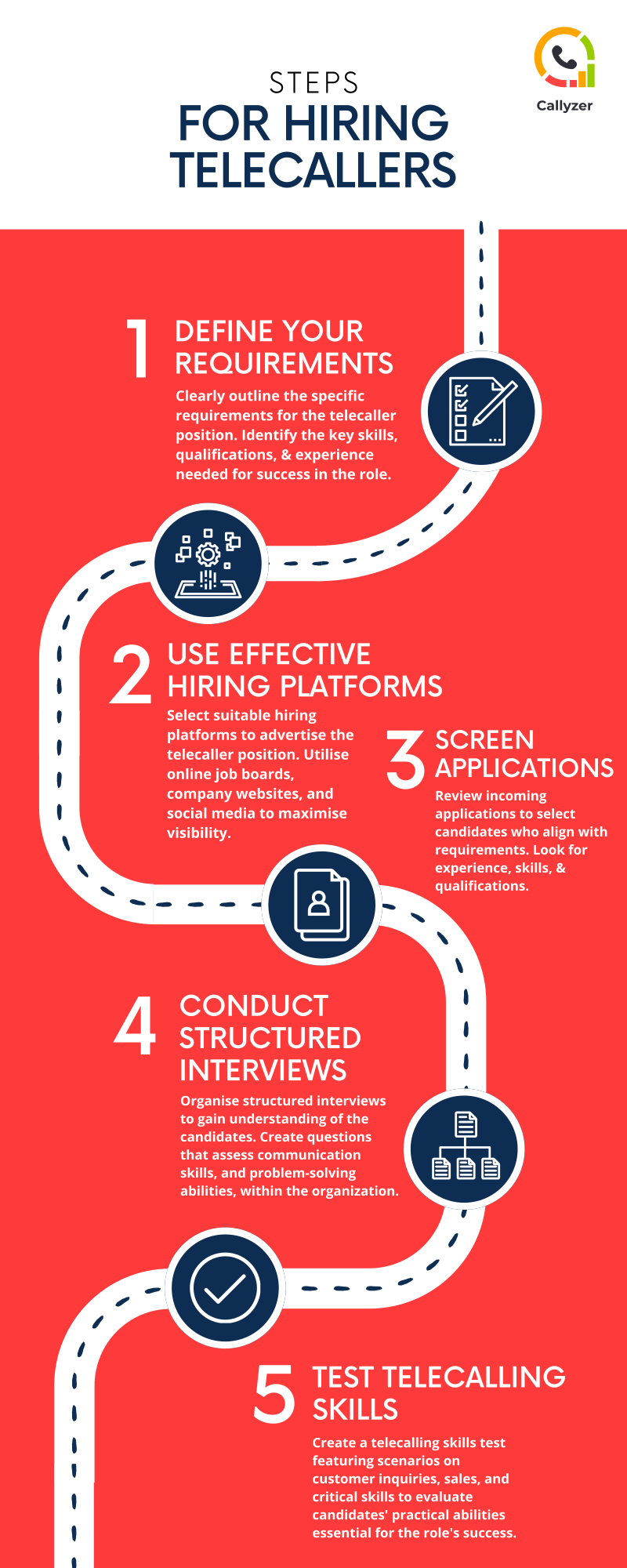
Step 1: Get Specific Before You Post Anything
The most common hiring mistake is posting before you know exactly what you need. Before you open Naukri, answer these:
What kind of calls will this person make?
Outbound lead generation, inbound support, collections, something else?
What language do they need to speak?
If your leads are in Surat, you need Gujarati, full stop.
What does success look like in 30 days? In 90 days? If you cannot answer that question, you are not ready to post.
And please, put the salary range in the job description. Telecallers move fast when they are job-hunting. They are applying to eight things at once. If your listing says "salary as per industry standards," the good ones will skip it.
Step 2: Pick Two or Three Platforms, Not Eight
Posting on every platform feels productive. It is mostly just noise. You will end up with five hundred applications, no time to screen them properly, and the best candidates will have already joined someone else.
Pick based on what you actually need:
- Entry-level in a metro city: Apna + Naukri
- Entry-level in Tier-2/3: WorkIndia + Apna
- Two or more years of experience: Naukri + Foundit
- Team lead or senior role: LinkedIn + Naukri
Also: write different job descriptions for each platform. The tone that works on LinkedIn sounds stiff and corporate on WorkIndia. Keep it simple and direct for blue-collar platforms.
Step 3: Reply Within 48 Hours or Lose Them
Telecaller candidates are not sitting around waiting for you. They are applying to six or seven openings at the same time and accepting the first offer that comes.
Set your filters before applications start: minimum experience, language, salary range, and last active on platform. Run those filters first thing. Then do a five-minute phone screen with anyone who passes. You are not assessing skills yet — you just want to hear their voice and see how they handle a conversation they were not expecting.
Listen for pace, clarity, and whether they actually ask questions or just answer yours.
Step 4: Ask the Same Questions to Everyone
Gut feel is unreliable in telecaller hiring. Someone can be charming in person and fall apart on a real call. The fix is simple: ask every candidate the same four or five questions in the same order, score the answers, and compare.
Questions that actually tell you something:
- How would you start a call to someone who has no idea who you are?
- Tell me about a call where a prospect was about to hang up. What did you do?
- What do you do when you're having a bad day and nothing is connecting?
- What do you know about what we sell?
Score each one from 1 to 3 as you go. It takes five minutes and it means your final decision is based on something real, not whoever you interviewed last.
If you want a longer list to work from, we have put together telecaller interview questions for freshers through to experienced hires that you can pull from directly.
Step 5: Do a Role-Play Before You Decide
The interview tells you how they think. The role-play tells you how they actually sound when there's pressure.
Give them your product and a common objection. Two minutes to prepare, three minutes of live call. Watch whether they listen or just talk. See how they open the call. Notice if they handle the objection or dodge it. And check if they push for a next step at the end.
Seven seconds. That is roughly how long a prospect will stay on the line before deciding whether to hang up. A candidate who fluffs the opening in a practice run will almost always do the same on a real call. One who adapts mid-conversation and keeps the energy going is the person you want.
After You Hire: How to Know If It's Working
Once you've hired the right people, the real work begins — learning how to train your telecalling team from day one.
Hiring someone is the easy part. The harder part is figuring out quickly whether they are actually performing or just filling a seat.
Most managers find out too late. By the time the numbers look wrong, it has been three weeks and you have already burned through onboarding time and early-stage lead opportunities you cannot get back.
Using a telecalling software, track four numbers from day one for every new hire:
- how many calls they make daily
- their average call duration
- their pickup rate
- how many leads they convert or appointments they book.
Those four will tell you within ten to fourteen days whether the person is getting traction or needs intervention.
This is where Callyzer makes a real difference.
The moment your team gets bigger than two or three people, manual tracking falls apart.
Agents log what they want to log. You spend your time asking "how many calls did you make today?" instead of actually coaching.
Callyzer works through the SIM card on the agent's Android phone. No app to install. No VoIP. No internet needed for it to work. Every outbound call gets logged automatically — duration, time, pickup or no pickup — and it all shows up in your dashboard in real time.
What that actually looks like on the ground: your new hire joins on Monday. By Wednesday you can already see their peak calling hours, how long their calls are running, and how many dials are going through versus being ignored.
By the end of week one you have enough data to sit down with them and say something useful: "Your calls are connecting well but your average talk time is under 90 seconds. The team average is 3 minutes. Let's listen to one of your calls together."
That conversation is ten times more valuable than a generic "work on your pitch" discussion. And it only happens if you have real data.
More than 1,000 sales teams across India use Callyzer for exactly this. They catch who is struggling early. They reward top performers with numbers that are hard to argue with. And every new hire gets benchmarked against a real baseline from their very first shift.
Choosing the right call monitoring software for business means you stop guessing how your team is performing and start seeing exactly what is happening on every call.
Start a free 15-day trial. No credit card needed. Connect up to five numbers and see the dashboard for yourself.
FAQs
Which platform is best for hiring telecallers in India?
For volume hiring, Naukri and WorkIndia are still the strongest. Apna is the best free option for entry-level roles in metro cities, especially because candidates there are actively engaged rather than passive. The right choice depends on your location and the experience level you need. The table at the top of this article breaks it down quickly.
How much does hiring a telecaller cost?
The salary itself ranges from ₹10,000 to ₹15,000 a month for freshers and ₹18,000 to ₹28,000 plus incentives for someone with two or more years of experience. Platform costs vary: most let you post for free and charge for resume database access, anywhere from ₹5,000 to ₹30,000 per quarter.
How do I know if a telecaller is actually good before I hire them?
Role-play is the only real test. Give them your product, a cold prospect, and one objection they will definitely face in the real job. Watch how they open, whether they listen when you push back, and whether they try to close for a next step. Someone who does that well in a practice run will usually do it well on real calls too.
How many telecallers do I need?
For B2C outbound, a rough starting point is one agent per 40 to 60 leads per day, assuming they are making 80 to 120 calls per shift. But factor in attrition — telecaller turnover in India runs at 25 to 40 percent annually. If you need a stable team of ten, plan to hire and onboard closer to thirteen or fourteen.
How do I track performance after hiring?
Set baselines in the first two weeks: call volume, pickup rate, average talk time, and your main conversion metric. The problem with manual tracking is that it relies on agents being honest about their own numbers, which is hit or miss. Callyzer logs everything automatically through the SIM, so your data is what actually happened on the phone rather than what someone reported in a spreadsheet.
Why do telecallers quit so early?
Usually it comes down to three things: they were not told clearly what the job involved before they joined, their first week was unstructured and they felt lost, or nobody gave them any real feedback in the first month. Salary is almost never the main reason. Fix those three things and your 30-day retention will improve noticeably.
What if I do not have time to run the hiring process myself?
A BPO staffing agency is the practical answer. They pre-screen candidates and place people faster than most in-house processes. Expect a placement fee of 8 to 15 percent of annual CTC. If you hire repeatedly, a retainer agreement usually works out cheaper than paying per placement each time.