
The Hybrid Visibility Dilemma
Last quarter, I reviewed a hybrid telesales dashboard where everything looked perfect: average handle time under five minutes, response times steady, FCR crossing seventy percent. However, when I tracked the calling data, I realized that half of the missed-call data wasn’t being logged.
Remote agents weren’t getting routed calls due to poor network handoffs. No one was doing anything wrong; the visibility was. That’s what many hybrid telesales leaders in India are dealing with.
Around 23% of the 290,000 active job postings offer full-time hybrid or fully remote work options. In January 2020, before COVID-19 reshaped how teams work, that number stood at just 1%. The opportunity is expanding, but so are visibility gaps.
The core problem we keep circling back to is how to build trust, maintain compliance, and still keep teams productive when half of them operate from different cities or internet zones.
The Real Problem: Visibility Without Clarity
I’ve seen dashboards that claim agents are “idle” while they’re actually on long outbound calls via personal SIMs. It looks like underperformance from a distance, but it is really incomplete data capture.
Sometimes routing rules misfire; all missed calls end up with one logged-out user. In hybrid setups, this happens daily.
The truth is what I’ve learned after fixing hundreds of campaigns is this: performance drops rarely because of agent effort. It drops because you can’t see what’s really happening when calls flow between CRM, network, and teams.
Visibility without clarity is noise.
What Live Call Monitoring Really Means
Live call monitoring isn’t about surveillance. It’s the ability to observe ongoing calls ethically, guide in real time, and identify call-quality trends without waiting for weekly reviews. Unlike recordings you audit later, live monitoring lets you step in immediately when something’s off.
For hybrid telesales teams, this becomes critical. With 83 percent of employees preferring hybrid models, you can’t manage with outdated review cycles. You need real-time clarity that doesn’t compromise privacy.
The DPDP Act now requires explicit consent before any recording or monitoring, with clear audit trails for who accessed data. That means compliance isn’t optional: every monitoring step must be logged, redacted, and stored securely.
The Four Pillars of Ethical Monitoring
- Transparency: Let your team know what’s being monitored and why. Clear communication prevents resistance.
- Accountability: Focus on metrics like answered calls, response time, FCR, rather than personal scrutiny.
- Compliance: Ensure DPDP guidelines: consent signals, auto-redaction, and retention within 180 days.
- Enablement: Use insights for coaching, not control. Monitoring should help people improve, not make them anxious.
Best Practice #1: Monitor, Don’t Micromanage
I once joined a session where a manager wanted to “live listen” to every call. Within a week, agent morale dropped.
Monitoring isn’t about listening to everything, it’s about surfacing the right signals. Focus on outcomes like first-call resolution, call volume, and missed calls. Set role-based visibility so leads see team-level trends, not individual details.
Callyzer makes this shift easier by clearly separating monitoring from micromanagement.
Instead of sitting in on every call, managers see dashboards that highlight team-level calling performance. Call volume, connected calls, missed calls, and follow-up activity are all visible at a single glance.
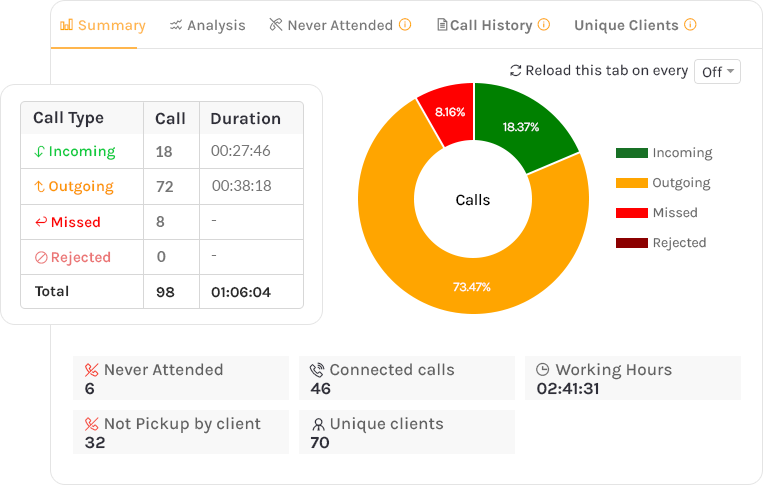
This changes how leaders manage. They are no longer reacting to individual calls, but reading patterns. A spike in missed calls, a drop in connections, or delayed follow-ups stands out immediately. Managers step in only when something actually needs attention.
For agents, this makes a real difference. They feel supported rather than watched. There’s clarity on expectations, room to work in their own style, and accountability that feels fair instead of intrusive.
Best Practice #2: Automate Real-Time Alerts for Key Metrics
I’ve learned the hard way that end-of-day summaries arrive too late. By the time reports show missed calls, the leads have gone cold. Real-time alerts change that.
Here are the four I recommend setting:
- Idle Time: less than 20%
- Attendance Login: above 90%
- Inbound Response: under 30 seconds
- FCR: above 70%
These are not arbitrary. In urban centers like Mumbai, this is achievable daily. In Tier-2 cities, you’ll hit close when connectivity holds steady. Proactive alerts can recover performance before it slips.
To track automatically, set them up through Callyzer’s real-time call monitoring dashboard. It takes minutes.
Best Practice #3: Create a Live Call War Room (Remotely)
I once worked with a small insurance telesales team that started every morning with a simple ritual: everyone logged into a shared dashboard and opened a Google Meet for the first two hours. No long speeches; just quiet monitoring with real-time responses to missed calls.
Within a week, their pickup rate jumped 18 percent. The system worked because it turned monitoring into a routine, not an audit.
Here’s the template they followed:
- 9 AM – Morning call check and routing validation
- 1 PM – Mid-day trend review
- 6 PM – Missed call recap and insight sharing
Pro Tip: Watch for burnout signals in dashboards. When login rates slip or handle times creep up, the issue isn’t laziness — it’s fatigue.
Best Practice #4: Turn Monitoring Into Live Coaching
When I first started live call whispering, I made two mistakes: interrupting too often and giving vague feedback. Agents froze. The point of coaching is micro-correction, not distraction. Use whisper or post-call reviews to guide better tone and pacing.
AI-assisted tools help, but nothing beats listening to a few calls with your rep and writing notes in a simple “Live Coaching Notes Sheet.” Make the experience transparent: when feedback turns into enablement, trust builds fast.
Best Practice #5: Build Resilience for Connectivity Failures
Connectivity still breaks the best setups. Internet connectivity problems and technical glitches affect 46.2% of wfh employees, who reported that unstable connections or system issues make it difficult to complete their tasks.
Simple fixes often work best:
- Use dual-SIM phones (Jio + Airtel) for redundancy
- Enable offline data sync in your call tracking app
- Set up failover routing for high-intent leads
Failover routing ensures calls never hit a dead end. If the primary dialer drops, backup SIMs take over instantly.
Callyzer’s SIM-based call tracking software model thrives here because it doesn’t rely on VoIP intermediaries:it logs genuine call data even during switching.
Compliance & Transparency Checklist for India’s DPDP Act
Compliance is not about paperwork. It’s about intent. Under the DPDP Act, you need to secure explicit call consent, maintain access logs for one year, and redact personal identifiers automatically.
Here’s your four-step readiness list:
- Get call consent scripts approved and transparent.
- Enable auto-redaction for recordings beyond 180 days.
- Maintain access logs with timestamped activity.
- Train managers on breach notification protocols within 72 hours.
Structuring a Sustainable Monitoring Workflow
Design your monitoring loop around predictability.
Clearly define key performance indicators such as First Call Resolution (FCR), Customer Satisfaction Score (CSAT), and agent idle time.
Decide who reviews each metric daily, weekly, and monthly, and assign clear ownership. Monitoring works only when it’s someone’s responsibility, not everyone’s part-time job.
Integrate dashboards and alerts directly with your CRM. Callyzer’s LeadSquared and Zoho connectors help automatically match call logs with lead and contact records in real time, saving hours of manual effort and keeping data consistently up to date.
That consistency makes feedback loops stronger and auditing easier.
Building Trust and Culture in Hybrid Teams
Surveillance breeds anxiety. Transparency builds trust.
Tell agents exactly what monitoring aims to achieve and what’s off-limits. When you move focus from “who made mistakes” to “what needs fixing”, you convert monitoring into shared ownership.
High-trust teams deliver significantly better results, showing up to 50% higher productivity and 40% lower burnout.
Measuring Impact and Continuous Improvement
Measure what matters: improvement in FCR, reduction in idle time, and quality of follow-ups. Real ROI comes from coaching impact, not just count metrics. Also track agent sentiment. A small pulse survey after each quarter can show how transparent monitoring boosts motivation.
Run regular optimization cycles: review, fix one bottleneck, re-measure after 30 days. That small, repeatable formula builds performance stability faster than any quarterly overhaul.
Key Takeaways & Action Plan
- Hybrid telesales needs real-time monitoring, not for control, but for clarity.
- Ethical monitoring follows four pillars: transparency, accountability, compliance, and enablement.
- Adopt tools that stay compliant yet practical. Callyzer helps automate visibility without invading privacy.
Try Callyzer’s automated call monitoring for free (15-day trial, up to 5 phone numbers).
Over the years, one thing has become clear to me. Sales aren't broken. Visibility is.